The Commission is preparing initiatives for November to apply AI in five sectors, from healthcare to defence



Always see our news on Google
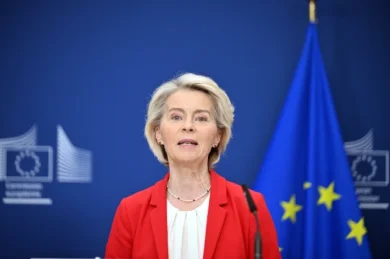
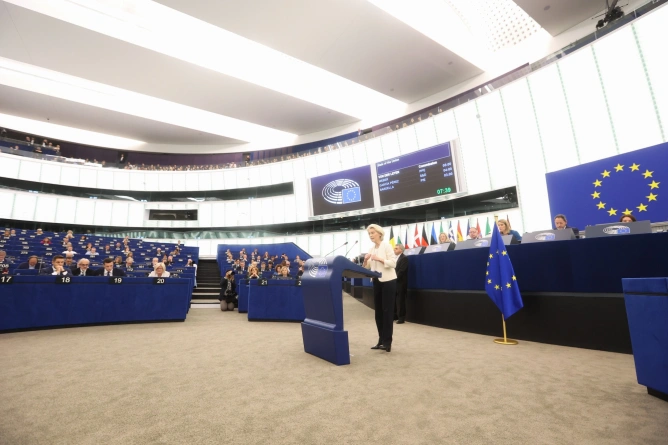
In November 2026, the European Commission will present initiatives for using artificial intelligence in healthcare, transport, the agri-food sector, advanced industrial production, as well as defence and space. In her State of the Union address, Ursula von der Leyen announced that the European executive wants to turn data held by European industries into specialised applications that can be used in the activities of businesses and public services.
In briefThe Commission will present initiatives in November 2026 for five groups of sectors. The list includes healthcare, transport, the agri-food sector, advanced manufacturing and, together, defence and space.
Sectoral data is the proposed basis for applications tailored to businesses’ activities. The European strategy on the data union already provides for laboratories to facilitate companies’ and researchers’ access to such resources.
In healthcare, von der Leyen proposes AI as support for doctors. A European network of centres already exists and is due to evaluate screening tools under clinical conditions, including safety and the cost-effectiveness ratio.
The speech announces the presentation of initiatives, not the launch of a programme with definitive rules. The budget, project selection, specific conditions for data access and implementation timetable have not yet been specified.
The emphasis is on the value obtained from using the technology. The Commission President maintains that Europe can benefit from AI even when cutting-edge technology is developed elsewhere. Developing a model and introducing it into a production process or a medical service are different stages. For the latter, von der Leyen invokes European industries and their specialised data as advantages that can support models adapted to specific tasks.
The speech points to applications on production lines, in precision agriculture, in energy networks and for autonomous driving. These illustrate the direction being pursued, without constituting a list of approved projects. The five groups of sectors selected for the November initiatives include both the food industry alongside agriculture and space activities alongside defence.
Access to data already has European instruments in preparation. The strategy on the data union provides for data laboratories that combine public and private resources and make high-quality sectoral data available to companies, including small and medium-sized enterprises, and researchers. These laboratories should facilitate the use, for AI, of data from the common European data spaces.
Access rights also already apply. The Data Regulation, known as the Data Act, allows users of connected products to access the data generated through their use and share it with third parties. For an industrial business or a farm, this could be data about the operation of machinery. The framework maintains conditions concerning use, confidentiality and the protection of personal data; it does not amount to free access for any AI developer to all of a company’s data.
The promised initiatives form part of an AI adoption policy that already exists. The Apply AI strategy covers ten industrial sectors and the public sector and also aims to support SMEs. It provides access to computing infrastructures, testing facilities and support through European Digital Innovation Hubs. The speech does not specify what additional instruments will be announced for the five priority areas.
In healthcare, von der Leyen chose breast cancer detection to illustrate the use of AI under doctors’ supervision. “The idea is that AI should support our doctors. Not replace them,” she states in the text of the speech. One example studied is the Swedish MASAI trial. According to Lund University, AI assigned mammograms for interpretation by one or two radiologists, depending on the estimated risk, and flagged suspicious areas in the images. Doctors continued to interpret the examinations.
The results published in The Lancet, in a study involving 105,934 women randomly assigned to two groups, show a sensitivity of 80.5% with AI, compared with 73.8% for double reading without AI. This measures the proportion of cancers identified through screening. Specificity, meaning the correct identification of the absence of cancer, was 98.5% in both groups. The result concerning cancers diagnosed between two screening rounds did not show a statistically significant reduction, and the study did not demonstrate an effect on mortality.
Lund also reports a 44% reduction in radiologists’ workload for interpreting mammograms through this work organisation. The figure does not represent a 44% saving in the service’s total cost. Evaluation in medical practice is also the purpose of the European network of AI-assisted screening centres, which held its first meeting in May 2026. The centres are to test the integration of the tools into routine work, local performance, safety and the cost-effectiveness ratio.
These studies and infrastructures provide concrete examples of use and evaluation, but they are not outcomes of the initiatives to be presented in November. Von der Leyen announced that member states, Members of the European Parliament, industry and entrepreneurs would be invited to participate. The speech and its accompanying factsheet do not specify the budget, the criteria for selecting projects, the specific conditions for data access or the implementation timetable. What support interested businesses and institutions will actually be able to request will depend on these details.
Latest News
19:38
19:29
19:13
19:01
18:55
See more news
NEWS ON THE SAME TOPICS