Imec Calls for European Biological Data Infrastructure to Develop AI-Driven Medicines
Liviu Brăteanu



EU
Foto: Pixabay

Always see our news on Google
Europe needs infrastructure capable of producing and connecting biological data for the development of AI-driven medicines, Liesbet Lagae, a researcher and director of life sciences technology programs at imec, argued. In a presentation in Brussels to the European Parliament’s Committee on Public Health, SANT, she explained that hospital data must be complemented with experimental information on how cells, proteins and tissues function.
In brief, imec proposes developing European infrastructure that combines biological experiments, measurement technologies and artificial intelligence models for drug research. Liesbet Lagae believes that insufficient access to relevant data limits current models. Clinical information and laboratory-generated data play complementary roles. The proposal aims to foster collaboration among researchers, technology companies, the pharmaceutical industry, biotechnology firms and startups. Members of the European Parliament asked who would control the data and results, how patent protection would work and how errors in training data could be managed. The presenter supported maintaining safety requirements for the authorization of medicines. The hearing did not announce a new European funding program or clinical results validating the overall approach.
Lagae described a research direction known as TechBio, in which measurement technologies, data analysis and artificial intelligence are integrated into the study of biological processes. The goal is to develop models capable of helping researchers understand diseases and better select the substances or interventions worth testing. She noted that current biological models are still maturing and do not yet have the reliability required for all these objectives.
One difficulty lies in the nature of the information they need. To understand how a cell reacts or what effect a molecule has, a model must be trained on data produced through relevant experiments and measurements. According to the presenter, this information is scattered across academic laboratories, hospitals and pharmaceutical companies, while access to separate fragments limits researchers’ ability to build more complete models.
The proposed infrastructure would bring together the tools that generate data and the systems that use it to train models. Lagae described a research platform in which laboratory experiments would continuously feed biological models, while their predictions could guide new experiments. She used the concept of a biofoundry for this combination of experimental capacity, automation and computational development.
In her presentation, the researcher gave examples from DNA sequencing, recording neural activity and toxicity testing using miniaturized biological systems. These technologies produce different types of information about organisms and their responses to interventions. Another area mentioned was DNA synthesis, which can support research into cell and gene therapies by building and testing designed biological structures.
Lagae stressed that these experimental data complement clinical information. The European Health Data Space can support the use of medical data for research within its rules, but designing a biological model also requires information not found in a patient’s record. Measurements concerning proteins, cells or tissues are needed for research questions different from those answered by clinical observations.
The proposal presented to Parliament also concerns the organization of European cooperation. The researcher called for technology partners, pharmaceutical and biotechnology companies and new enterprises to be brought together, drawing on the experience of collaboration in semiconductor research. In her assessment, Europe can support shared infrastructure and links between these fields in order to retain drug research and development capacity in Europe.
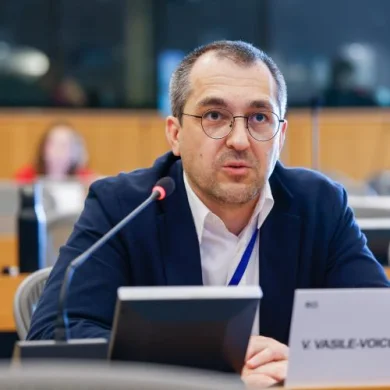
Control over the data was one of the central questions raised by MEPs. Lagae warned that companies holding the data and models could gain an important position in future biological research and urged European authorities to examine the implications for patients and industry. She did not identify a single solution regarding public or private ownership of the data, but argued that this choice requires political attention.
MEP Ondřej Dostál asked how the results of these systems should be viewed from the perspective of patents and the contribution of those providing data. The discussion raised the issue of how value created should be divided among research infrastructure, model developers and information providers. The presenter’s response explored the possibility of protecting certain inventions, without the hearing establishing a general legal interpretation of the patentability of models or their results.
András Kulja asked how biases in medical data could be managed, including those related to diagnostic coding practices, and how accelerating research could be reconciled with assessing long-term effects. Lagae considered that using larger datasets could help identify certain biases, while noting that this was her opinion and that she is not a specialist in hospital organization. Expanding the dataset was not presented as a guarantee that all errors would disappear.
Regarding authorization, her position was that medicines developed with the help of artificial intelligence must meet equally strict safety requirements. The intended benefit is better selection of candidates and reduced investment in projects that prove ineffective. This research perspective does not replace demonstrating a product’s quality, safety and efficacy before clinical use.
Imec is a research center in nanoelectronics and digital technologies that also develops tools for the life sciences. The work presented to SANT focuses on using measurement technologies and computing capacity to address biological and medical problems through cooperation among fields with different infrastructures and areas of expertise.
The debate was an exchange of views on the opportunities, limitations and conditions for developing this research. It did not establish a European budget for the proposed infrastructure, a mandatory implementation timetable or a special authorization procedure for medicines designed with artificial intelligence.
Imec calls for European biological data infrastructure AI medicines development research biofoundry healthcare data TechBio life sciences pharmaceuticals
In brief, imec proposes developing European infrastructure that combines biological experiments, measurement technologies and artificial intelligence models for drug research. Liesbet Lagae believes that insufficient access to relevant data limits current models. Clinical information and laboratory-generated data play complementary roles. The proposal aims to foster collaboration among researchers, technology companies, the pharmaceutical industry, biotechnology firms and startups. Members of the European Parliament asked who would control the data and results, how patent protection would work and how errors in training data could be managed. The presenter supported maintaining safety requirements for the authorization of medicines. The hearing did not announce a new European funding program or clinical results validating the overall approach.
Lagae described a research direction known as TechBio, in which measurement technologies, data analysis and artificial intelligence are integrated into the study of biological processes. The goal is to develop models capable of helping researchers understand diseases and better select the substances or interventions worth testing. She noted that current biological models are still maturing and do not yet have the reliability required for all these objectives.
One difficulty lies in the nature of the information they need. To understand how a cell reacts or what effect a molecule has, a model must be trained on data produced through relevant experiments and measurements. According to the presenter, this information is scattered across academic laboratories, hospitals and pharmaceutical companies, while access to separate fragments limits researchers’ ability to build more complete models.
The proposed infrastructure would bring together the tools that generate data and the systems that use it to train models. Lagae described a research platform in which laboratory experiments would continuously feed biological models, while their predictions could guide new experiments. She used the concept of a biofoundry for this combination of experimental capacity, automation and computational development.
In her presentation, the researcher gave examples from DNA sequencing, recording neural activity and toxicity testing using miniaturized biological systems. These technologies produce different types of information about organisms and their responses to interventions. Another area mentioned was DNA synthesis, which can support research into cell and gene therapies by building and testing designed biological structures.
Lagae stressed that these experimental data complement clinical information. The European Health Data Space can support the use of medical data for research within its rules, but designing a biological model also requires information not found in a patient’s record. Measurements concerning proteins, cells or tissues are needed for research questions different from those answered by clinical observations.
The proposal presented to Parliament also concerns the organization of European cooperation. The researcher called for technology partners, pharmaceutical and biotechnology companies and new enterprises to be brought together, drawing on the experience of collaboration in semiconductor research. In her assessment, Europe can support shared infrastructure and links between these fields in order to retain drug research and development capacity in Europe.
Control over the data was one of the central questions raised by MEPs. Lagae warned that companies holding the data and models could gain an important position in future biological research and urged European authorities to examine the implications for patients and industry. She did not identify a single solution regarding public or private ownership of the data, but argued that this choice requires political attention.
MEP Ondřej Dostál asked how the results of these systems should be viewed from the perspective of patents and the contribution of those providing data. The discussion raised the issue of how value created should be divided among research infrastructure, model developers and information providers. The presenter’s response explored the possibility of protecting certain inventions, without the hearing establishing a general legal interpretation of the patentability of models or their results.
András Kulja asked how biases in medical data could be managed, including those related to diagnostic coding practices, and how accelerating research could be reconciled with assessing long-term effects. Lagae considered that using larger datasets could help identify certain biases, while noting that this was her opinion and that she is not a specialist in hospital organization. Expanding the dataset was not presented as a guarantee that all errors would disappear.
Regarding authorization, her position was that medicines developed with the help of artificial intelligence must meet equally strict safety requirements. The intended benefit is better selection of candidates and reduced investment in projects that prove ineffective. This research perspective does not replace demonstrating a product’s quality, safety and efficacy before clinical use.
Imec is a research center in nanoelectronics and digital technologies that also develops tools for the life sciences. The work presented to SANT focuses on using measurement technologies and computing capacity to address biological and medical problems through cooperation among fields with different infrastructures and areas of expertise.
The debate was an exchange of views on the opportunities, limitations and conditions for developing this research. It did not establish a European budget for the proposed infrastructure, a mandatory implementation timetable or a special authorization procedure for medicines designed with artificial intelligence.
Imec calls for European biological data infrastructure AI medicines development research biofoundry healthcare data TechBio life sciences pharmaceuticals

Latest News
10:17
October 23, 2026. TV: What was discussed last night on the news channels
10:15
Japanese writer Ryu Murakami has died at the age of 74, leaving behind provocative novels about drugs, sex, and alienation
10:09
The National House of Public Pensions launches the MyCNPP application / Romanians can estimate their pension and submit requests without having to go to a service counter
09:57
Natalia Intotero’s first visit to ANM as minister after the public spending scandal / Elena Mateescu refuses to resign
09:54
Prime Minister Luca Niculescu announced on Friday the convening of an evaluation meeting with the ministers responsible for fulfilling the outstanding milestones under the NRRP / We cannot afford to lose European funds
See more news
NEWS ON THE SAME TOPICS





Personalized news feed, AI-powered search, and notifications in a more interactive experience.











.webp)