Commission wants to accelerate AI in industry and internationally coordinate the pace of development of the most advanced models




Always see our news on Google
The European Commission wants to accelerate the use of artificial intelligence in industry and, in parallel, coordinate with international partners the pace of development of the most advanced models in order to limit security risks. Thomas Regnier, the Commission spokesperson for technological sovereignty, explained that discussions with the heads of the main AI laboratories are still being prepared, following the announcement made by Ursula von der Leyen in her State of the Union address.
In short, the Commission is separating the acceleration of AI use in industry from coordinating the development of the most capable models. Support for economic applications remains conditional on safety, European standards and fundamental rights. The meeting announced by Ursula von der Leyen with the heads of AI laboratories is still being prepared. The United Kingdom and Canada are among the partners mentioned for international cooperation, without the briefing announcing an agreement on the pace of development. The Commission is defending the AI Act as a risk-management instrument. The briefing did not specify what commitments companies might accept or how international coordination of model development would work.
At the Commission’s press briefing, Regnier was asked whether the call to moderate the development of advanced models represented the European executive’s policy. He distinguished between the use of AI in the economy and the risks associated with models at the frontier of current technological capabilities. For industrial applications, the Commission is seeking to accelerate adoption while respecting safety, European standards and fundamental rights. For the most capable models, it considers internationally coordinated action necessary because the risks extend beyond the Union’s borders.
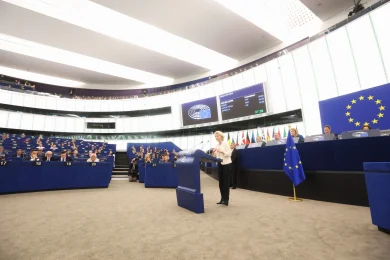
The industrial component already has five priority areas, presented by von der Leyen in Strasbourg in her speech on 16 September. These are healthcare, transport, the agri-food sector, advanced manufacturing, and defence and space. The Commission President announced initiatives for November and identified data held by European industries as a resource for developing models tailored to their needs.
Regarding advanced models, Regnier referred to incidents in recent weeks and months and to warnings issued by the leaders of the companies developing them. He did not provide details about these incidents in his response. He did, however, outline the sequence of steps envisaged by the Commission, which intends to work first with international partners, including the United Kingdom and Canada, and to organise the discussion with laboratory heads. At the time of the briefing, preparations were continuing, with no date announced for the meeting.
Von der Leyen also supports an international appeal, published by the Finnish Presidency, to keep AI under human control. The document calls on companies to conduct tests before launch and independent evaluations, with sufficient access for evaluators. It proposes that UN member states consider creating an institution to set standards, enable verification and bring states together when certain system capability thresholds are exceeded. The appeal puts forward a cooperation proposal without establishing such an institution.
Asked how such a body would fit into the existing architecture and what role would be assigned to the United States and China, Regnier argued that Europe must play a leading role, without specifying the responsibilities of the other partners. The Commission’s argument is that European regulatory experience can contribute to the international response. The briefing did not present a negotiated mandate, governance structure or timetable for the possible institution.
In the EU, the Artificial Intelligence Act already establishes specific obligations for providers of general-purpose AI models with systemic risk. These include model assessment and adversarial testing, which seeks to identify dangerous behaviour; assessment and mitigation of risks at Union level; reporting serious incidents to the AI Office and, where appropriate, national authorities; and the cybersecurity protection of models and infrastructure. The obligations apply to this legal category and not indiscriminately to every industrial AI application.
The safety debate is taking place against the backdrop of limits on Europe’s capacity to develop such models. In the experts’ conclusions published by the AI Office in July, computing infrastructure and the energy needed to power it were among the urgent priorities, alongside access to capital and attracting specialists. The experts found that the development of frontier models is largely concentrated outside the EU. Their assessment, which does not represent the Commission’s official position, recommends strengthening Europe’s ability to access, choose and control these technologies.
Regnier defended the adequacy of the AI Act and said that the European cybersecurity agency has access to the latest advanced models, without presenting evaluation results. The next announced step in relations with industry remains the meeting with laboratory heads. The briefing did not specify what form coordination of the pace of development would take or what commitments companies would accept.

Latest News
09:13
09:12
09:02
08:45
08:40
See more news
NEWS ON THE SAME TOPICS