November 2026: Informat.ro – INSCOP Research BAROMETER, 15th Edition – Chapter X: Temporary Restriction of Access to Online Platforms



Always see our news on Google
November 2026: Informat.ro – INSCOP Research BAROMETER 15th Edition – Chapter X: Temporary restriction of access to online platforms
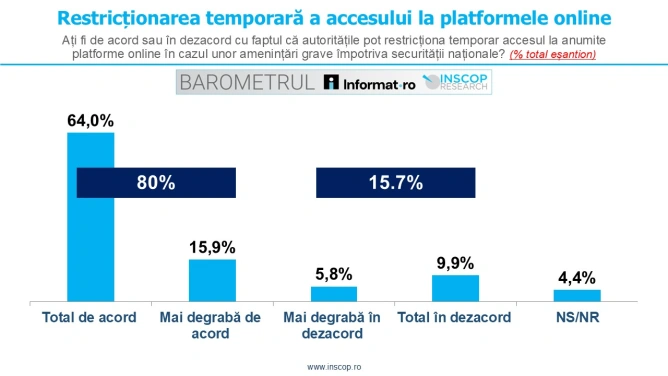
The majority of the population (80%) totally agree or rather agree with the temporary restriction of access to online platforms against the backdrop of serious threats to national security, according to the Informat.ro – INSCOP Research BAROMETER, 15th edition, conducted between October 26 and November 2, 2026.
The Informat.ro – INSCOP Research BAROMETER is a monthly opinion poll conducted by INSCOP Research at the request of the Informat.ro news platform in partnership with the Strategic Thinking Group think tank.
The Informat.ro – INSCOP Research BAROMETER aims to bring issues of public interest to the public’s attention in order to stimulate national conversations on diverse topics and public policies essential to Romania’s present and future, starting from the opinions of Romanians in partnership with prestigious think tanks and academic institutions. It is an initiative through which we aim to contribute to strengthening democracy by using scientific and credible tools that bring citizens’ voices to the forefront of public debate.
Methodology: The survey was conducted by INSCOP Research at the request of the Informat.ro news platform, in partnership with the Strategic Thinking Group think tank. The data were collected between October 26 and November 2, 2026. Research method: the data were collected using the sequential mixed-mode method (CATI - CAWI), with a simple, random sample of 1197 people, including 1081 CATI respondents and 116 CATI to CAWI. The sample is representative of the significant socio-demographic categories (sex, age, occupation) of Romania’s non-institutionalized population aged 18 and over. The maximum permitted margin of error is ± 2.8%, at a confidence level of 95%.
Remus Ștefureac, director of INSCOP Research: ”The very high support for temporarily restricting online platforms in the event of serious threats to national security shows that Romanians are willing to accept the limitation of certain digital freedoms when they consider collective safety to be at risk. Security thus becomes a strong argument for accepting state intervention, including in a space associated with freedom of expression and information. It is important to specify that the question refers strictly and explicitly to temporary restrictions in the event of serious threats to national security, not to accepting censorship or the general restriction of free access to online platforms. Support for such restrictions cuts across all generations, education levels, and political orientations, suggesting the existence of broad social consensus regarding the need for exceptional measures in situations of major risk.”
The graphical presentation of the data is available here.
Temporary restriction of access to online platforms
64% of respondents totally agree with the possibility that authorities may temporarily restrict access to certain online platforms in the event of serious threats to national security. 15.9% rather agree with this decision, 5.8% rather disagree, while 9.9% totally disagree. The share of non-responses is 4.4%.
Those who state that they agree with the possibility that authorities may temporarily restrict access to certain online platforms in the event of serious threats to national security in a percentage far above the sample average are PSD, PNL, and USR voters, residents of large urban areas, and public-sector employees.
AUR voters, men, residents of the Capital and small urban areas, and private-sector employees oppose the possibility that authorities may temporarily restrict access to certain online platforms in a significantly higher proportion than the rest of the sample.
Latest News
09:28
09:26
09:25
09:20
09:15
See more news
NEWS ON THE SAME TOPICS