NOVEMBER 2026: Informat.ro – INSCOP Research Barometer, 15th Edition / Chapter IV: How today's generation perceives life compared with their parents' generation



Always see our news on Google
NOVEMBER 2026: Informat.ro – INSCOP Research BAROMETER 15th Edition / Chapter IV: How today’s generation perceives life compared with their parents’ generation
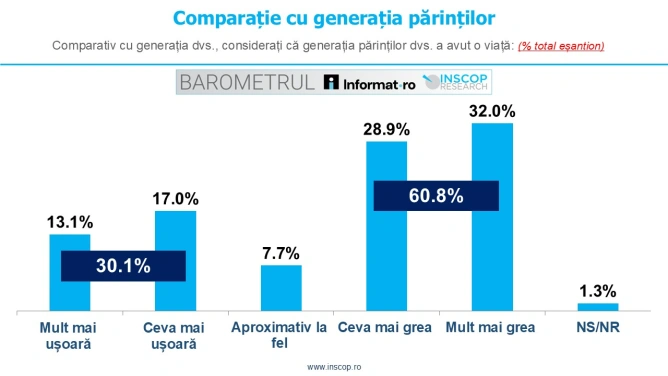
According to the Informat.ro – INSCOP Research BAROMETER, 15th edition, conducted between October 26 and November 2, 2026, three out of five Romanians believe that their parents’ generation had a harder life (28.9% somewhat harder and 32% much harder). At the same time, more than half of respondents (51.3%) believe that, at present, all categories face approximately equal difficulties.
The Informat.ro – INSCOP Research BAROMETER is a monthly opinion poll conducted by INSCOP Research at the request of the Informat.ro news platform, in partnership with the Strategic Thinking Group think tank.
The Informat.ro – INSCOP Research BAROMETER aims to bring topics of public interest to the public’s attention in order to stimulate national conversations about diverse subjects and public policies essential for Romania’s present and future, starting from Romanians’ opinions in partnership with prestigious think tanks and academic institutions. It is an initiative through which we aim to contribute to strengthening democracy by using scientific and credible tools that bring citizens’ voices to the forefront of public debate.
Methodology: The survey was conducted by INSCOP Research at the request of the Informat.ro news platform, in partnership with the Strategic Thinking Group think tank. The data were collected between October 26 and November 2, 2026. Research method: the data were collected using the sequential mixed-mode method (CATI - CAWI); the simple random sample consisted of 1,197 people, including 1,081 CATI respondents and 116 CATI to CAWI respondents. The sample is representative of the significant sociodemographic categories (sex, age, occupation) of Romania’s non-institutionalized population aged 18 and over. The maximum permitted margin of error is ± 2.8%, at a confidence level of 95%.
Remus Ștefureac, director of INSCOP Research: “The majority of Romanians acknowledge that life is easier today than in their parents’ time, showing that society’s progress is visible and appreciated, even though dissatisfaction with the present remains strong. Romanians appear to believe that economic and social problems affect everyone, regardless of age, showing that dissatisfaction in society has a broader basis and cannot be explained solely by differences between generations. Also, although the majority of Romanians believe that young people today have more chances of success than previous generations, the differences between social categories are very significant: those with higher education and residents of large cities see more opportunities, while people with less education and rural residents are much more skeptical. This difference shows that Romania’s progress is not perceived in the same way by all citizens, and the feeling of whether or not one has a chance to succeed in life depends heavily on the social environment in which one lives.”
The graphical presentation of the data is available here.
Comparison with parents’ generation
30.1% of those surveyed believe that their parents’ generation had an easier life compared with their own generation (13.1% much easier and 17% somewhat easier). 7.7% believe that their parents’ generation had an approximately similar life, while 60.8% believe that they had a harder life (28.9% somewhat harder and 32% much harder). 1.3% do not know or do not answer.
Those who believe that their parents’ generation had an easier life compared with their own generation are represented in a significantly higher proportion than in the rest of the population among: AUR voters, women, people aged between 45 and 59, and those with primary education.
Those who believe that their parents’ generation had a harder life are represented in a much higher proportion than the average among: PNL and USR voters, men, young people under 30, those with higher education, and residents of Bucharest and large urban areas.
There are no major variations according to the sociodemographic variables analyzed among respondents who believe that their parents’ generation had an approximately similar life.
The generation with the most difficult life
51.3% of survey participants believe that all categories currently face approximately equal difficulties. 22.8% believe that people aged 60 and over currently have a more difficult life in Romania, 16.6% indicate young people under 35, 4.4% people aged between 35 and 44, 3.6% people aged between 45 and 59, while 1.2% do not know or do not answer.
AUR voters and women believe, in proportions much higher than the sample average, that all categories currently face approximately equal difficulties in Romania.
Those who state that people aged 60 and over currently have a more difficult life in Romania are represented in a significantly higher proportion than the average among: PSD voters, men, people aged between 30 and 44, those with higher education, and residents of Bucharest and large urban areas.
People aged between 18 and 29 and Instagram users indicate, in a much higher proportion than the rest of the sample, that young people under 35 currently have a more difficult life in Romania.
Opportunities for young people in Romania
51.4% of survey participants believe that young people today have more opportunities to succeed in life compared with previous generations (28.1% of respondents believe they have many more, while 23.2% believe they have somewhat more opportunities). 5.2% of Romanians believe that the situation is approximately the same. On the other hand, 40,9% believe that young people today have fewer opportunities (18,8% believe they have somewhat fewer opportunities, while 22,2% believe they have many fewer opportunities). 2.5% do not know or do not answer.
Those who believe that young people in Romania today have many more opportunities to succeed in life compared with previous generations are represented in a much higher proportion than the rest of the population among: PNL and USR voters, people aged between 18 and 44, those with higher education, residents of the capital and large urban areas, Instagram users, and public-sector employees.
Those who believe, in a proportion significantly above the sample average, that young people in Romania have fewer opportunities than previous generations include: AUR voters, people over 60, those with primary education, and rural residents.
There are no major variations according to the sociodemographic variables analyzed among respondents who believe that young people in Romania have approximately the same number of opportunities compared with previous generations.
Latest News
11:46
11:42
11:38
11:38
11:38
See more news
NEWS ON THE SAME TOPICS