


And yet, Gen Z…




Always see our news on Google
Generations are a very interesting topic in sociology. A topic that has, in fact, long been debated, usually correlated with some extraordinary events. In classical thinking, you did not simply construct a generation demographically. There were significant historical events that gave you the right to be part of a generation. Of course, this obsession with a heroism that gives you the right to be part of a generation is somehow dysfunctional and analytically out of place. In the end, every generation has its challenges, and major events are not only wars, revolutions, and cataclysms. Generally, with the idea of combining the context of each age with a socio-historical reference, many sociological studies use the familiar structure of the “silent generation,” “baby boomers,” “Gen. X,” “millennials – Gen. Y,” “Gen. Z,” and “alpha.” On average, about 15 years per generation, although this is not, of course, the criterion. It is an interesting schematization, based on the assumption that each generation comes with its own social context, the tension being between the ability to adapt to the new and the understanding of the past. It is an analytical trend, with its own explanations; it is debatable whether it fits Romania’s situation. An alternative is to use socially relevant intervals for data collection—and if significant differences emerge, you can also delve into the philosophy of generations as qualitatively different clusters from simple age segments.
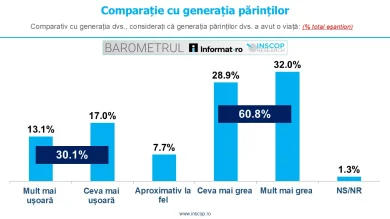
But until a potential broader project on operationalizing the concept of generation (a note to any organizations interested in such a thing), let us start from the data we have. Last week, INSCOP published some data concerning perceptions of life and opportunities by age, with ages grouped into sociologically relevant intervals, as usual (18–29, 30–44, 45–59, 60 plus). We are now discussing two questions: which generation has had a more difficult life, and whether today’s young people have more opportunities than previous generations. Our stereotype—and not only in our country—says that young people do not understand their opportunities and tend not to understand how much easier their lives are today compared with those of past generations. Of course, the stereotype is more complex: it says that young people are unwilling to make an effort, want everything all at once, want to be well paid for doing the work they choose, place extremely high value on their free time and flexible schedules, and do not want to accept the classic condition of a beginner in an activity/profession. Is it true or not? We do not intend to answer that now. But it must be noted that here we are dealing with a psychosociological profile that intersects multiple variables, from what they believe they deserve, to what their parents taught them they deserve, to what consumer society teaches us we are entitled to and need. And I have nothing against consumer society—quite the contrary—but it seems to have become its own enemy when it is no longer capable of reminding people that there was a time when the problem was not that you could not buy anything you wanted, but that what you needed could not be found and you were not allowed to talk about it.
But the two questions in the INSCOP survey tell us something interesting at this point. First of all, the youngest age segment is significantly less convinced than the others that all generations have faced similar difficulties. And, of course, it is the most convinced—twice as much or more than the other generations—that its own age group has the hardest life. This is not an individual matter; it is a statistical regularity coming from the generation that grew up in the greatest prosperity and with the best opportunities in this country’s history. Of course, life does not mean merely having salami and a variety of puffed corn snacks, nor having the internet, a mobile phone, and more than 50 satellite TV channels. But everyone should nevertheless understand that a difficult life refers above all to shortages and complicated circumstances in their objective sense. The only problem is that this works for those who can make the comparison, because they have actually seen worse times.
Now, the fact that very young people are more convinced than others that they have a difficult life is also a characteristic of age. Having something to prove, feeling this pressure instead of the peace of knowing that you have things and services your parents and grandparents did not have, is fairly common at this stage of life. Especially since the range of things you can have but do not have is very broad, and everyone who is not, let us say, in the top third of it in this respect will feel a social handicap. After all, that is the environment in which you develop, those are the people among whom you live and with whom you talk, those are the people you compete with, and among them you have to find your life partner, etc.
The interesting part only comes with the second question. Ultimately, it explains to us that, with Generation Z, as one might say, perhaps it is not simply a lack of endurance or a nature cultivated to be too sensitive but, rather, what we described in the immediately preceding paragraph. 51% of Romanians believe that young people have more opportunities than past generations. The 18–29 age segment believes, by 60%, that it has more opportunities than other generations, therefore somewhat more than the average.
The figure is slightly contradictory if we relate it to the question discussed earlier. But you can see that a difficult life is the result of social comparison, not of a lack of salami, as in the old days. And no one denies the opportunities. Quite the contrary. Let us just hope that only some of them do not take advantage of them…
Latest News
08:54
08:52
08:36
08:18
08:06
See more news
NEWS ON THE SAME TOPICS





.webp)


