Informat.ro – INSCOP Research BAROMETER – 14th Edition, September 2026. Chapter II: Public Perceptions of the Education System



Always see our news on Google
Informat.ro - INSCOP Research BAROMETER - 14th Edition, September 2026. Chapter II: Public Perception of the Education System
According to the Informat.ro – INSCOP Research BAROMETER, 14th Edition, conducted between September 1-7, 2026, Romanians are divided in their opinions regarding the preparedness of educational institutions for the start of the new school year, and support the introduction of uniforms, audio-video monitoring, and drug testing.
The Informat.ro – INSCOP Research BAROMETER is a monthly opinion poll conducted by INSCOP Research at the request of the Informat.ro news platform, in partnership with the Strategic Thinking Group think tank.
The Informat.ro – INSCOP Research BAROMETER aims to bring topics of interest to public attention in order to stimulate national conversations about diverse subjects and public policies essential to Romania’s present and future, based on Romanians’ opinions and in partnership with prestigious think tanks and academic institutions. It is an initiative through which we aim to contribute to strengthening democracy by using scientific and credible tools that bring citizens’ voices to the forefront of public debate.
Methodology: The data were collected between September 1-7, 2026. Research method: questionnaire-based interview. The data were collected using the CATI method (telephone interviews), with a simple random sample of 1,100 people, representative of the significant socio-demographic categories (gender, age, occupation) of Romania’s non-institutionalized population, aged 18 and over. The maximum permitted margin of error is ± 2.95%, at a 95% confidence level.
The graphic presentation of the data is available here.
Remus Ștefureac, director of INSCOP Research: The data indicate a deeply divided society regarding the education system’s ability to prepare adequately, but one that is highly determined when it comes to introducing stricter rules in schools. The strong support for drug testing and audio-video monitoring suggests that, in public perception, children’s safety tends to prevail over concerns regarding individual autonomy or privacy protection. This is a relevant signal of the level of social concern associated with the school environment and of the expectation that institutions should intervene more firmly to prevent risks. School uniforms appear to be viewed less as an instrument of discipline and more as a mechanism for reducing visible social differences among children. Their consistent support indicates a very high level of public sensitivity to inequalities manifested within schools. Beyond reducing discrimination, the result may also indicate a more general need for order, predictability, and shared reference points in the school environment.
Schools’ level of preparedness
45.3% of survey participants believe that schools in Romania are very well or fairly well prepared for the start of the new school year (8% very well prepared and 37.3% fairly well prepared), while 45.5% assess that educational institutions are fairly poorly or very poorly prepared (25.4% fairly poorly prepared and 20.1% very poorly prepared). 8.5% do not know / cannot assess, and 0.7% do not answer.
Those who believe that schools in Romania are well prepared for the start of the new school year represent a higher proportion than in the rest of the population: PSD and AUR voters, people aged 30 to 44, residents of large urban areas, and public-sector employees.
Those who believe that schools are poorly prepared for the start of the new school year represent a higher proportion than the sample average: USR voters, young people aged 18 to 29, residents of Bucharest and small urban areas, and private-sector employees.
School uniform
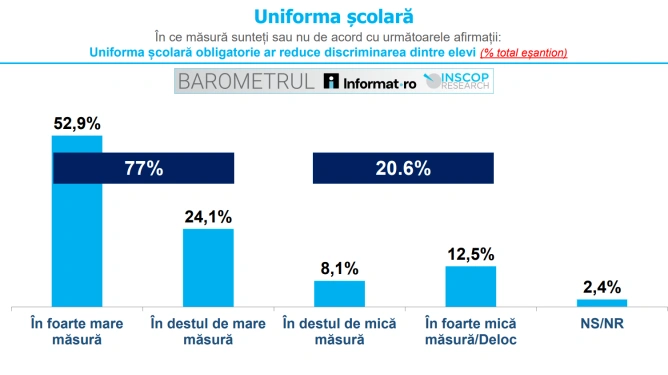
77% of those surveyed believe that mandatory school uniforms would reduce discrimination among students to a very great or fairly great extent (52.9% to a very great extent and 24.1% to a fairly great extent). By contrast, 20.6% express disagreement with this measure (8.1% agree to a fairly small extent and 12.5% to a very small extent/not at all). Non-responses total 2.4%.
Those who believe that mandatory uniforms would reduce discrimination represent a higher proportion than in the rest of the population: PSD and AUR voters, women, people aged 60 and over, those with primary education, and public-sector employees.
People over the age of 45, those with primary or secondary education, residents of large urban areas, and public-sector employees believe, in a higher proportion than the average, that school uniforms would not reduce discrimination.
Introduction of drug testing
83.4% of respondents agree to a very great or fairly great extent with introducing drug testing among students over the age of 14 (60.8% to a very great extent and 22.6% to a fairly great extent). At the opposite end, 15.2% express disagreement with such a measure (5% agree to a fairly small extent and 10.2% to a very small extent/not at all). The share of those who do not know or do not answer is 1.4%.
Those who agree with introducing drug testing in schools represent a higher proportion than in the rest of the population: AUR voters, people over the age of 45, those with secondary education, TikTok users, and public-sector employees.
USR voters, young people aged 18 to 29, people with higher education, and residents of Bucharest express disagreement with drug testing for students over 14 in a higher proportion than the average.
Audio-video monitoring
74.5% of those interviewed agree to a very great or fairly great extent that classrooms should be monitored continuously through audio-video means (51% to a very great extent and 23.5% to a fairly great extent). By contrast, 22.8% agree with this measure to a fairly small or very small extent/not at all (7.5% to a fairly small extent and 15.3% to a very small extent/not at all). Non-responses account for 2.7%.
Support for continuous audio-video monitoring in classrooms is higher than average among PSD and AUR voters, women, people aged 60 and over, those with primary or secondary education, rural residents, and TikTok users.
USR voters, young people aged 18 to 29, people with higher education, residents of Bucharest, residents of urban areas with more than 90,000 inhabitants, Instagram users, and private-sector employees reject the measure in a higher proportion than the rest of the population.
Latest News
23:00
22:55
22:47
22:39
22:33
See more news
NEWS ON THE SAME TOPICS