EXCLUSIVE | Romania, as viewed by the Russian press / The scenario of unification with the Republic of Moldova, described as a “capitulation” of Chișinău



Always see our news on Google
During the period from 7–20 November 2026, the monitored Russian press addressed the prospect of Moldova’s union with Romania, presented by some publications in a negative light, as a process of subordinating Chișinău to Bucharest. Other reports focused on energy interconnection between the two states and statements by Romanian politicians opposing aid for Ukraine. Romania also appeared as a base for NATO aircraft operations and as a logistical support point for Kyiv, according to statements by the commentators cited. Disputes over the Romanian language in Gagauzia and maritime incidents in the Black Sea completed the agenda. The data were collected by the NewsVibe media monitoring platform during the period from 7 to 20 November 2026. The report identified 624 items published in the Russian press during this period.
Romania’s union with Moldova becomes a distinct topic
One of the most important additions is the series of articles about a possible union of Moldova with Romania. On 7 November, RIA Novosti, RT in Russian, Vzglyad, Argumenty i Fakty, Nezavisimaya Gazeta, and Moskovsky Komsomolets published reports interpreting statements by Mihai Popșoi, Deputy Prime Minister and Minister of Foreign Affairs of Moldova, about shared infrastructure as a sign that unification had begun. The materials refer to bridges over the Prut, the Union Motorway, and energy interconnections.
The editorial treatment differs among the publications. RT in Russian presents the statements attributed to the Moldovan minister, along with the clarification that there is no timetable for a possible union. RIA Novosti adds accusations by the Moldovan opposition regarding alleged annexation and negative historical interpretations. Moskovsky Komsomolets uses an explicitly hostile framing, including comparisons with Nazi Germany’s annexation of Austria.
The title of an article published by Moskovsky Komsomolets can be translated as follows: “Moldova capitulated to Romania: Popșoi announced the beginning of unification.” The choice of the verb “capitulated” presents the rapprochement between the two states as a relationship of subordination, rather than as a process of cooperation. However, the report documents this media interpretation and does not demonstrate the existence of a legal process of unification.
Energy interconnection with Moldova is also interpreted geopolitically
Energy cooperation between Romania and Moldova generated a separate series of reports. Interfax, Izvestia, Russkaya Vesna, URA.RU, and the feed labeled Echo of Moscow addressed the commissioning of the Vulcănești–Chișinău line and the possibility of importing electricity from Romania without transiting infrastructure in Transnistria.
Interfax presents the technical characteristics, transport capacity, and financing of the project. Russkaya Vesna emphasizes Chișinău’s intention to reduce its dependence on Transnistria. Izvestia also interprets the new infrastructure in light of the alleged possibility of exerting pressure on the separatist region.
Statements against aid for Ukraine receive visibility
RT in Russian and Rambler published statements attributed to Viorica Dăncilă about stopping support for Ukraine and prioritizing Romanian citizens. Rambler also includes references to Dan Dungaciu’s position regarding the limits of the resources available to aid Kyiv.
In the translation of the quote reproduced by RT, Viorica Dăncilă states: “If I were making decisions now and held a high-ranking position in the state, I would stop aid to Ukraine.” This topic adds the perspective of domestic disagreement with the policy of supporting Kyiv, while the publications give visibility to Romanian voices challenging the aid.
NATO and Ukraine: Romania as a military base and logistics route
Another substantial group brings together reports about reconnaissance aircraft, the American presence in Europe, European defense, and support for Ukraine. RIA Novosti, Vzglyad, Vedomosti, Rambler, and Lenta mentioned Romania in materials about American aircraft taking off from Mihail Kogălniceanu or operating over the Black Sea and near the Kaliningrad region. The repetition of these reports gives the Romanian base consistent visibility.
The tone of the reports about the aircraft routes is predominantly informative, with times, itineraries, and technical characteristics. However, RIA Novosti frequently adds Moscow’s perspective on the expansion of NATO activity, described as a cause for concern for Russia. Romania thus appears not as an autonomous political protagonist, but as a support point for Western military infrastructure presented as threatening.
Argumenty i Fakty publishes statements by General Vladimir Popov according to which reconnaissance data pass through a NATO base in Romania before reaching Ukraine. Lenta reproduces an expert’s statement about the assembly of drones for the Ukrainian army, including in Romania. These are allegations attributed to the publications’ interviewees, not demonstrated conclusions. Moskovsky Komsomolets goes further, hosting calls for the destruction of logistics links between Ukraine, Poland, and Romania.
Moldova and Gagauzia: the Romanian language presented as a political filter
Another group is driven by the succession of reports about the elections in Gagauzia. Romania enters these reports through the requirement to know the Romanian language, the citizenship of some candidates, Chișinău’s relationship with Bucharest, and references to a possible union. Materials were published by RIA Novosti, Vesti.ru, Interfax, Rossiyskaya Gazeta, Moskovsky Komsomolets, Life, and Svobodnaya Pressa.
RIA Novosti repeats in numerous updates the explanation that candidates were required to take a Romanian-language examination. In some texts, this requirement is described as a linguistic filter and associated with the exclusion of certain politicians. Vesti.ru emphasizes an identity-based interpretation through statements by deputy Bogdan Țîrdea. In translation, he states: “But here you need to know Romanian; you practically have to declare yourself Romanian.” The wording transforms a linguistic condition into alleged pressure on identity. The tone is negative toward the policies of the Moldovan authorities and, indirectly, toward their association with Romanian identity.
Other materials broaden the framework to security. RIA Novosti presents a warning by a Transnistrian deputy about the possible deployment of Romanian troops in Moldova, while Svobodnaya Pressa discusses the scenario of union with Romania. The repeated association of Romania with identity pressure and military risk creates an unfavorable backdrop.
Black Sea: maritime incidents between reporting and insinuation
Attacks on vessels and maritime accidents generated a distinct group, with Romania presented as a littoral state, a commercial destination, or a participant in interventions. RIA Novosti, RT in Russian, Vesti.ru, Zvezda, Rambler, URA.RU, and Moskovsky Komsomolets reported on a vessel being struck near Sfântu Gheorghe. Other articles followed the vessels GAS HUSKY and Betul 8.
The editorial difference appears in the attribution of responsibility. Vesti.ru and Zvezda recorded that the drone’s origin was to be established through verification. RIA Novosti reproduces the same reservation but adds context about alleged Ukrainian attacks on civilian shipping. This juxtaposition may guide the reader’s interpretation, although the report of the incident does not establish who carried out that particular attack. Russkaya Vesna uses a more combative register, associating the vessels with the alleged Ukrainian shadow fleet and mocking NATO’s response.
General Tone in the Russian Press
Analyzing the 624 items published from 7 to 20 November 2026, several clear characteristics emerge regarding how Romania is represented in the Russian press: 275 (44%) have a negative tone, 257 (41%) a neutral tone, and 92 (approximately 15%) a positive tone.
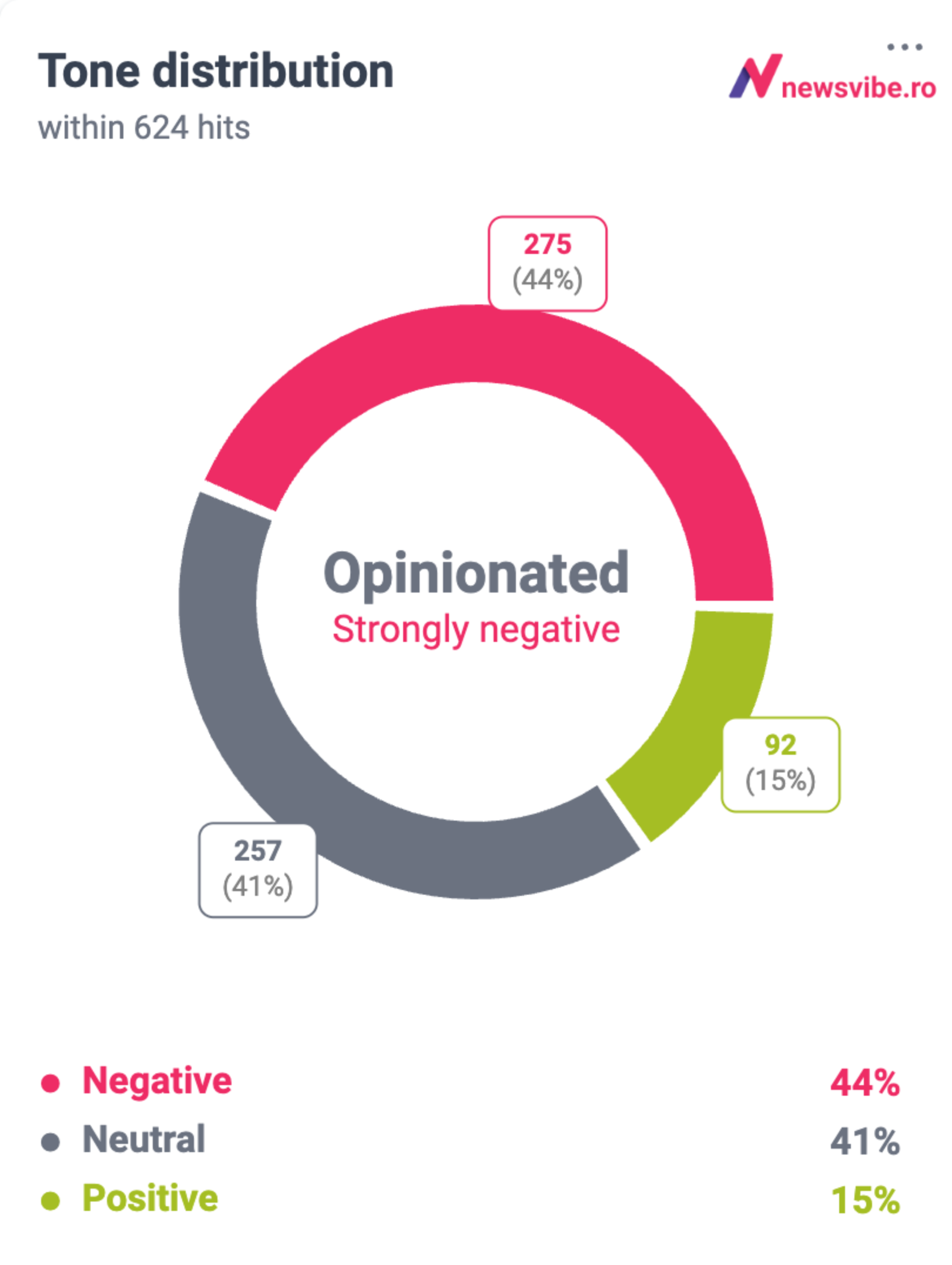
Chart: NewsVibe
*****Summary prepared with the help of a data-monitoring feed provided by the NewsVibe Romania media monitoring platform. The analysis, data, and images presented were enhanced with the help of Machine Learning and Artificial Intelligence tools
Latest News
10:48
10:45
10:37
10:30
See more news
NEWS ON THE SAME TOPICS


.webp)