EXCLUSIVE | Romania, in the view of the Russian press: Ukraine’s “logistical rear”


Always see our news on Google
Over the past two weeks, the Russian press has presented Romania primarily as NATO’s frontline state on the Black Sea and as a transit route for military aid destined for Ukraine. The most discussed topic was the series of drone attacks on commercial vessels near Constanța. The second was Romania’s role as Kyiv’s “logistical rear,” as characterized by Russian commentators. Other topics concerned the issue of unification with the Republic of Moldova, the sabotage network in Brașov, and abandoning Russian gas. The data were collected by the NewsVibe media monitoring platform for the period from October 24 to November 6, 2026. The report identified 705 items published in the Russian press during this period.
Black Sea Security and the Attacks near Constanța
The most discussed topic was the series of drone attacks on commercial vessels in the western Black Sea. On October 24, Top News reported that the bulk carrier Khoryv sank approximately 24 kilometers from Constanța. One person died in the attack, while three others were reported missing. The publication presented the vessel as part of Ukraine’s shadow fleet, but acknowledged that the claim had no independent confirmation. Vzgliad quoted President Nicușor Dan’s reaction, in which he asked NATO for air defense assets: “We requested temporary defensive capabilities within NATO and have already received support from our allies. We are better equipped to respond to this challenge, but we must remain calm.”
The topic continued with several neutrally reported stories. Moskovski Komsomolets wrote that a French Atlantique 2 aircraft had been sent to Mihail Kogălniceanu Air Base. RIA Novosti reported on a meeting in Sofia between the defense ministers of Turkey, Bulgaria, and Romania. Lenta.ru described the sinking of the Contship Jet, which was heading toward Constanța. Vzgliad presented, based on Reuters information, NATO’s decision to strengthen patrols in the region.
The agency reports were factual, but the commentaries challenged Bucharest’s position. Moskovski Komsomolets wrote that NATO had responded to the Romanian president’s initiative in order, in fact, to protect shipments made under Ukrainian contracts.
Romania Presented as Ukraine’s “Logistical Rear”
Svobodnaya Pressa argued that the port of Constanța had become Ukraine’s main military transit hub. The publication wrote: “Most likely, Bucharest also tacitly decided to make its warehouses and logistical facilities available to Kyiv for the storage and transportation of military equipment.” In a commentary, Vzgliad wrote: “On the territory of Romania and Poland, which are de facto the main rear bases of the Armed Forces of Ukraine, intensive 20-day courses for instructors were organized.”
The Russian press justified strikes on bridges over the Dniester by citing the transit of goods coming from Romania. Moskovski Komsomolets chose the headline: “Russian Geran drones sever Romanian-Ukrainian links, while a strategic bridge is in the crosshairs.” In an interview with the same newspaper, military expert Vladimir Evseev, deputy director of the Institute of CIS Countries, openly stated that Russian strikes had reached the territorial waters of Romania and Bulgaria. Asked about a possible reaction from Bucharest, he said: “Romania is quite cautious when it comes to confrontation with the Russian Federation. It is not prepared for such a confrontation.” Moskovski Komsomolets also wrote about alleged mercenaries from Poland and Romania who had reportedly robbed a truck in the Kherson region.
The Republic of Moldova and the Issue of Unification with Romania
In agency reports, the issue of unification was treated predominantly neutrally. RIA Novosti, Lenta.ru, and Novosti Mail reproduced Maia Sandu’s statement: “For now, we do not have sufficient support from the population for such a decision. However, there is a majority that supports integration into the European Union, which is why we are pursuing this objective insistently.” Argumenty i Fakty published an IMAS poll. According to it, approximately 84% of Gagauzia’s residents oppose unification.
In opinion pieces, the tone became ironic. Vzgliad wrote: “On planet Earth, there are at least two heads of state who dream of abolishing their own state: Moldova’s president, Maia Sandu, whose goal is to enter the EU and NATO as quickly as possible through absorption by Romania, and, for now, Belgium’s prime minister, Bart De Wever.”
The Sabotage Network in Brașov and the Russian Ambassador’s Response
The Romanian Intelligence Service (SRI) announced the dismantling of a sabotage network. It was one of the few topics with Romania in the headline that was simultaneously picked up by several newsrooms. Fontanka.ru and Vesti.ru reported on the September 14 arson at the Carfil factory in Brașov. Romanian authorities attribute it to a network coordinated from Russia. Both publications emphasized that the link to Moscow was only presumed and that Russia rejects the accusations. Novaya Gazeta and Ekho reproduced the SRI version without these reservations.
Vzgliad, Interfax, and RT quoted the Russian Embassy in Bucharest: “The Russian Federation has never planned, coordinated, or committed acts of sabotage on the territory of Romania.” According to Interfax, Ambassador Vladimir Lipaev described the accusations as slander. He argued that the danger to Romania comes not from Russia, but from aligning with the escalation course of NATO and EU leadership.
The Cancellation of the Elections and the Călin Georgescu Case
The Russian press frequently used Romania as an argument against the European Union, especially in the context of Poland’s constitutional crisis and the elections in Bulgaria. Novosti Mail reported factually, based on TASS, that Călin Georgescu’s pretrial detention had been extended in a fraud case. The commentaries, however, were negative toward Romanian institutions. RIA Novosti quoted Florian Philippot, leader of the French sovereigntist party Les Patriotes. He argued that the EU had secured the cancellation of Romania’s elections and the imprisonment of the winner. According to Lenta.ru, Russian Senator Alexei Pushkov stated: “In Romania, EU-linked authorities went so far as to cancel elections that promised the victory of a Eurosceptic.”
A commentary published by Vzgliad explains why Romania appears so often as an example: “We have seen the Romanian precedent. But Romania borders Ukraine and is essential to its supply, whereas Bulgaria’s role is visibly more modest.”
Energy: Russian Gas, the Strike at Oil Terminal, and the Reactor at Cernavodă
Economic topics were treated largely neutrally. PRIME quoted Secretary of State Marius Poșa, who stated that Romania was preparing to completely give up Russian gas. The official nevertheless added a qualification: “If someone says that, from the perspective of international law, we can buy Russian gas, no one will object.” Lenta.ru challenged the statement through economist Igor Yushkov, who said: “They simply do not take it from Russian companies.”
RIA Novosti reported on the warning strike at Oil Terminal Constanța. PRIME wrote about the restart of a reactor at Cernavodă. Vesti.ru noted that Romania’s gas storage facilities were nearly 90% full. Vzgliad reproduced Energy Minister Dumitru Chisăliță’s warning: “We have three scenarios, which foresee increases in electricity prices of 16%, 22%, or 27%.”
General Tone in the Russian Press
Analyzing the 705 items published from October 24 to November 6, 2026, several clear features emerge regarding how Romania is represented in the Russian press: 341 (48%) have a negative tone, 286 (41%) a neutral tone, and 78 (approximately 11%) a positive tone.
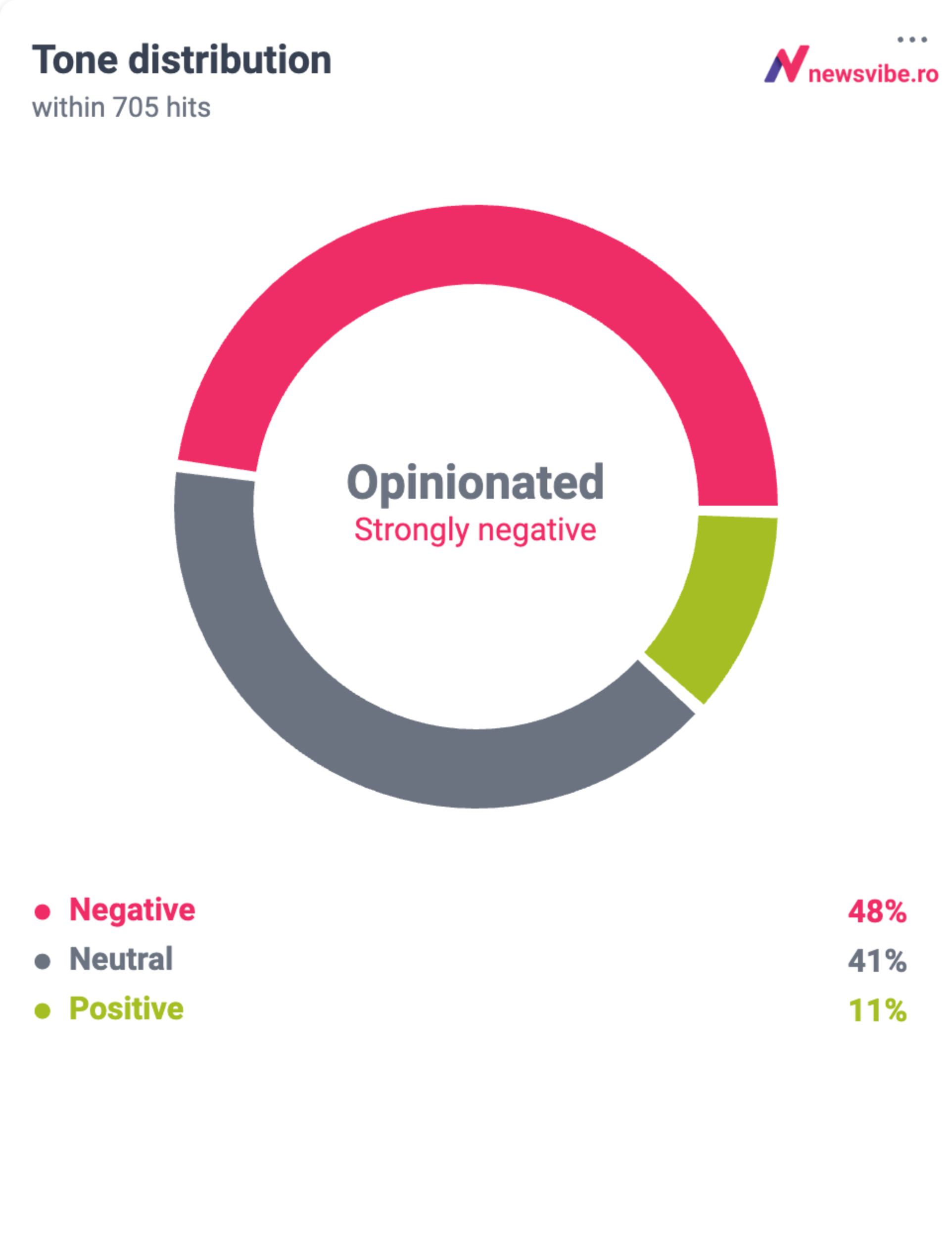
Chart: NewsVibe
*****Summary prepared with the help of a data monitoring feed provided by the NewsVibe Romania media monitoring platform. The analysis, data, and images presented were enhanced with the help of Machine Learning and Artificial Intelligence tools
Latest News
17:35
17:35
17:34
17:32
17:18
See more news
NEWS ON THE SAME TOPICS

.webp)