EXCLUSIVE | Romania, as seen by the Russian press / The “Romanian scenario,” cited in the Russian press as a possible way to block Marine Le Pen in the race for the presidency of France


Always see our news on Google
During the monitored period, Romania was presented in the Russian press mainly through its role in NATO, the flights of Western reconnaissance aircraft, and the neutralization of drones over the Black Sea. Other topics concerned the formation of the government in Bucharest and economic and energy vulnerabilities. At the same time, Russian publications picked up claims about a possible “Romanian scenario” in the French presidential election, invoked to suggest that Marine Le Pen’s opponents might try to block her access to power. The data were collected by the NewsVibe media monitoring platform between 10 and 23 October 2026. The report identified 577 items published in the Russian press during this period.
“The Romanian scenario,” used in a dispute over the French election
Romania was also invoked in the Russian press as a precedent in a dispute over the French presidential election. On 18 October, Izvestia, RIA Novosti and Lenta picked up statements by Senator Aleksei Pushkov claiming that Marine Le Pen’s opponents might resort to a “Romanian scenario” to prevent her from coming to power. The three items stem from statements by the same politician, published on Telegram.
Pushkov describes two possibilities: using judicial procedures to prevent Le Pen from taking part in the election or annulling a possible first-round victory, citing alleged Russian interference. The second option is explicitly associated with Romania and the annulment of the election in which Călin Georgescu won the first round. Izvestia reproduces the senator’s comparison, which, translated into Romanian, states: “That is how they proceeded with Călin Georgescu in Romania, and the same could be done with Marine Le Pen.” The wording expresses Pushkov’s interpretation of the Romanian case and projects it onto a future election in France.
In this construction, Romania is not analyzed through the particularities of its own electoral process, but is transformed into a precedent for the accusation that opponents of certain candidates may use institutions and suspicions of Russian interference to block an undesired result. RIA Novosti also reproduces Pushkov’s statements about the possible involvement of European actors, including European Commission President Ursula von der Leyen.
The reports also link the electoral scenario to the war in Ukraine. Izvestia and RIA Novosti mention a statement attributed to Marine Le Pen regarding the cessation of funding for Ukraine if she comes to power. Through this association, the possible blocking of the candidate is presented not only as a French political dispute, but also in connection with her position on support for Kyiv. The case of Romania thus becomes an element in a broader argument about power, elections and Western policy toward the war.
Romania, presented through its role in NATO
The most substantial topic was Romania’s association with the Western military presence. Vzgliad, RIA Novosti, Argumenty i Fakty, Vedomosti, Lenta, Rambler and other sources reported on American reconnaissance aircraft departing from or returning to Romania after missions near Russia. Mihail Kogălniceanu Air Base thus appears as a recurring reference point in reports about surveillance of the Black Sea and the Kaliningrad region.
These reports are often technical: they mention routes, takeoff times and flight duration. Romania is the place of operation, not necessarily the target of an explicit judgment. The repetition of this association, however, constantly places it within the framework of the confrontation between Russia and NATO, making it far more visible than in civilian or cultural contexts.
The tone becomes more emphatic in reports about strengthening the allied presence in the Black Sea. Interfax, Vesti.ru, URA.RU, Lenta and Rambler picked up statements by Russian diplomat Vladislav Maslennikov about NATO activity. In this interpretation, aircraft based in Romania and the expansion of allied infrastructure are associated with the risk of escalation.
The difference in approach is visible in the headlines. Moskovski Komsomolets presented the strengthening of NATO’s presence as the use of a pretext. By contrast, Rossiyskaya Gazeta reported on the reinforcement of allied assets and on discussions initiated by Romania and Bulgaria in a more informative register. Vzgliad and PRIME also picked up information attributed to Bloomberg regarding investments of approximately four billion euros in Mihail Kogălniceanu Air Base by 2040.
Neutralization of drones
The interception of two drones by Romanian F-16 aircraft received significant coverage. The topic appeared in RIA Novosti, RT in Russian, Vesti.ru, Izvestia, Lenta, Rambler, Fontanka, Life, Svobodnaya Pressa, URA.RU and Argumenty i Fakty. Most reports reproduced a statement from Romania’s Ministry of Defense and specified that the aircraft had been shot down over territorial waters.
The immediate treatment of the incident was predominantly neutral. Several publications emphasized that the origin of the drones was not specified in the cited statement. Another item in the group concerned the neutralization of drones floating at sea. Argumenty i Fakty presented it with a headline that, translated into Romanian, states: “NATO is afraid: Romania flinched after Russia’s response to provocations at sea.” The text includes commentary from a Russian expert who disputes the Romanian presentation and attributes provocative intentions to it. This is a clear example of a shift from reporting an incident to a negative interpretation of Bucharest’s conduct.
Domestic politics: institutional reporting, but also an emphasis on crisis
The report covering the past two weeks records news about the approval of a government led by Luca Niculescu in RIA Novosti, Interfax, Vesti.ru and Argumenty i Fakty, as well as two appearances on the Russian-language channels of Euronews. The information must be attributed to the monitored items: the analysis tracks what the sources in the report published, without external verification of the events described.
RIA Novosti foregrounds the approval of the cabinet “on the fourth attempt,” emphasizing the difficulty of forming a majority. Interfax describes the composition of the government and the parliamentary procedure. Argumenty i Fakty highlights the end of a political crisis lasting more than five months, with the item labeled positively. Institutional reporting therefore does not constitute an exclusively hostile approach.
Economic and energy vulnerabilities
The economic group brings together six items about diesel fuel, the Cernavodă nuclear plant, the National Bank of Romania’s interest rate and Lukoil’s international assets. Romania is not the main subject in all of them: in Interfax reports about Lukoil, it appears among the countries where the company owns refineries. These mentions should be distinguished from news dedicated to the Romanian economy.
Vzgliad presents the possibility of a diesel shortage in winter, citing Digi24 and the company Frames. The item emphasizes price increases, dependence on imports and access to reserves. Argumenty i Fakty reports on the prospect of restarting the reactors at Cernavodă, while PRIME reports on keeping the key interest rate at 6.5%. Both items are labeled neutral.
General Tone in the Russian Press
Analyzing the 577 items published between 10 and 23 October 2026, several clear features emerge in the way Romania is represented in the Russian press: 279 (48%) had a negative tone, 242 (42%) a neutral tone and 56 (approximately 10%) a positive tone.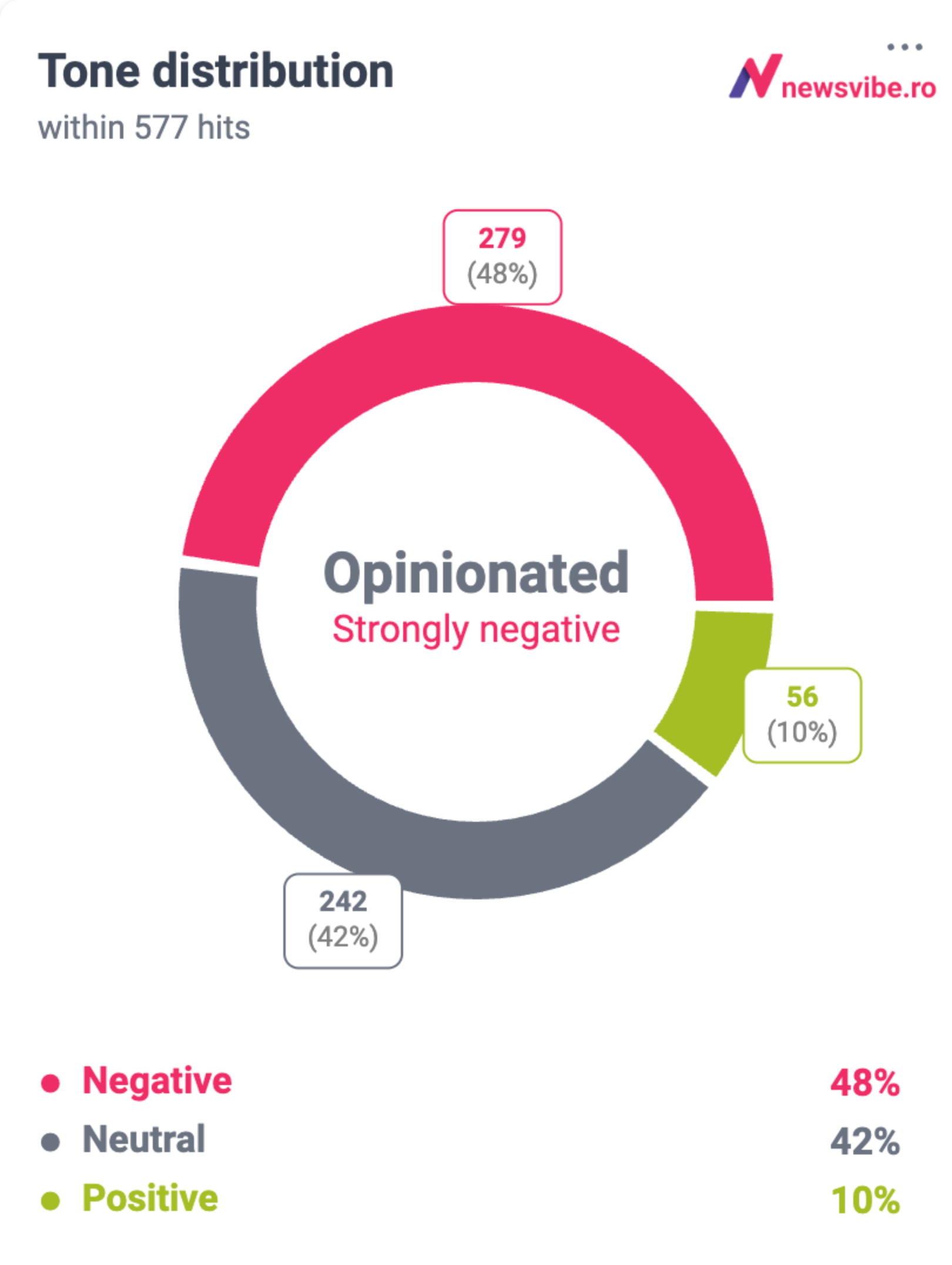
Chart: NewsVibe
*****Summary prepared with the help of a data-monitoring workflow provided by the NewsVibe Romania media monitoring platform. The analysis, data and images presented were enhanced with the help of Machine Learning and Artificial Intelligence tools
Latest News
23:12
22:53
22:53
22:25
22:06
See more news
NEWS ON THE SAME TOPICS
.webp)