SPECIAL Informat.ro / Romania in the European press: Top topics from the past two weeks. The political crisis, the topic with the most negative tone


Always see our news on Google
Romania and Romanians remained present on the agenda of the European press during the period analyzed, but attention focused more strongly than before on security, political stability, and economic pressure dossiers. The NewsVibe analysis for the period September 19–October 2, which identified 4,351 items from 24 European countries, shows that external attention on Romania focused mainly on four themes: the political crisis in Bucharest, the security of NATO’s eastern flank, the cost of energy, and cooperation against cybercrime.
Political crisis, a subject with a negative tone in the European press
One subject affecting Romania’s external image is the reporting on the political deadlock in Bucharest following the rejection of Siegfried Mureșan for the position of prime minister. The topic was picked up by several publications across Europe, with a dominant narrative framework: instability and institutional deadlock.
De Dagelijkse Standaard, Nieuws, Reformatorisch Dagblad, and Nederlands Dagblad published reports on the continuation of the political crisis following the rejection of the Mureșan government. The articles, carried by ANP/AFP, state that the deadlock persists after another negative vote in Parliament and that President Nicușor Dan has limited options for continuing the procedure. The tone can be classified as negative because the emphasis falls on deadlock, instability, and the absence of an immediate governmental solution.
The repetition of the same narrative in the Dutch press may affect perceptions of Romania’s political predictability, especially at a time when regional security and European coordination are priority issues. For Romania’s relationship with its European partners, the implication is one of political reputation: the foreign press is not discussing only an internal parliamentary procedure, but Bucharest’s ability to produce a functioning majority. Editorially, this is the issue that generated the most explicit negative tone about Romania as a state, distinct from negative reports about the effects of the war.
Publications from other countries intensified this framing through more emphatic formulations. POLITICO Europe headlined that “Romania’s political crisis deepens” after the rejection of the designated prime minister. In Austria, Der Standard described the situation as the continuation of “the most serious governing crisis in post-communist Romania,” while Die Presse used the same framing of a major crisis still unfolding. ORF adopted a more strictly informative tone, focusing on the loss of the confidence vote and the 51-vote difference from the required threshold. Nevertheless, simply placing the result within a succession of failed attempts to form a government maintains the perception of instability.
In Italy, Il Post presented the case as that of “the third prime minister-designate in five months” to whom Parliament denied its confidence. L’Huffington Post Italia wrote that “the crisis reopens” and that the Mureșan government “falls immediately in Parliament,” associating the event with the approaching new vote. The Portuguese publication Notícias ao Minuto described the vote as a moment that “aggravates the political crisis.”
In Hungary, the language was even more explicit. Telex reported that, after two failed candidates, calls for early elections were growing; Origo evoked the possibility of a “political avalanche”; and Népszava stressed that the formation of the government had failed again, associating the deadlock with fears that AUR might come to power. In the Hungarian reports, the Romanian crisis is described not merely as a procedural one, but as one capable of altering the political balance and creating an advantage for the far right.
Romania, NATO flank facing Russian drones
An important geopolitical subject was the security of the airspace along Romania’s border with Ukraine and the Republic of Moldova. In the corpus analyzed, the topic of drones, the war in Ukraine, NATO, combat aviation, and regional security had the greatest scope among the themes of strategic relevance.
The Spanish press paid particular attention to the mission of its own military personnel stationed in Romania. El País published an article about the activities of Spanish forces at the 57 Mihail Kogălniceanu air base, presenting Romania as the place from which Spain participates in NATO’s defense against the threat posed by drones. La Razón reported on the Spanish mission to intercept Russian drones from Romania and on the fact that pilots responded to several alerts during the month. The tone is neutral, focused on the details of the mission and the increasing operational pressure. La Vanguardia also covered the topic neutrally, describing the interventions of Spanish F-18s against drones considered a challenge to NATO.
Within the same family of subjects, Greek publications such as Enikos reported on alerts in Romania and the Republic of Moldova during a Russian attack on Ukraine. Here, the negative tone does not target Romania as an actor, but rather the security risk generated by the war and Romania’s geographical proximity to the conflict zone.
Geopolitically, this type of coverage is favorable to Romania’s position within NATO: the country appears as collective-defense infrastructure, not as a peripheral spectator. In relations with Spain, the reports reinforce the image of concrete military cooperation taking place on Romanian soil. Regarding the Republic of Moldova and Ukraine, the press portrays Romania as part of the security space exposed to Russian threats, but also as a state capable of acting together with its allies.
Romania and the cost of energy
Rising fuel prices were an economic theme with European reach and a direct impact on Romania’s image in relation to the common market. Euronews reported that the average price of diesel in the European Union reached a record level of 2.24 euros per liter, amid disruptions to energy supply routes. The article includes Romania among the countries where diesel reached record prices. The tone is negative, focusing on the cost of living and pressure on consumers. Including Romania among the countries with record prices may fuel the perception of high social and economic pressure.
Cooperation against cybercrime
The international operation against the KillSec ransomware group brought Romania into the European press in a context of cybersecurity and cooperation between authorities. TAG24.de reported on the dismantling of the group, presenting its alleged teenage leader and the scale of the attacks attributed to the network.
In Spain, Europa Press reported both on the downfall of the KillSec group and on the detention of a minor in Alicante as part of the international operation. ABC España and El Periódico emphasized the teenager’s alleged involvement and the cyberattacks. The reports show that the operation also included actions in Romania, alongside other European states.
Overall tone in the European press:
Of the total 4,351 articles analyzed, 36% had a negative tone, 34% a neutral tone, and 30% a positive tone.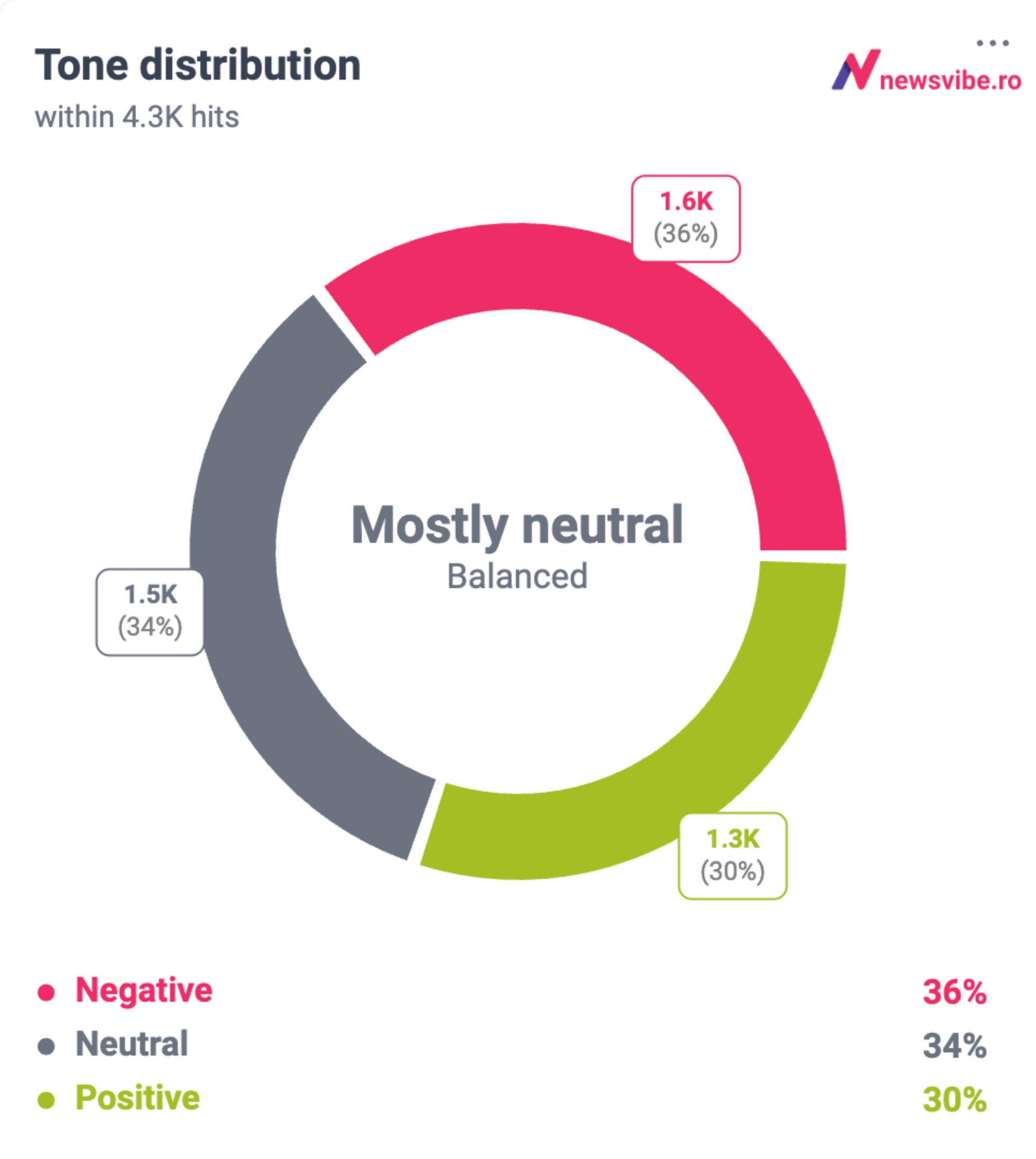
Chart: NewsVibe
****Summary prepared with the assistance of a data-monitoring workflow provided by the NewsVibe Romania media monitoring platform. The analysis, data, and images presented were enhanced with the help of Machine Learning and Artificial Intelligence tools.
Latest News
22:52
22:34
22:28
21:56
21:29
See more news
NEWS ON THE SAME TOPICS