SPECIAL Informat.ro / Romania, in the European press: Top topics from the past two weeks. Black Sea security, Europe's focus




Always see our news on Google
Romania was present on the European press agenda through topics related to security in the Black Sea, the investigation into the alleged Russia-coordinated sabotage network and the dispute with Bulgaria, as well as reports on cooperation with France and Turkey to protect commercial shipping. The NewsVibe analysis for the period October 17–30, which identified 4,540 items from 24 European countries, shows that external attention on Romania focused mainly on four themes: the political crisis in Bucharest, the security of NATO’s eastern flank, the cost of energy, and cooperation against cybercrime.
Attacks in the Black Sea, a European concern
The attack on the Khoryv cargo ship, reported on October 23, represents one of the press’s main points of convergence. POLITICO, Euronews, Deutsche Welle, Le Figaro, Der Spiegel, and Tagesschau present the incident, which occurred approximately 13 nautical miles from Constanța, outside Romanian territorial waters. The toll communicated at the time was one sailor dead, three missing, and nine survivors. Nicușor Dan is the main Romanian voice quoted, attributing the attack to Russian escalation in the context of the war against Ukraine.
The geopolitical importance stems from the overlap of three issues: the proximity of attacks to a NATO state, the vulnerability of civilian shipping, and the threat to Ukrainian commercial routes. Les Echos develops this connection in an analysis of the testing of the Alliance’s defenses. The French publication links the attacks to grain exports and economic pressure on Ukraine. Romania thus appears not only as a neighbor of the war, but also as part of the commercial infrastructure affected by it.
European reactions support Bucharest’s position. Renascença and Observador relay António Costa’s statements about “full solidarity” with Romania and the need to stop the attacks. Euronews and Le Figaro quote Ursula von der Leyen’s condemnation. In this context, Romanian concerns are presented as European security issues, not as isolated national demands. The tone is negative because of the gravity of the events, but predominantly neutral in reporting Romania’s actions and favorable in presenting European solidarity.
The Brașov sabotage: Romania, Germany, and Poland in a cross-border investigation
The announcement concerning an alleged sabotage network coordinated from Russia is the second major topic. Le Figaro, Il Messaggero, ORF, La Razón, Sud Ouest, and numerous Greek publications picked up information from Romanian services about the fire on September 14, which occurred near an armaments facility in Brașov. The week’s newsworthiness derives from the communicated conclusions and the investigation’s progress, not from the date of the fire.
Le Figaro reports that two Belarusian citizens and a Ukrainian citizen are being investigated, while two suspects had been detained in Germany. Notes from Poland subsequently reported the detention in Warsaw of a Ukrainian citizen sought by Romania under a European arrest warrant. The publication explains the connection with the Carfil military equipment factory and with information communicated by SRI and DIICOT.
For foreign relations, the documented consequence is concrete cooperation with Germany and Poland. Romania appears not only as the target of alleged operations, but also as a participant in a European investigative mechanism. In relation to Russia, the direction is the opposite: Observador records the summoning of the Russian ambassador and Bucharest’s protest, alongside Nicușor Dan’s statements about the intensification of hybrid warfare.
The treatment is predominantly factual, against a negative backdrop determined by the threat. Most reports attribute the allegations to the Romanian authorities. This clarification preserves the distinction between the conclusions communicated by investigators and the final establishment of criminal responsibility.
The dispute with Bulgaria: political trust is put to the test
Rumen Radev’s statements at the Sofia Economic Forum on October 26 opened a distinct controversy. According to the reports included in the analysis, he associated Bucharest’s public accusations against Russia with the subsequent attacks on vessels. Vesti, Darik News, Mediapool, Actualno, and Novinite followed the Romanian reactions and the effects on bilateral relations.
Onet Wiadomości relayed Cătălin Predoiu’s response: Romania’s positions regarding the drone incidents were based on evidence and documented situations. Predoiu called for solidarity and recalled the diplomatic support provided to Bulgaria in joint cases. Mediapool also recorded Mihai Fifor’s reaction, in which he challenged the suggested link between Bucharest’s statements and the attacks.
Editorial differences are visible. Darik News explains the dispute in a predominantly neutral register. Mediapool emphasizes the outrage caused in Romania. A Novinite opinion article explicitly criticizes Radev’s reasoning and the risk of damaging trust in a strategic partner.
The stakes go beyond the exchange of statements: maritime cooperation requires a joint assessment of threats. However, the report does not document a diplomatic rupture. Reports on the meeting of the defense ministers show that coordination mechanisms continue.
Cooperation with France and Turkey: the practical response to the maritime crisis
Allied support constitutes a theme separate from reporting on the attacks. Sud Ouest and CNEWS present the participation of a French Atlantique-2 aircraft in surveillance and rescue operations. Jean-Noël Barrot explains the involvement during his visit to Bulgaria. MDR and Darik News also report the deployment of a French aircraft in Romania.
Sud Ouest mentions a project for a maritime security platform in Varna and Constanța, intended for monitoring, information exchange, and early warning. For Romanian-French relations, the relevance is operational: solidarity is accompanied by a concrete surveillance contribution. The tone is neutral, with positive accents in the presentation of the support.
Hürriyet Daily News, TRT World, and The Sofia Globe report on the Romania–Bulgaria–Turkey consultations of October 28. Yașar Güler, Dimitar Stoyanov, and Ștefan-Radu Oprea support information sharing and coordination of the response. The continuation of discussions in Ankara and Bucharest indicates the preservation of a trilateral framework. This is one of the clearest examples in the analysis of a common threat stimulating cooperation, even in the presence of political disagreements.
Overall tone in the European press:
Of the total 4,540 articles analyzed, 46% had a negative tone, 31% a neutral tone, and 22% a positive tone.
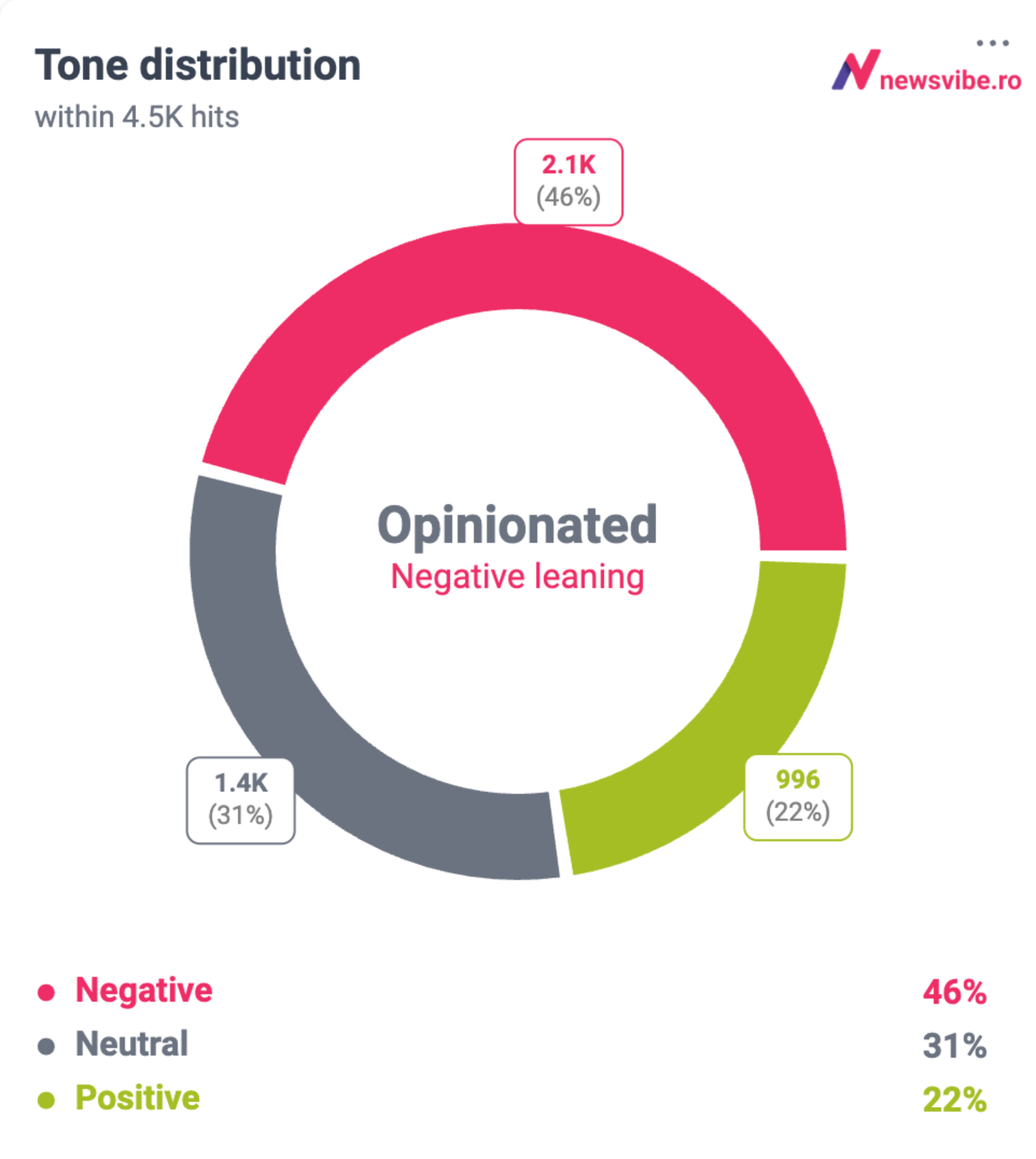
Chart: NewsVibe
****Summary produced with the help of a data-monitoring workflow provided by the NewsVibe Romania media monitoring platform. The analysis, data, and images presented were enhanced with the help of Machine Learning and Artificial Intelligence tools.
Latest News
20:12
20:10
20:03
19:56
19:44
See more news
NEWS ON THE SAME TOPICS


.webp)