EXCLUSIVE | Romania, as seen by the Russian press / Refusal to increase the transit of Ukrainian grain, welcomed by some publications


.webp)

Always see our news on Google
During the monitored period, Romania was presented in the Russian press mainly through reconnaissance flights by Western aircraft over the Black Sea, Bucharest and Warsaw’s refusal to increase the transit of Ukrainian grain, and the sinking of the Royad Mammadov, following which the Romanian authorities intervened to rescue the crew. The data were collected by the NewsVibe media monitoring platform between September 26 and October 9, 2026. The report identified 977 items published in the Russian press during this period.
Reconnaissance flights: Romania, a support point for Western activity
The activity of reconnaissance aircraft over the Black Sea was the most frequently identified specific topic. Romania appears as a takeoff, landing, or operational support location for American and Swedish aircraft. The topic was covered by RIA Novosti, Vedomosti, RT, Vesti.ru, Business Online, Rambler, Vzgliad, Life, and Svobodnaia Pressa.
The reports focused on the duration of the missions, altitude, and routes. Vedomosti described the flight of the Swedish Gulfstream S102B Korpen aircraft, which departed from Bucharest, and emphasized that it remained above neutral waters. The publication quoted a source from the air traffic control services: “The aircraft flew at an altitude of approximately 13 kilometers without entering the airspace of any of the coastal states.”
RIA Novosti separately reported that the American Bombardier ARTEMIS II aircraft landed at Mihail Kogălniceanu Airport after a mission over the Black Sea. The technical description was followed by a presentation of Moscow’s position regarding the intensification of NATO activity near its borders.
The dominant tone was neutral, but some language choices emphasized the idea of surveillance. The title of Svobodnaia Pressa can be rendered as follows: “The Pentagon’s ‘Eye’ Remained Over the Black Sea.” Romania is not directly criticized, but appears as part of the infrastructure used for the Western military monitoring of Russia.
Ukrainian grain: from logistical explanations to Kyiv’s alleged “betrayal”
Romania and Poland’s refusal to increase the transit of Ukrainian grain was the next-ranked topic. The information circulated in RIA Novosti, RT, Izvestia, Vesti.ru, Kommersant, RBC, Lenta, URA.ru, Argumenty i Fakty, InoSMI, Life, Business Online, and Piati Kanal. Numerous publications attributed the initial report to Politico.
The explanations reproduced concern the protection of local farmers, overburdened ports, and the low level of the Danube. In the text reproduced by InoSMI, Tánczos Barna is attributed the statement: “The interests of our own farmers remain a priority.” The same article mentions Romania’s efforts to optimize logistics and a memorandum with Ukraine to facilitate transportation.
The differences arise in how these limitations are presented. URA.ru retains an economic explanation, while RIA Novosti uses the title: “The West Found Out Who Decided to ‘Betray’ Ukraine.” Piati Kanal presents Bucharest and Warsaw’s choice as a preference for their own economies at the expense of continuing support for Kyiv.
Bucharest’s position is used to illustrate the limits of European solidarity with Ukraine. In some texts, the protection of Romanian farmers even receives favorable justification.
The sinking of the Royad Mammadov: Romanian intervention and the dispute over responsibility
The sinking of the Royad Mammadov occupied the next position among the identified topics. RIA Novosti, Interfax, Vesti.ru, Lenta, Rambler, Business Online, Zvezda, TopNews, Versia, and Bloknot reported on the incident. Romania appears through the location of the incident and the rescue operation conducted by its authorities.
RIA Novosti attributed to Romania’s Ministry of Internal Affairs the information about the rescued crew members and the victims. Business Online also presented the evacuation of survivors and their transportation for medical care.
Some publications described the sinking as the result of a drone attack. Bloknot claimed that Ukraine may have caused the incident in order to strain Russia’s relations with Turkey and Azerbaijan. The negative tone reflects both the tragic nature of the event and the conflicting interpretations, while the political dispute focuses on the alleged responsibility for the incident.
Călin Georgescu, presented through the criminal investigation and his positions toward the West
The publication Novosti Mail presents Călin Georgescu as a staunch critic of NATO, the European Union, and Western aid for Ukraine, introducing a geopolitical dimension into its report on the DIICOT investigation into alleged fraud involving €1.1 million, which he and two other people allegedly obtained from a Romanian entrepreneur by promising to help him access a line of credit at a foreign financial institution. The text recalls the annulment of the presidential election and suspicions of Russian interference, noting that Moscow rejects these accusations.
Through this contextualization, Georgescu appears not only as a suspect in a criminal case, but also as a participant in the political confrontation over Romania’s foreign-policy orientation. The publication nevertheless reproduces the allegations and notes that the former candidate denies any wrongdoing.
The General Tone in the Russian Press
Analyzing the 977 items published between September 26 and October 9, 2026, several clear features emerge regarding how Romania is represented in the Russian press: 500 (51%) have a negative tone, 377 (39%) a neutral tone, and 100 (approximately 10%) a positive tone.
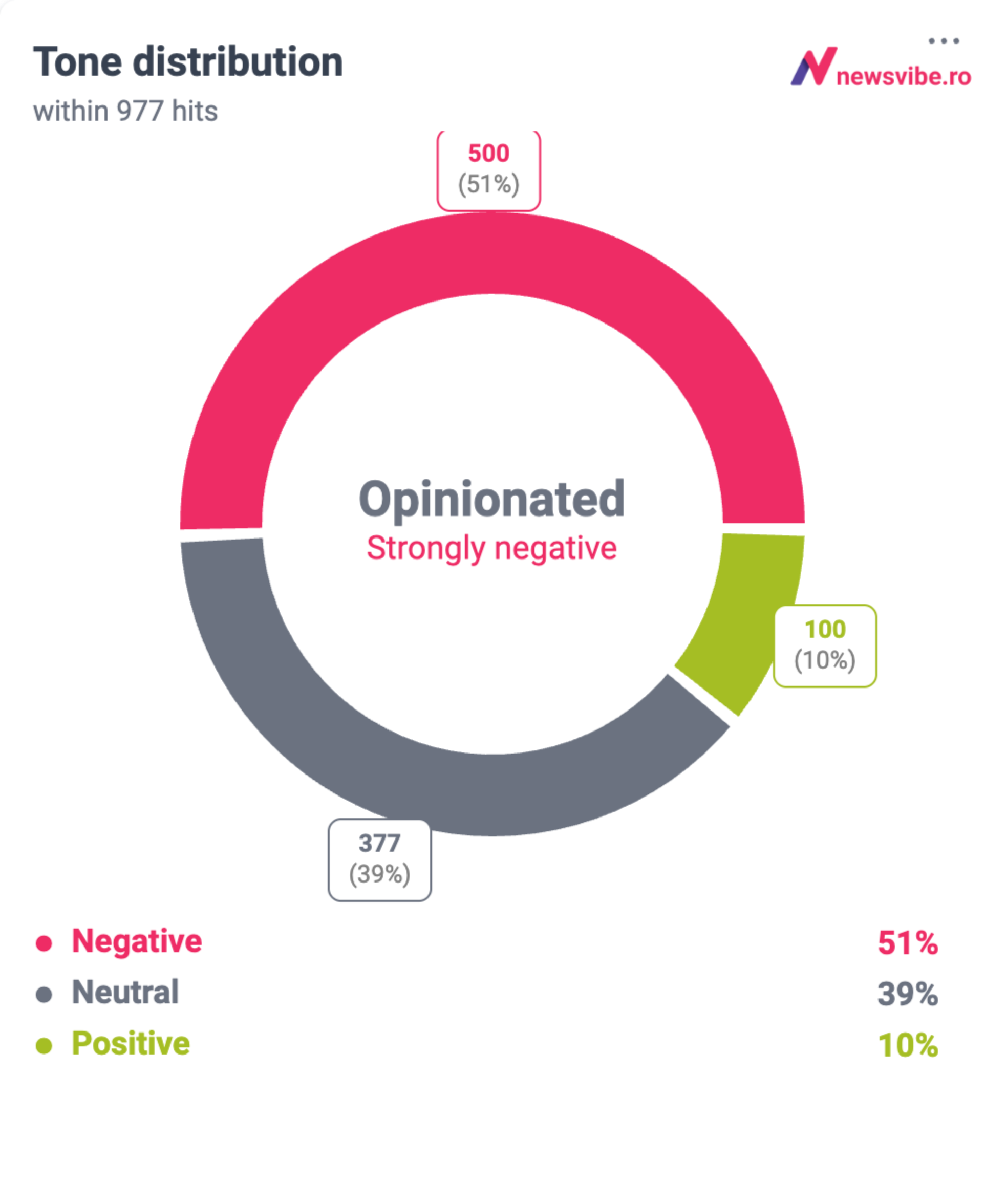
Chart: NewsVibe
*****Summary prepared with the help of a data monitoring feed provided by the NewsVibe Romania media monitoring platform. The analysis, data, and images presented were enhanced with the help of Machine Learning and Artificial Intelligence tools
Latest News
19:04
18:51
18:50
18:49
18:43
See more news
NEWS ON THE SAME TOPICS