SPECIAL Informat.ro / Romania in the European press: Top topics from the past two weeks. Security in the Black Sea remains in the spotlight of European publications




Always see our news on Google
Romania was present on the European press agenda through reports on the security of navigation in the Black Sea, European support for the Romanian-Bulgarian maritime security center, and differences in positioning between Bucharest and Sofia regarding responsibility for attacks. The materials analyzed also addressed the energy interconnection of the Republic of Moldova with Romania, Spain’s contribution to counter-drone defense, technological cooperation with France, and the joint operation by Romanian and Belgian authorities against a network suspected of cargo theft. The NewsVibe report for the period October 31–November 13, which comprises 4,458 records, thus outlines four directions of Romania’s visibility: maritime security, regional energy cooperation, allied defense, and cross-border judicial cooperation.
Black Sea: European support for maritime security
Navigation security in the Black Sea is one of the most widely reported topics in the report, with Romania presented both as a state exposed to attacks on commercial transport and as a participant in organizing the European response. EL PAÍS separately addresses Romanian-Bulgarian divergences in an analysis of the orientation of policy in Sofia. The common element in the reports is Ursula von der Leyen’s announcement of an allocation of 50 million euros to accelerate the Romanian-Bulgarian maritime security center. POLITICO explains its role in monitoring maritime activity and protecting subsea infrastructure, while Euronews also presents support for search-and-rescue operations. The tone is generally informative and favorable toward cooperation, but political differences emerge: Bulgarian Prime Minister Rumen Radev calls for additional evidence regarding those responsible for the attacks, while Bucharest attributes responsibility to Russia. EL PAÍS critically examines Sofia’s distancing from the Romanian position. By contrast, BTA records Nicușor Dan’s assessment that the cooperative relationship with Bulgaria is “very good.”
Romania–Republic of Moldova: energy interconnection presented as reducing vulnerability to Russia
The Vulcănești–Chișinău power line and the connection of the Republic of Moldova to the Romanian and European grids are presented by Le Figaro, in a piece produced with AFP, Notizie Geopolitiche, EUobserver, and Georgia Today. The reports place Romania in a favorable role: that of linking the Moldovan energy system to the European market, as part of a process of diversifying supply. Le Figaro explains that Vulcănești was already connected to the Romanian grid, with the new line extending this connection to Chișinău, and presents the project as an alternative to dependence on the Cuciurgan power plant in the Transnistrian region. Maia Sandu is the main political voice quoted: she states that Moscow has used energy as an instrument of pressure and announces preparations for two other connections with Romania. In the same article, European Commissioner for Enlargement Marta Kos emphasizes the possibility of purchasing energy wherever it is cheaper. EUobserver develops the strategic dimension through an interview with Moldovan Energy Minister Dorin Junghietu, who describes the diversification of sources and imports from Romania and Ukraine. The tone is predominantly informative, but favorable toward interconnection and Romania’s role. Regarding the bilateral relationship, the subject indicates deeper cooperation through infrastructure and supply, without the reports demonstrating the elimination of all the Republic of Moldova’s energy vulnerabilities.
Counter-drone defense: Spain’s contribution and technological cooperation with France
The activation of Spanish NH90 helicopters for a real NATO alert in Romania is reported by 20minutos, La Razón, and the Greek publication Flight, while Bulgaria’s Focus separately covers the anticipated delivery of two Thales radars. The articles about the NH90s are based on information from Spain’s General Staff of Defense and describe the takeoff of two helicopters from Mihail Kogălniceanu Air Base after unidentified drones were detected. According to the reports, the drones disappeared before it was necessary to neutralize them, and the Spanish aircraft returned without using their weapons. Flight dates the incident to November 5, meaning that the materials from the monitored period describe an event immediately preceding the week analyzed. La Razón quotes Lieutenant Colonel Alberto B. Calvo López, commander of the “Paznic” detachment, who explains that the helicopters complement the capabilities of the F-18 aircraft rather than replace them. The tone is neutral to positive, with emphasis on reaction capability and the allied contribution to protecting Romanian airspace. In parallel, Focus reproduces statements by Romanian Defense Minister Ștefan-Radu Oprea regarding the Thales radars and links the acquisition to cooperation coordinated by France and to the participation of local industry. The two topics present relations with Spain and France through concrete operational and technological results, in a difficult security context.
Judicial cooperation between Romania and Belgium
Romanian-Belgian cooperation against a network suspected of cargo theft appears in La Libre Belgique and in an Eurojust notice, both recorded in the report on November 6. La Libre reports the detention of five suspects in Belgium and 11 in Romania, in an investigation into approximately 70 stolen shipments, mainly in the two countries but also in other European states. According to the information presented, the group allegedly used transport companies to collect goods and then staged thefts, breakdowns, or trailer swaps, with the help of forged documents. Eurojust states that the Romanian and Belgian authorities had been cooperating since February 2026 through a joint investigation team, and that the operation on November 3 included the execution of 65 search warrants in Romania. The institutions involved include DIICOT and Romanian organized-crime enforcement structures, together with prosecutors and the federal judicial police in Antwerpen. The coverage is predominantly neutral and factual: the criminal context is negative, but Romania also appears as an active partner in investigating the network, not merely as a location where the suspects operated. The bilateral relevance lies in the concrete judicial cooperation documented by the joint action and the exchange of evidence.
Overall tone in the European press:
Of the total 4,458 articles analyzed, 42% had a negative tone, 33% a neutral tone, and 25% a positive tone.
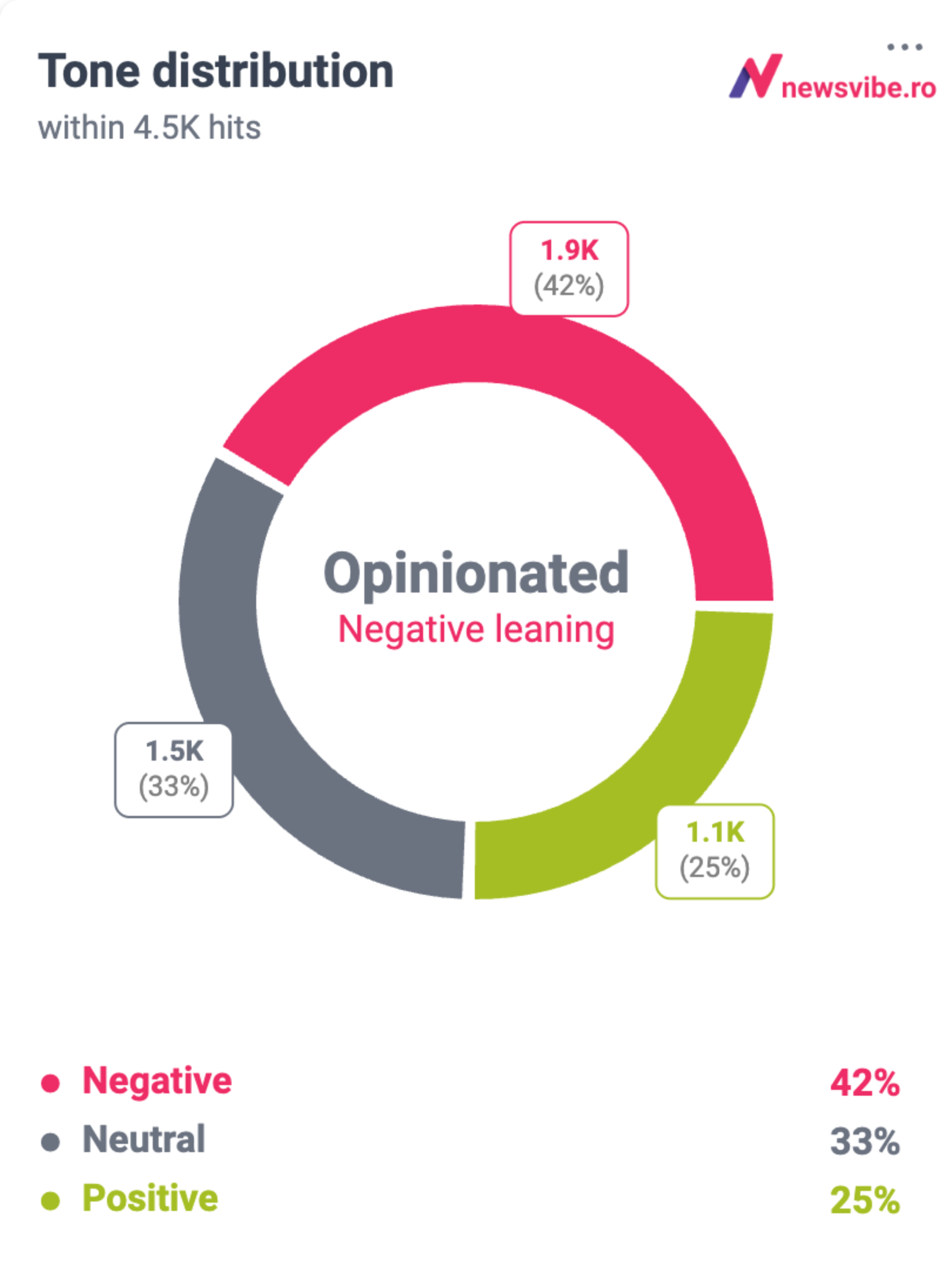
Chart: NewsVibe
****Summary prepared with the help of a data-monitoring workflow provided by the NewsVibe Romania media-monitoring platform. The analysis, data, and images presented were improved with the help of Machine Learning and Artificial Intelligence tools.
Latest News
21:16
20:43
19:59
19:28
19:07
See more news
NEWS ON THE SAME TOPICS