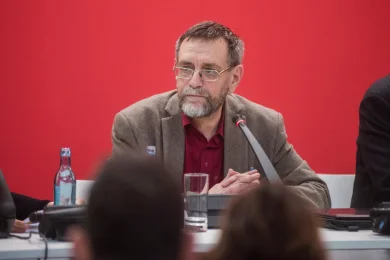
Sever Voinescu: Which kind of extremism do you prefer, right-wing or left-wing?




Always see our news on Google
At the end of the Second World War, responsibility for European thinking about Europe's future could belong only to France. Germany was crushed and dismembered, Italy was ruined and convulsed, Spain was politically isolated and poor, the north of the continent was minor both politically and economically, while France was the only victorious continental power. The Soviets were devouring their half of Europe, Great Britain continued to consider itself a global empire and saw itself as outside the continent (see Churchill's historic 1946 speech in which he spoke of the “United States of Europe”), while America had already become the global power for which Europe was merely one part of the dominated world.
Between 1948 and 1952, two Frenchmen (Robert Schuman, Foreign Minister, and Jean Monnet, head of the government structure for planning France's economic development), anti-Gaullists, thought together and planted the seed of the European Union. After the terrible experience of the two world wars, Schuman and Monnet believed that Europe's great problem was nationalism. Therefore, a future, pacified Europe had to be a Europe without nationalisms. The solution was to unite Europe's free countries, first in economic and then in political arrangements, in a federation. The success of this great process of unification through the progressive integration of public policies would initially be economic in nature and would lead to prosperity for all Europeans, while prosperity would mitigate nationalism, pull its teeth, and tame it completely. Their vision collided with that of General De Gaulle, who would become president of France in 1959. He believed that the role of nations remained decisive and cultivated the values of national patriotism. The Schuman-Monnet vision bore fruit for the first time in 1951, when the European Coal and Steel Community was established—the first community which, together with others that would be established in the following years, would form the European Union. Since the Alsace and Lorraine regions, the European steelmaking epicenter, had for decades constituted the core of the clash between French and German nationalisms, this first European community, consisting of eight countries, including France and West Germany, carried a powerful symbolic charge. The Coal and Steel Community was a success. The Gaullist vision, however, blocked the next step desired by Schuman and Monnet. The establishment of the European Defence Community, also planned by Schuman and Monnet, who wanted a single European army, failed that same year, 1951. The Gaullists found themselves in an apparently bizarre alliance with the French Communist Party on this issue and rejected the project for that community because it entailed the rearmament of Federal Germany. The nightmare was still vivid in the minds of the French.
These early histories have marked the Union's evolution to this day. Even today, the European Union lives amid the unresolved tension between the federal model (Schuman-Monnet) and the national model, the so-called “Europe of nations” (De Gaulle). We ourselves discuss the Union's future in these terms: will it be a federal Union or a Union of nation-states? The path we have embarked upon leads toward the second option. We all agree that a “Europe of nations” would at least entail stopping the integration process, if not actually reversing it to some extent, which is extremely difficult to manage. As for the future, however, we will agree with that American wag: it is no longer what it used to be. What seemed to us a natural thing to happen has become an unattainable dream, while what seems plausible or even possible to us today seemed yesterday like madness, unimaginable.
I recall this recent history to support the thesis that the European Union, even though it is now much more complicated and larger than it was at its beginnings, even though Germany has since been reunified and has become its main economic engine, even though countries such as Italy, Spain, or Poland have acquired economic and political weight similar to that of France, remains a French construction in spirit. That is why it is so secularized; that is why it is institutionally dual (the Parliament elected by all Europeans is characteristic of a federal Europe, while the European Council and the Councils of Ministers are characteristic of the “Europe of nations”); that is why it is hyper-bureaucratized and naturally tends toward centralism. Well, knowing that the EU's soul is to a considerable extent French, I view what is happening today in French politics as a kind of premonition of the Union's future developments. In short, as things stand today in France, in the presidential election in April 2027 (that is, six months from now), the second round will feature a candidate from the right, Marine Le Pen, and a candidate from the left, Jean-Luc Mélenchon. With the essential qualification that, this time, for the first time in French history since the founding of the European Union, we are talking about the far right and the far left being represented simultaneously in the presidential final.
Political right and left in our world now exist only in their extreme forms. The center-right and center-left are today abandoned electoral territories, while the formations that once represented these areas have moved toward the corresponding extremes. It is difficult to say whether the parties followed the voters or the voters followed the parties. I tend to believe that the radicalization of the right and the left began with voters, who increasingly validated, through their votes, hard, aggressive, combative, even violent positions. The transformation of politics from a manly dance into an extreme sport took place amid the cheers of the stands.
Until now, in France, we had been accustomed to having in the decisive round of presidential elections a candidate from the center, right, or left of the spectrum, and the far-right candidate. A “barrier” was always formed to block the extremist candidate's rise (in the last two elections, in 2022 and 2017, Marine Le Pen herself), and the centrist candidate gathered absolutely all the other votes scattered in the first round in order to win. Voters abandoned their ideological nuances and formed a common front so that the extremist candidate would not win. Whether they leaned more to the left or more to the right no longer mattered—shoulder to shoulder against the extreme. That is how Emmanuel Macron defeated Marine Le Pen twice. Now the question is: if you have to choose between Le Pen and Mélenchon, against whom do you form the barrier that saves the country from an extremist president? Or, more precisely, which extremist do you want to lead you, from the left or from the right? Well, I fear that this kind of question will become a general one in Western democracies in the coming years. I can clearly see what is happening across the Ocean as well: the alternative to one extreme is no longer a united center, but the other extreme. The proportion of people who are politically radicalized is growing ever larger. Today, radical options are no longer marginal. The mere fact that you have an answer to the question “Which extremist do you prefer, from the right or from the left?” is serious. This is the question that a decent person refuses to answer. And yet, as can be seen both in France and in the United States, people do have an answer to this question. I fear that here, too, they will...
https://www.dilema.ro/tilc-show/ce-fel-de-extremism-preferi-de-dreapta-sau-de-stinga
Latest News
23:50
23:45
23:32
23:25
23:05
See more news
NEWS ON THE SAME TOPICS