Andrei Cornea: Under the Shock of Violence




Always see our news on Google
It is known that, toward the end of his life, in his essay “Beyond the Pleasure Principle,” Sigmund Freud formulated the hypothesis that the human psyche might be the battleground of two drives more elementary than the “pleasure principle,” which he had considered fundamental in his earlier works: these are the “life instinct” and the “death instinct” – Eros and Thanatos. The former would tend to encourage the expansion of life and its organization into increasingly complex forms; the latter, by contrast, would seek to bring life back to earlier forms, that is, to dead matter. Here, then, is the ultimate explanation of sadism, cruelty, and apparently purposeless and irrational violence – directed both at one's fellow human beings and at animals: the pure, senseless pleasure of destroying would be the expression of the “death instinct” – Thanatos.
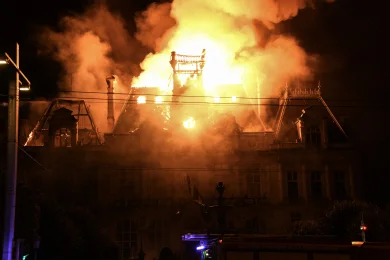
This explanation – on the borderline between mythology and psychology – came to mind as I noted the outburst of absurd and destructive violence in the cities of France two Saturdays ago. How can one credibly and comprehensively explain, by “normal” means – economic, sociological, political, demographic – the burning of town halls or schools, the destruction of shops, looting, and other acts of violence? I know: the radical left always blames unsatisfactory living conditions, the decline in living standards, exorbitant rents, the marginalization of certain social groups, etc.; the populist right denounces the excessive number of immigrants, especially from countries in Africa and Asia. They are all partly right, to a greater or lesser extent, but beyond these partial explanations and many others of this kind, I wonder whether something deeper is at work here: why burn schools when the protests broke out among students dissatisfied precisely with the number and facilities of the schools? Why vandalize or burn town halls? Mayors do not decide national economic policy. Why fight the gendarmes? You will not manage to defeat them, nor is it believable that the demands of a violent and anarchic mass will be heeded. You are more likely to trigger a backlash. Why vandalize shops whose employees have done you no harm and whose owners pay the taxes from which you receive your allowances and social benefits? Of course, you will say that the unleashed gangs were not engaging in economic reasoning but, driven by anger and resentment, were destroying everything they happened to find in their path. But that is exactly what Freud's theory says too: when freed from “civilized” restraints, we may witness the violent, furious unleashing of a mass that destroys without reasoning, solely out of the delight of destroying. It is a kind of aggression that is frightening not only because of its victims and material and economic damage but, above all, because of the useless, irrational, and disproportionate nature of the violence in relation to the modest possible gain. Well, does not this irrationality, this nonsense, amount to Thanatos?And apropos of the recent devastation in European cities: it is natural for the right and the left (especially when they move well away from the center) to have different, even opposite, answers to nearly all the sociopolitical problems I referred to above. But it is curious that sometimes their interpretations are so diametrically opposed that, paradoxically, they end up resembling each other in their less anticipated consequences. For example, Professor Valentin Naumescu, presidential adviser, maintains in an essay (“Under Assault by Revolutionary Socialism. The Impact on the EU”) that the far-left and far-right ideologies assaulting the liberal center are nothing other than “revolutionary socialism.” This would currently be “dressed up either as neo-Marxism, wokism, Occupy, radical socialist environmentalism... etc., or as neo-Nazism, supremacist movements, etc.” The distinction between Nazism and communism, for example, or between neo-Marxism and Legionaryism, would therefore be merely an appearance. I do not at all deny that there are many similarities between the extremes, as well as reciprocal influences, but it does not seem productive to me at all to ignore the differences between them, manifested over time in their values, intellectual genealogies, solutions, treatment of the economy, attitudes toward ethnicity, race, class, etc.
On the other hand, I am reading a text on Facebook by Teodora Dumitru (literary critic, researcher at the “G. Călinescu” Institute), who firmly declares that “there was no communism in Romania” (nor in the other countries of the “socialist bloc”!) But what was it that put us in chains for decades? Only “state capitalism.” (An old leftist theory, incidentally, nothing new!)
Thus, one person confidently declares that, ideologically speaking, there is only “revolutionary socialism,” and that everything we have seen in the world for more than a century is merely an avatar of one and the same current, and that to believe otherwise is to succumb to an epistemic illusion. Someone else, with at least as much aplomb, wants to teach us “as if we were toddlers” that socialism (“revolutionary” or otherwise) neither exists nor has ever existed, either here or in general. Another epistemic illusion! One says: there are only disguises of capitalism. The other says: no, the disguises belong to socialism! In either case, distinctions and specificities disappear or become insignificant – which, beyond the debatable seriousness of the detailed analysis, seems to me methodologically flawed through and through.
Forgive me, but it is as if someone were to claim that all dogs are “disguised” cats, while someone else insisted that, in fact and in reality, cats are merely dogs in feline camouflage! Would it not nevertheless be simpler to repeat the old platitude that, because cats and dogs are two different species (united, of course, under the common genus of carnivores), neither is barking undercover meowing, nor vice versa?
Latest News
20:12
20:10
20:03
19:56
19:44
See more news
NEWS ON THE SAME TOPICS