Informat.ro Summary / Why Europe Is Protesting: from schools without teachers and unaffordable rents to looted shops and a city hall set on fire



Always see our news on Google
From France, where demonstrations were marked by looted shops and the torching of Limoges town hall, to Spain and Portugal, where protesters pitched tents in squares to demand affordable housing, social discontent has brought people onto the streets in several European countries. The protests have different triggers, but their demands converge around the same pressure: rising prices, insufficient incomes and the deterioration of public services. Violence in some cities has placed authorities before a dual challenge: responding to social demands while restoring order without confusing peaceful demonstrators with those responsible for the destruction.
Images that “broke the hearts” of the French
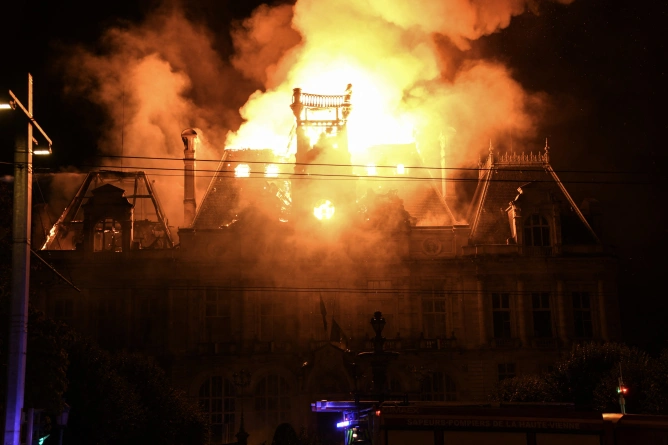
In Limoges, people watched as flames engulfed the roof of the town hall, then as the clock tower collapsed. The Neo-Renaissance building, inaugurated in 1883 and a survivor of two world wars, was devastated on Saturday evening. “My heart broke. I relived the Notre-Dame moment, except this time it was our town,” Françoise Faurie, a witness to the fire, told Reuters. On Sunday, residents gathered in front of the ruins while specialists assessed the damage.
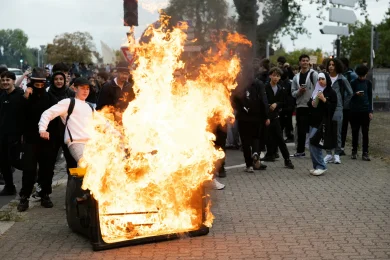
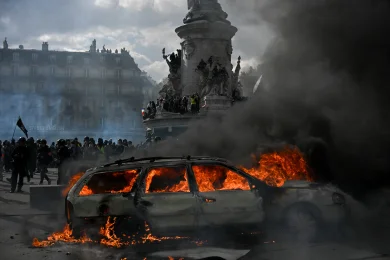
In Paris, at Place de la République, police again used tear gas on Sunday, while bicycles were set on fire. In Bordeaux, the mayor announced that up to 100 shops had been looted. In other cities, supermarkets and luxury stores were ransacked, buildings were covered in graffiti, and police vehicles became targets. From Lille to Marseille, the weekend ended with clean-up operations and damage assessments.
These were the most violent images of a weekend in which more than half a million people took to the streets in France. They do not, however, represent the entire mobilization: hundreds of thousands demonstrated peacefully. Behind the confrontations are demands concerning schools, incomes and public services. In other European countries, protesters are calling for affordable housing and protection against evictions. The common denominator is economic insecurity.
From shortcomings in schools to looted shops
To understand how things reached this point, one must look beyond the images of fires. The French mobilization began at the end of September, in high schools in disadvantaged suburbs of Paris. Students complained about absent teachers and a lack of substitute teachers, deteriorating buildings and difficulties related to access to university. Staff shortages meant missed classes and the feeling that students from certain neighborhoods were starting with a disadvantage that schools should be reducing.
Gradually, the discontent moved beyond the gates of the high schools. Students were joined by trade unionists and people affected by rising prices. The General Confederation of Labour (CGT), which brings together unions from different sectors, backed the demonstrations, calling for lower prices and higher wages and pensions. The protest over school conditions thus converged with broader discontent over inequality, cuts in public spending and the deterioration of state-provided services.
The link between these demands explains the scale of the mobilization. For a family, an absent teacher, a higher bill and insufficient income are not separate problems but pressures that accumulate. In France, this accumulation transformed a movement that began in education into a much broader social demonstration. The violence, however, shifted the focus: from protesters’ demands to the authorities’ ability to protect people, shops and institutions.
In Limoges, the destruction of a building became a local trauma
The fire at Limoges town hall encapsulates this rupture. According to Mayor Guillaume Guérin, several hundred people overwhelmed local police, smashed windows and forced their way through the main entrance. The mayor spoke of organization and premeditation and complained about the absence of national police officers to protect the institution’s headquarters.
The roof collapsed onto the lower levels, and the prefect described the destruction as a “heritage catastrophe.” For residents interviewed by Reuters, it was not merely an administrative building but part of the city’s identity. One of the women present expressed the distinction running through the entire crisis: people have the right to protest and make demands, but not to resort to violence.
Spain and Portugal: Tents in squares tell the story of the housing crisis
In Spain, the starting point was different: the eviction of an 87-year-old woman. María del Carmen Abascal was removed from her home after the investment firm that had bought the apartment demanded a 230% rent increase. The woman later died after being hospitalized. The case became a symbol of a crisis that is forcing people to ask not only how much they will pay next month, but whether they will still be able to remain in their own neighborhood.
A protest camp appeared in central Madrid. The demands call for lower rents, an end to evictions and a ban on investment funds purchasing homes. Prime Minister Pedro Sánchez proposed emergency measures to improve access to housing, and after they were rejected in parliament, he announced snap elections for November 29.
In Portugal, camping tents installed by protesters in public spaces first appeared in Porto and then in Lisbon’s Rossio Square. The central message is similar: housing is becoming unaffordable for some of the people who work and live in these cities. Housing prices rose by 124% between 2015 and 2024, approximately twice as fast as the EU average, according to official data cited by The Guardian. The protests also include demands concerning wages, pensions and public services.
Milan: Social demands, then burning barricades
In Milan, the demonstration against rising prices began peacefully but was followed by clashes. Masked individuals threw stones and set barricades on fire; police intervened with tear gas and water cannon. Approximately 50 people were detained, according to LaPresse, cited by The Guardian.
The authorities’ reactions reveal the dispute over the meaning of these events. Prime Minister Giorgia Meloni accused “hooligans” of exploiting the demonstration. Mayor Giuseppe Sala said the reasons for the protest were understandable, but that violence could not be justified. The distinction is important: the existence of legitimate demands does not absolve those responsible for the destruction, while the destruction alone does not explain why the others took to the streets.
Why these grievances converge
Although not all the protests have the same origin, certain problems recur: expensive housing, insufficient incomes and a lack of trust in the authorities’ ability to improve daily life. A specific case—an absent teacher or an evicted pensioner—can turn an individual difficulty into a collective symbol.
The forms of mobilization also recur: occupying squares, setting up tents and broadening demands beyond the initial grievance. Rather than describing a revolt that began in one country and was “exported” to others, it is more accurate to speak of national crises reaching the streets simultaneously.
How the French authorities responded
Before the weekend, the French government had announced 3,000 additional substitute teachers, student participation in school decisions and the abandonment of increases in certain university enrollment fees. The concessions did not halt the movement’s expansion.
After the violence, the response focused on restoring order and supporting those affected. The Economy Minister promised assistance for shopkeepers, while Marseille announced emergency financial aid. Carrefour said that 50 of its stores had been affected, including 20 that were looted. These losses also show the immediate consequence of the violence: the social crisis creates additional losses for employees and businesses.
Are the arsonists far-left? What we know and what we do not
Macron accused radical left-wing groups, allegedly joined by criminals. Interior Minister Laurent Nuñez offered a similar explanation: the initial destruction was reportedly carried out by people from the far-left milieu, followed by opportunistic looting. This is the official attribution of responsibility, not a demonstrated political identity for every violent individual.
The sources consulted do not provide individual case files or judicial evidence establishing the political affiliation of all those responsible for the fires and looting. Investigations to identify them are ongoing. In Limoges, the Reuters account documents an attack by masked individuals and the mayor’s statements regarding premeditation, but does not establish the arsonists’ political affiliation. Organizing an attack may indicate preparation; it does not, by itself, prove the perpetrators’ ideology.
The weekend’s images must therefore be read together, not used in place of one another: the tents of those demanding housing, the marches of those calling for better public services, the ransacked shops and the burned town hall. They describe the same crisis, but involve different people, actions and responsibilities.
Russia uses the protests in propaganda messages
The protests were exploited for propaganda purposes by figures close to the Kremlin, who presented the violence as a sign of Europe’s decline and the failure of its policies.
Le Monde reports that figures close to the Kremlin presented the violence as proof of Europe’s “decadence” and an alleged “migratory chaos.” Kirill Dmitriev also linked the tensions to European energy policy and sanctions against Russia, claiming that these deprive Europeans of cheap Russian gas. These interventions show how events are used to promote messages favorable to Moscow.
Separately, French Foreign Minister Jean-Noël Barrot had denounced on October 13 the exploitation of student demonstrations through “hostile narratives” originating from Russia, China, Iran and the MAGA community. His accusation concerned interference in the information space.
Latest News
10:25
10:24
10:21
09:59
09:51
See more news
NEWS ON THE SAME TOPICS