After the violence in France, the Commission calls on platforms to limit the amplification of incitement to violence



Always see our news on Google
The European Commission announced new discussions with the French authority Arcom regarding the risks associated with online platforms and their algorithms, following the violence in France. At the briefing on 19 October, Thomas Regnier did not confirm the detection of any foreign manipulation operations and did not announce a formal investigation related to the protests. The Commission also stressed the need to protect peaceful protests.
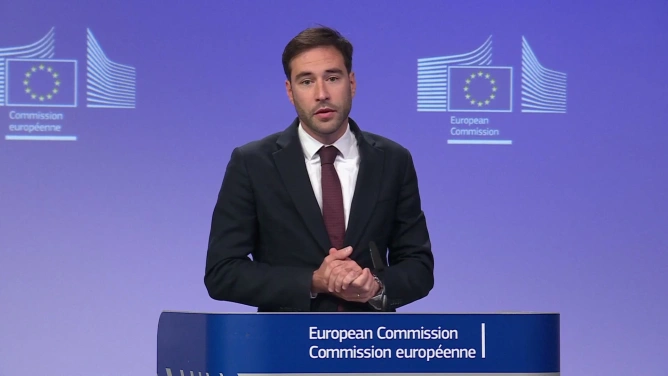
The European Commission called on online platforms to limit the risk that their algorithms and services could amplify incitement to violence, amid the unrest in France. At Monday’s press briefing, 19 October 2026, Thomas Regnier, the Commission spokesperson for technological sovereignty and disinformation, announced close contacts with the French authority Arcom and a new meeting with the French authorities on the same day. Asked about possible foreign information-manipulation operations, he did not confirm that any had been detected.
In brief
The European Commission recalled that online platforms must manage the risks of amplifying violence and apply their rules against incitement to violent acts.
Brussels is cooperating with Arcom, the French coordinator for digital services, and announced a new meeting with the French authorities for 19 October.
At the briefing on 19 October, Thomas Regnier did not confirm the detection of any foreign manipulation operations linked to the protests and did not announce a formal investigation into the matter.
The DSA requires very large online platforms and very large online search engines to assess and mitigate systemic risks. Hosting providers must report suspicions of criminal offences that threaten people’s lives or safety.
The Commission condemned arson, looting and attacks on people or public buildings, stressing that peaceful demonstrators must be distinguished from the perpetrators of violence.
Thomas Regnier called on platforms to prevent the misuse of their services and algorithms to amplify violence and incitement to violence. He was responding to a question about possible information manipulation during the unrest in France and other European states. The spokesperson highlighted three lines of action provided for by the DSA, depending on the services and obligations concerned, ranging from risk management to applying their own terms of use and cooperating with national law-enforcement authorities.
Regnier stressed that platforms must diligently apply their own rules against incitement to violence. Article 14(4) of the DSA requires providers of intermediary services to apply the restrictions in their terms of use diligently, objectively and proportionately, taking into account the rights and legitimate interests of users. Content moderation is distinct from establishing criminal liability, which falls to the competent authorities under applicable law.
The Digital Services Act, known by the acronym DSA, provides for additional obligations for very large online platforms and very large online search engines. Articles 34 and 35 require them to assess and mitigate systemic risks arising from the operation of their services, including negative effects on public safety, civic discourse and the exercise of fundamental rights. The assessment must also take into account how recommender systems, advertising and other functionalities may influence these risks.
Mitigation measures may include adjusting algorithmic recommendations, moderation or terms of use. Article 35 requires reasonable, proportionate and effective measures adapted to the risks identified, with particular attention to effects on fundamental rights. These provisions do not amount to a general ban on mobilising for peaceful demonstrations and do not automatically turn controversial political content into unlawful incitement to violence.
Cooperation with the authorities takes several forms. Articles 9 and 10 of the DSA establish requirements for orders from competent judicial or administrative authorities concerning illegal content or information about certain users, as well as obligations to provide information on the effect given to those orders. Separately, Article 18 requires hosting providers, including online platforms, to promptly report to the law-enforcement or judicial authorities of the Member States concerned and transmit the relevant available information when they become aware of information giving rise to a suspicion of a criminal offence that threatens people’s lives or safety and has been committed, is being committed or is likely to be committed.
The obligation under Article 18 does not concern every controversial piece of content or every possible breach of the law. The European Board for Digital Services adopted good practices for its application, presented by the Commission on a page published on 25 September 2026. These explain the assessment of information, the identification of the Member States concerned and the transmission of reports to the authorities.
Arcom is the French coordinator for digital services. Under Article 56 of the DSA, the Commission has exclusive competence for the additional obligations in Chapter III, Section 5, including those concerning the systemic risks of very large platforms and search engines. For the other obligations, the allocation of competences depends in particular on the Member State in which the provider has its main establishment and on whether the Commission opens proceedings. Arcom explains that it may forward complaints concerning providers established there to the coordinator in another Member State. Cooperation in the French case does not alter this legal allocation.
Regnier confirmed the existence of close contacts between the Commission and Arcom and announced a new meeting with the French authorities during the day on 19 October. He explained that, in the current situation, the French authorities have the leading role in managing matters within national competence, while the Commission is ready to provide support in areas falling within its remit.
Asked whether discussions with Arcom had already identified information manipulation, Regnier responded by describing the competences and cooperation between the authorities. At this briefing, he did not confirm the detection of a foreign campaign, did not identify a platform that had breached the DSA and did not announce the opening of a formal investigation related to the protests. The absence of confirmation in the response does not prove the absence of such activities.
The Commission’s position also concerned the fundamental rights of people participating in demonstrations. Markus Lammert, spokesperson for home affairs, democracy, justice and the rule of law, stated that the right to peaceful protest is fundamental in a democratic society and must be protected. He said that demonstrators expressing their demands without violence must not be confused with people involved in arson, looting or attacks against people and public buildings.
The Commission expressed support for the efforts of the French authorities to protect people, property and public institutions, with full respect for fundamental rights. Lammert stated that maintaining public order and investigating crimes are national competences and that investigations are being conducted in France. He did not issue an assessment of the legality of each police intervention and did not answer affirmatively when asked whether the right to demonstrate had been violated.
In the same exchange, the Commission was asked about political statements associating the protests with migration. Lammert avoided commenting on the positions of other leaders and presented the general principles concerning the protection of peaceful demonstrations and the condemnation of violence. His answer does not confirm a link between migration and the unrest in France.
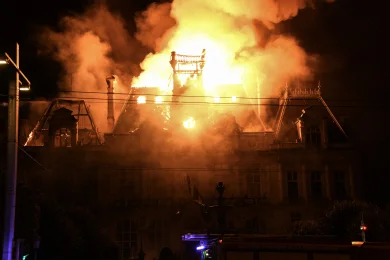
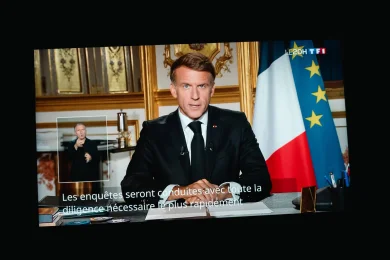
The social context was described by Emmanuel Macron in his speech on the evening of 18 October, following the demonstrations the previous day. The French President referred to grievances concerning the cost of living and fuel prices, as well as young people’s concerns about living and studying conditions. He reported attacks on public buildings and shops, arson and looting in several cities.
Macron condemned the violence, called for judicial measures against the perpetrators of the crimes and asked the government to draw the necessary conclusions regarding intelligence and anticipation in order to prevent the situation from recurring. At the same time, he insisted on the distinction between those responsible for the destruction and demonstrators who had expressed legitimate social demands.
The French President announced that the Prime Minister would hold consultations with pupils, students, teachers, trade unions, employers, local authorities and parliamentarians to identify solutions to the grievances that had fuelled the mobilisation. His message associated public-order measures with the need for a political and social response.
Latest News
08:10
07:59
07:52
07:42
07:33
See more news
NEWS ON THE SAME TOPICS


.webp)