SPECIAL Informat.ro / Romania, in the European press: Ranking of the topics from the past two weeks in the European press, about Romanians and Romania


Always see our news on Google
Romania and Romanians remain present on the agenda of the European press, but the data from September 5–18 paint a more diverse picture than the one previously dominated by security dossiers. The analysis based on NewsVibe data for the period under review indicates 4,054 items and shows that attention to Romania is now focused primarily on the judicial case of brothers Andrew and Tristan Tate, which places Romania at the center of an investigation with international resonance, but also on the country’s economic image, oscillating between high inflation and income growth, on bilateral relations with Greece, on the diaspora in Spain, Italy, and the United Kingdom, as well as on Romanian presence in sports and the automotive industry.
The Tate Brothers: The Topic with the Greatest Exposure
The most visible explicit references to Romania appeared in the judicial cases involving brothers Andrew and Tristan Tate. The BBC reported on British prosecutors submitting documents for the extradition of the two from the United States to the United Kingdom, while Romania appears in the legal background of the case through the investigations and accusations previously brought by Romanian prosecutors.
The BBC, The Guardian, and Deutsche Welle (DW) also published pieces about Andrew Tate being charged in Romania with accusations including child trafficking, human trafficking, and money laundering. In its article, The Guardian placed the information within the European news flow, while Deutsche Welle (DW) treated it directly as a decision by the Romanian justice system.
The tone is clearly negative, as the subject is linked to serious crimes and criminal proceedings. However, the press’s wording is generally factual and attributes the accusations to prosecutors or courts, without extending responsibility from the individuals under investigation to Romania as a state.
From a geopolitical perspective, the case does not represent a classic foreign-policy topic, but it affects Romania’s institutional image. The country appears as a relevant jurisdiction in a globalized, media-covered case followed by British and international publications, but its visibility comes from the area of criminal justice, not from diplomatic initiative or public policy.
Romania’s Economy: Between Inflation and Income Recovery
The Bulgarian publication Novinite mentioned Romania in an analysis of annual inflation in the European Union. The publication indicated a rate of 6.3% for Romania, the highest among the EU states presented in the comparison, ahead of Lithuania and Cyprus.
Novinite uses Romania as a benchmark in an article about the evolution of inflation in Bulgaria. The language is statistical and neutral, based on Eurostat data, but the association with the top of the European ranking produces an unfavorable image effect: Romania becomes an example of persistent price pressures.
In contrast, capital.gr and other Greek publications in the feed picked up Eurostat data on the evolution of median disposable income and identified Romania as the country with the strongest growth during the period compared: 160.2%. The reference appears in an analysis of Greece’s situation and places Romania in a favorable economic context, as an example of income recovery.
Romania and Greece: Cooperation in Bucharest
The publication Proto Thema reported on the meeting in Bucharest between Greek Economy Minister Kyriakos Pierrakakis and the President of Romania. The publication explicitly introduced Romania within a bilateral framework linked to political dialogue and economic cooperation.
The tone of the article is positive and institutional. Unlike the economic articles in which Romania appears only as a term of statistical comparison, here Bucharest is the venue for an official meeting, and Romanian-Greek relations are addressed through direct contact between political representatives.
The geopolitical relevance of the subject is greater than that of a sports mention or a human-interest item, although the feed does not indicate the existence of a major decision or a new agreement. The Proto Thema article nevertheless shows that Romania also appears in the Greek press as a partner for economic and institutional discussion, not merely as a benchmark for European indicators.
The Diaspora in Spain, Italy, and the United Kingdom
The Spanish publication EL PAÍS reported that Colombian workers had overtaken Romanians as the second-largest group of foreign citizens in Spain’s labor market. The article uses the Romanian community as a demographic and economic benchmark, confirming its importance within the structure of Spain’s foreign workforce.
EL PAÍS’s tone is neutral, based on labor and migration data. Romanians are presented as an established and numerically significant community whose position in the ranking has been surpassed by the more recent dynamics of immigration from Colombia.
In Italy, the publication Alto Adige reported that two Romanians were under investigation in San Candido for alleged fraud after they reportedly asked passersby and tourists for money in the name of a purported charitable campaign. The publication mentions documents and forms seized by police for verification, maintaining the legal wording of an ongoing investigation. The tone is negative due to the nature of the suspicions.
In the United Kingdom, the Daily Mail reported that several construction companies had received fines totaling £1.1 million following the death of a Romanian worker who was buried in a trench that collapsed. Beyond the tragic individual case, the subject highlights the vulnerability of migrant workers and employers’ responsibility in enforcing workplace safety regulations.
Also in the British media space, the BBC reported on the deportation of a Romanian driver convicted following the death of British triathlete Rebecca Comins. It is one of the most negative references to a Romanian citizen in the report, but the account treats the act and the judicial decision as an individual situation, not as a characteristic of the Romanian community.
Sports: Positive Visibility
The publication MARCA published statements by Cristian Chivu about José Mourinho in an article with a positive tone toward the Portuguese coach and toward a former Romanian international with a high profile in European football. MARCA also reported on the introduction of the “black card” in youth football in Romania. The article presents the initiative as a zero-tolerance tool against abusive behavior and violence in children’s football, and the tone is favorable: Romania is presented as a setting for a sports-governance and youth-protection measure.
EL PAÍS mentioned Romanian international Andrei Rațiu in its report on a match won by Rayo Vallecano. The tone is positive and strictly sports-related, and the Romanian player is naturally integrated into coverage of the Spanish championship.
Dacia: Romania in the Automotive Industry
MARCA published an article about the Dacia Spring and the upcoming generation of the electric model. The article emphasizes the model’s transformation, its price positioning, and its ambition to compete more credibly in the European market for affordable electric cars.
Although the article focuses on the product and the automotive market, Dacia provides a relevant reference to Romania through its association with the European automotive industry. The tone is positive, and Romania is indirectly linked to a brand recognized in foreign markets and to the topic of affordable electric mobility.
General Tone in the European Press:
Of the nearly 4,100 articles, 37% have a neutral tone, 33% have a negative tone, and 30% have a positive tone.
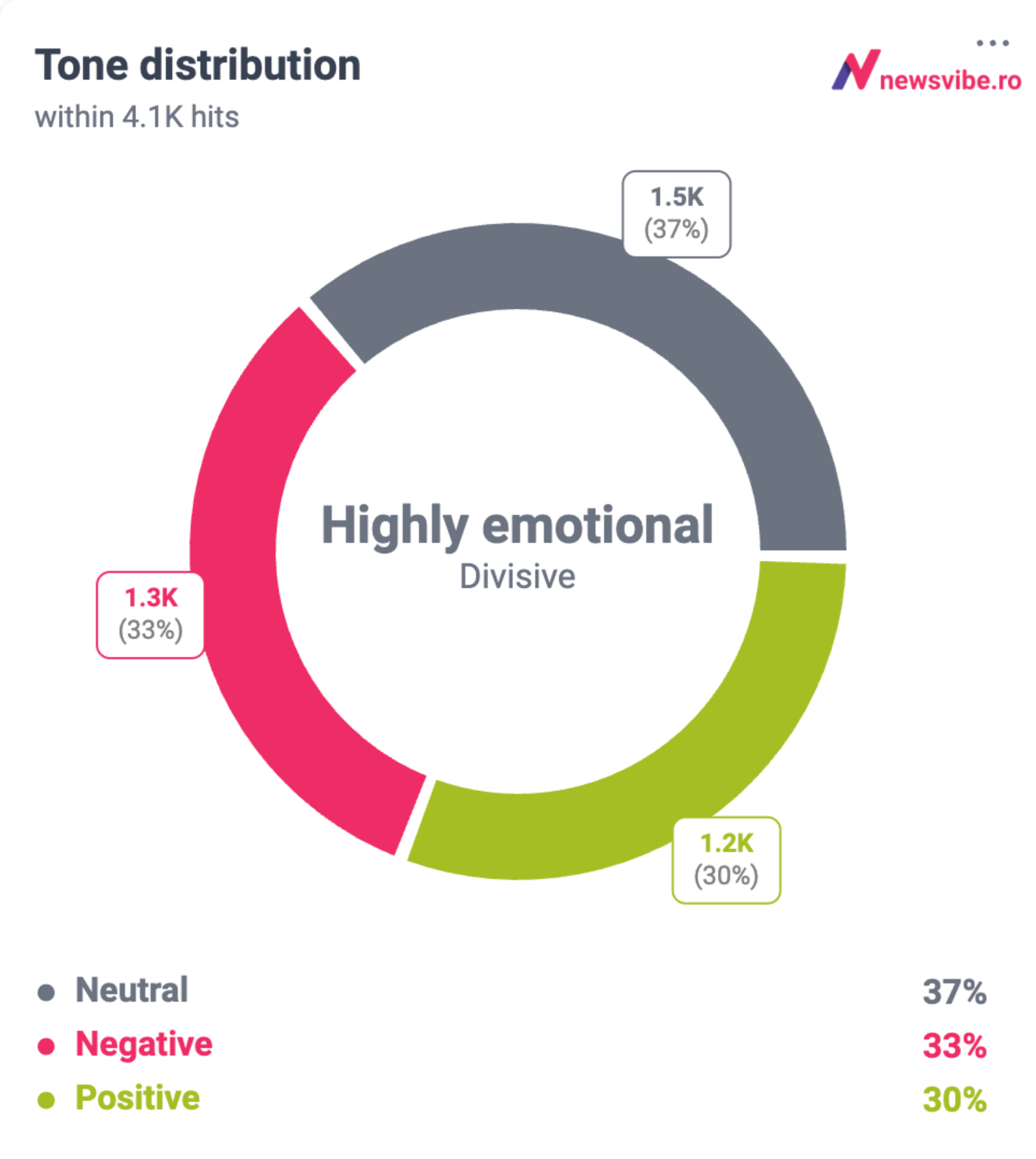 Chart: NewsVibe
****Summary prepared with the help of a data-monitoring feed provided by the NewsVibe Romania media-monitoring platform. The analysis, data, and images presented were enhanced with the help of Machine Learning and Artificial Intelligence tools.
Latest News
15:52
15:48
15:48
15:43
15:33
See more news
NEWS ON THE SAME TOPICS


.webp)









.webp)