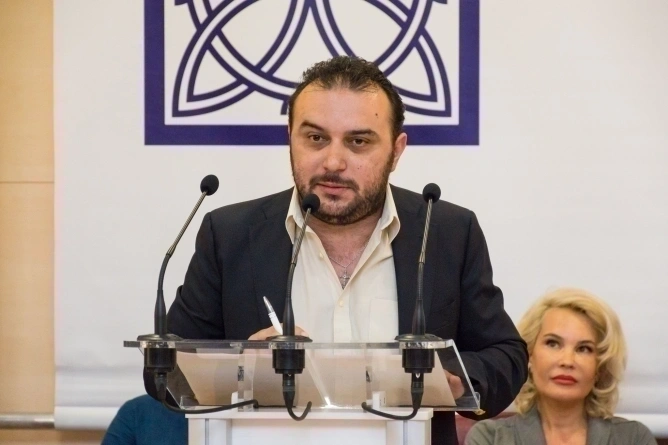
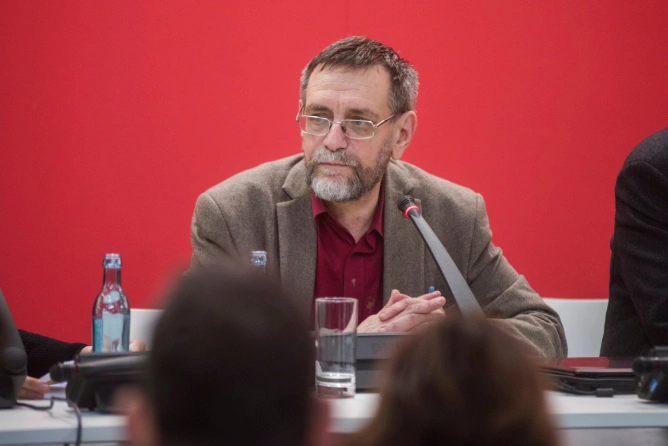
Andrei Cornea: Politics, Ethics and Fanaticism



Always see our news on Google
Now, after it has become evident that Nicușor Dan is not “one of us,” many are eager to explain to us how foolish we were, those of us who had high expectations of him. Perhaps we were, I’m not saying we weren’t, but neither is “showing that you’re smarter” after the fact particularly advisable.
Some acknowledge that Nicușor Dan appears hostile to the major concerns of civil society – the Judiciary, control over the Intelligence Services, pro-European policy, right-wing extremism, authoritarianism, etc. They also admit that the president is intolerant and obstinate, that he is already abusing his authority, and seems unable to tolerate contradiction. We should have realized the man’s flaws in time, they say. We would have been even more wrong. Some, such as Vasile Ernu recently, regard us as fanatics in search of an impossible Messiah and therefore easy to disappoint. The blame would thus always lie with us, the voters, not with the person in question. He says that in 2025 we gave N.D. not a vote, but “an anointing.” That at the time, excessively and quasi-religiously, “a candidate became a moral promise.” (He also gets confused, when recalling the slogan, with the indeed ethically false “Mathematics, not garlic,” which had actually been used in the 2020 campaign for Bucharest City Hall.) He also says that the tone, which was excessive then, is excessive now as well: “Back then he was the Messiah, now he is the Traitor... There is only the icon: ‘first gilded, then spat upon.’”
False. Few people looked at Nicușor Dan as one looks at an “icon” or a “savior” in the religious sense. Most viewed him as the least implausible solution at that moment, which was indeed delicate: a candidate who, after the annulment of the presidential election in 2024, could face the apparently irresistible rise of sovereigntism and extremism embodied by George Simion. Thus, the designation of the former general mayor was rational and, moreover, accompanied by quite a few hesitations, but I admit that at the time it was difficult to find a candidate who was both highly recognizable, possessed some political experience, and was as little compromised as possible by previous politics.
As for the “moral promise” that N.D. supposedly embodied, Mr. Ernu seems not to understand that every candidate for the presidency of Romania expresses, or must explicitly or implicitly express, a moral promise. The president’s role is not to set the VAT rate, nor even to keep the country in the good graces of international rating agencies (as Nicușor Dan wants), but primarily to give the country’s major policies an ethical dimension as well – a dimension that, in our case, was concentrated in the formula “an honest Romania.” Yes, an “honest Romania” would be one where Mr. Pahonțu would be immediately dismissed (it is hardly “revenge” to retire after twenty years), where Ms. Cristina Chiriac would not have been appointed prosecutor general, where Mr. Veștea would not have been designated prime minister, where Ilie Bolojan would have been supported rather than opposed, and where there would already have been a solid report on the annulment of the election. Hoping for the “chance” of an “honest Romania” was therefore not at all a “salvationist” appeal in the religious sense, but an entirely natural ethical and rational demand. An “honest Romania” (especially at the level of the state apparatus, so protected by the president, and that of the political class) would not be a perfect Romania, nor one “bright as the sun in the sky.” It is a legitimate aspiration to normality. To being treated fairly and with dignity. To not being robbed, lied to, despised, or misinformed. I do not know how Vasile Ernu fails to understand that you do not demand “honesty” from an “icon.” (The fact that some people expressed themselves more bombastically in posts during the election campaign has nothing to do with what I am saying.)
Of course, there is a widespread opinion that Nicușor Dan disappointed expectations. In this sense, it may be considered that he “betrayed” the trust of those who supported and voted for him. Opinion polls, which Mr. Ernu also cites, show this. Hence the frustrations, recriminations, and harsh words. But was the “derailment” predictable? Those who “know” better, no matter what happens and at all times, claim that it was. We can no longer verify this to know whether they are right or not. Others (Adrian Papahagi, for example) say that, in any case, by blocking George Simion’s path to power, the current president fulfilled his task, or most of it. We should, they say, be content with this minimum for now and be grateful to him. Well, we are not content.
One thing is being unable to fulfill certain electoral promises for various objective reasons (which happens with just about all politicians), or even because of one’s own weakness or incompetence, or a miscalculation, and quite another is to deliberately and openly work against many of the hopes and expectations of those who placed their trust in you. The president not only refuses to propose a moral direction in politics, but plunges politics into ethical drift. This drift can only be explained by what seems to me to be Nicușor Dan’s conviction that he is personally “anointed” and “has a mission,” for which, in essence, he is accountable to no one, least of all to the press or public opinion, since, supposedly, History will show that he was right.
Thus, it was not we, the voters, who treated him like an “icon” – whether gilded or spat upon – the former civic activist; rather, he himself increasingly seems to behave as though his mandate had not merely apparently come from the voters, when in fact it is a secret anointing.
https://www.dilema.ro/situatiunea/politica-etica-si-fanatism
Latest News
15:58
15:57
15:57
15:57
15:52
See more news
NEWS ON THE SAME TOPICS
.webp)