EXCLUSIVE Ranking of domestic politics topics trending over the past week


Always see our news on Google
Over the past week, the public agenda was dominated by the political crisis generated by the rejection of the Mureșan Government and by the scandal triggered by the Wall Street Journal revelations regarding the alleged influence of the US on politics in Romania. An assessment conducted through the NewsVibe platform, which integrates artificial intelligence technologies to analyze content from the mass media and social networks, indicated the publication of 50,860 items about domestic politics during this period, on web sources and on Facebook, YouTube, and TikTok accounts relevant to Romania. The processed data revealed ten entities that benefited from an intensified presence in the digital environment, analyzing both the factors underlying this growth and the contribution of online channels to the dissemination and consolidation of the messages. The ranking of trending topics is based on new trends that emerged over the past week.
Top 10 trending entities in the context of domestic politics
1.Kimberly Guilfoyle
2.Wall Street Journal
3.National Council of Students
4.guvernanta.gov.ro
5.Association of Italians in Romania
6.Vertical Corridor
7.Petr Pavel
8.Ioana Grosaru
9.Radu Marinescu
10.Stavros Papastavrou
Political topics on the rise
The scandal over allegations regarding US influence on Romania’s energy and domestic policy: Revelations in the Wall Street Journal (WSJ) about statements by US Ambassador to Greece, Kimberly Guilfoyle, concerning alleged American pressure on Romania to purchase gas from the US and involvement in the dismissal of the Bolojan Government generated a wave of reactions. According to the WSJ, at a dinner in Athens in March, Guilfoyle allegedly told Greek Minister of Environment and Energy Stavros Papastavrou, in the context of the Bolojan government crisis: “We can do this to any country we want. We can do it here too.” Papastavrou allegedly replied that the Greek government had been elected by the Greeks and could not be changed by anyone else, while the Hellenic Government later denied that it had been threatened. Former Energy Ministers Bogdan Ivan (PSD) and Sebastian Burduja (PNL) denied the existence of any pressure. The US Ambassador in Bucharest, Darryl Nirenberg, reiterated the United States’ confidence in Romanian democracy, while the Ministry of Foreign Affairs stated that the ambassador’s visit was related to a private-sector business event. Sorin Grindeanu said that discussions with the US ambassador about the Vertical Corridor gas corridor concerned Romania’s strategic role, not contract negotiations.
Student protests against mandatory uniforms: The National Council of Students organized a nationwide protest, urging students to wear black clothes in schools as a sign of opposition to the reintroduction of mandatory uniforms. The main argument is that uniforms do not solve the education system’s fundamental problems, such as bullying. Kelemen Hunor (UDMR) supported the students’ position, considering the measure pointless.
Transparency of income and political affiliations in state-owned companies and the data security breach: The guvernanta.gov.ro platform was launched by the Government to publish the income and political affiliation of the heads of 121 state-owned companies, highlighting affiliations with parties such as PSD, PNL, USR, and UDMR. The publication revealed substantial salaries and the holding of multiple positions by some officials, including retirees. Just one day after its launch, the platform experienced a security breach involving the publication of sensitive personal data, prompting the Government to order additional checks.
Challenge to the appointment of Siegfried Mureșan as prime minister: Ioana Grosaru, a member of parliament from the Association of Italians in Romania (RO.AS.IT), challenged Decree No. 770/2026 in court, through which President Nicușor Dan designated Siegfried Mureșan as a candidate for the position of prime minister. The association initially requested that the decree be annulled, then amended its action and requested its suspension. On Tuesday, September 29, the Bucharest Court of Appeal rejected the request for suspension as inadmissible. Ultimately, the Mureșan Government failed to secure a vote of confidence. In the vote held on September 30 in a joint plenary session of Parliament, it received 182 votes “for” and 15 “against,” although it needed at least 233. PSD and AUR, which together hold 218 seats, did not support the Cabinet.
Political crisis and the president’s visit to the Czech Republic: Against the backdrop of the rejection of the Mureșan Government in Parliament, President Nicușor Dan paid an official visit to the Czech Republic, where he was received by President Petr Pavel. From Prague, Nicușor Dan made statements regarding Romania’s political crisis, emphasizing the need for the parties to reach an agreement to end this period of instability, and rejected the idea of snap elections as a solution.
Controversies related to the judicial system: Former Minister of Justice, Radu Marinescu (PSD), criticized the Mureșan Cabinet’s governing program on justice, considering it an attempt to weaken the independence of the judicial system.
Top 15 online sources on domestic political topics over the past week
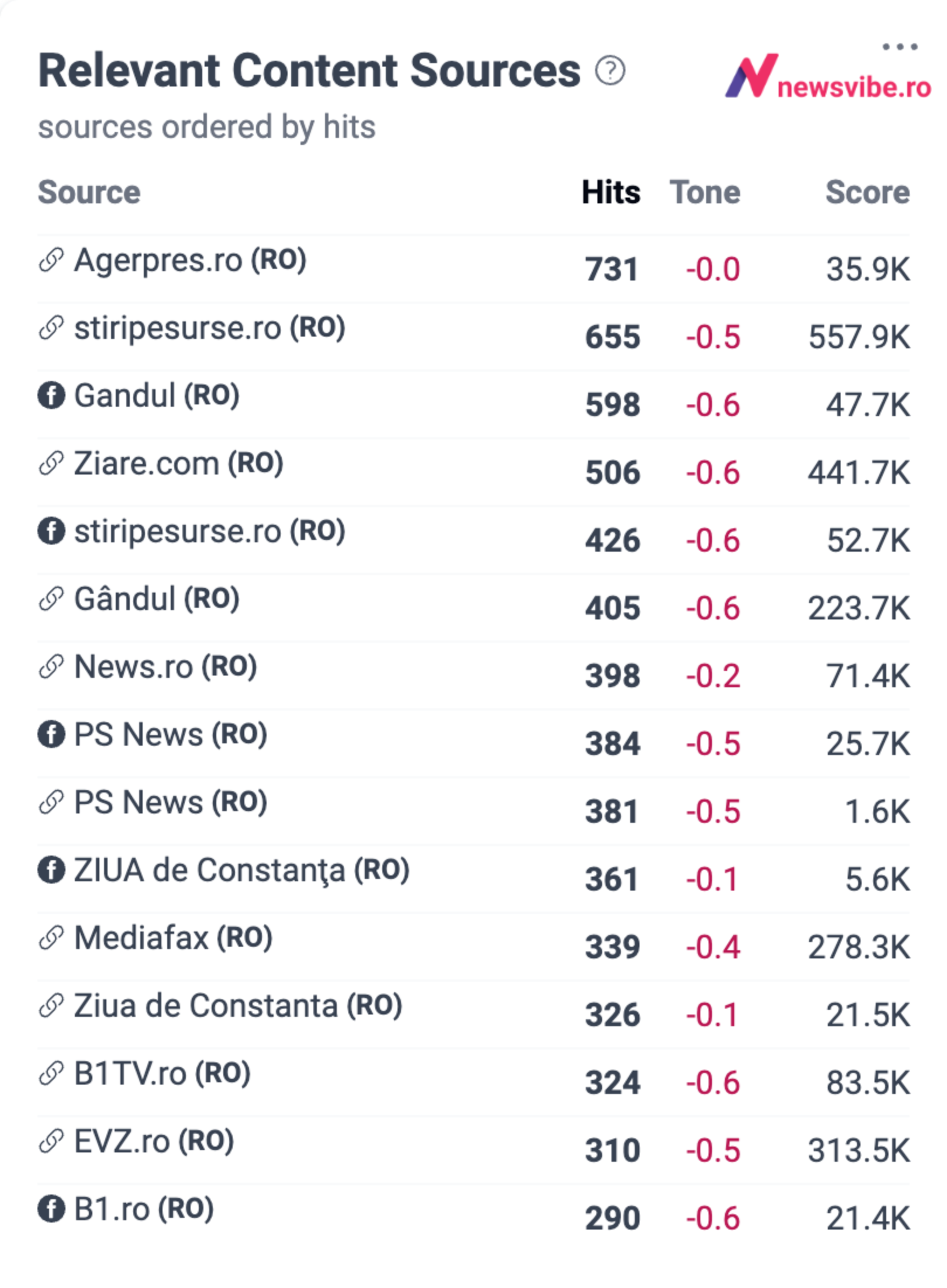
NewsVibe chart. Ranking of the relevant web and social media sources that published the most articles and posts on domestic political topics over the past week
*****Summary prepared with the help of a data monitoring feed provided by the NewsVibe Romania media monitoring platform. The analysis, data, and images presented were enhanced with the help of Machine Learning and Artificial Intelligence tools.
Latest News
11:30
11:15
11:04
10:57
10:46
See more news
NEWS ON THE SAME TOPICS