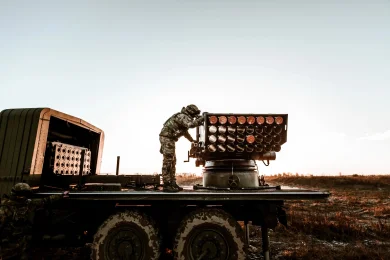
The European Commission proposes five joint defense projects for drones, air shield, space, sea, and the eastern flank.



Always see our news on Google
The European Commission proposes five European projects of common interest in the field of defense, through which member states can develop military capabilities that are difficult to achieve individually. The projects focus on drones and anti-drone systems, maritime and seabed defense, space, air defense and missile defense, as well as the security of the EU's eastern flank. On average, 18 member states participate in each project, and Ukraine participates in four of the five.
The European Commission proposes five common defense projects through which member states can jointly develop drones, anti-drone systems, maritime and seabed defense, space capabilities, air defense and missile defense, and security measures for the eastern flank of the European Union. The projects are called European Defence Projects of Common Interest, EDPCI, and are designed for industrial military initiatives that are too large or too complex to be developed by a single state.
In short
1. The European Commission proposes five common European defense projects.
2. The targeted areas are drones, maritime defense, space, air defense and missile defense, and the eastern flank.
3. On average, 18 member states participate in each project.
4. Ukraine participates in four of the five projects.
5. The Commission states that the total funding ambition is approximately 190 billion euros by 2036.
The five projects come from a call by the Commission to member states for proposals for possible European defense projects of common interest. Through the European Defence Industry Programme, EDIP, worth 1.5 billion euros, the Commission has allocated 325 million euros to support the establishment and implementation of these projects.
The proposed list covers five military and industrial priorities. The first area is that of drones and anti-drone systems, in a context where the war in Ukraine has shown how important these technologies have become for surveillance, attack, defense, and infrastructure protection. The second area is maritime and seabed defense, related to the security of underwater infrastructure, cables, pipelines, and maritime routes.
The third area is space, where observation, communication, warning, and navigation capabilities are increasingly linked to defense. The fourth is air defense and missile defense, including early warning. The fifth project focuses on the security of the eastern flank of the European Union, the area closest to Russia and the war in Ukraine.
The Commission states that these projects must create a framework for long-term cooperation among EU countries. The objective is for member states to jointly develop major military systems, strengthen the European defense industry, and improve responses to common threats, in line with NATO's capability priorities.
Participation is broad. On average, 18 member states are involved in each project, and Ukraine participates in four of the five. The inclusion of Ukraine shows the link between strengthening the European defense industry and military support for a country at war with Russia.
The Commission will participate in the EDPCI, provide financial support, and continue coordinating implementation together with member states. The institution will monitor progress in relation to the agreed objectives, so that the projects advance on time.
The next step is at the Council. Member states will discuss the formal establishment of the projects, the objectives and characteristics of each, the participating countries, and the estimated investments. After the adoption of the list by the Council, the projects will become eligible for funding through the EDIP, within a dedicated procedure.
The initial funding should allow the launch of the projects and create the basis for possible additional funding through the future European Fund for Competitiveness. The Commissioner for defense and space, Andrius Kubilius, stated that these projects have a combined funding ambition of approximately 190 billion euros by 2036.
Henna Virkkunen, executive vice president for technological sovereignty, security, and democracy, stated that the common projects must strengthen Europe's security and defense capacity.
"We need to move faster, produce more together, and invest in our security," said Virkkunen. She added that the EDPCI will help deliver more efficiently, strengthen the industrial base, and support Ukraine.
Andrius Kubilius stated that the projects will directly contribute to the development of a European air, maritime, and space shield, to stronger capabilities for drones and anti-drones, and to securing the Eastern Flank Watch.
The EDIP program was adopted on December 16, 2025. The instrument aims to modernize the European defense industry, increase production capacity, support joint acquisitions, strengthen supply chains, and ensure a steady flow of military equipment for the armed forces of member states.
The projects are open to Norway and Ukraine. This openness may allow for broader cooperation with close EU partners in the field of defense, especially in areas where European security depends on interoperability, joint production, and rapid delivery capacity.
The European Commission proposed five European Defence Projects of Common Interest on July 3, 2026. The projects must be discussed and formally established by the Council before becoming eligible for funding through the European Defence Industry Programme.
Latest News
22:52
22:48
22:43
22:38
22:20
See more news
NEWS ON THE SAME TOPICS
.webp)