Parliament approves AGILE, a EUR 115 million programme to move defence technologies from start-ups to armed forces more quickly



Always see our news on Google
The European Parliament approved at first reading the agreement with the Council to create AGILE, a EUR 115 million pilot programme that will fund SMEs, start-ups and scale-ups developing emerging and disruptive defence technologies in 2027. The programme aims to award grants rapidly, with a target of approximately four months, provide accelerated access to testing and certification, and establish more direct links between innovative companies and major defence industry contractors. Ukraine will be able to participate by associating with the programme.
On 6 October, the European Parliament approved the agreement negotiated with the Council to create the Programme for Agile and Rapid Defence Innovation, AGILE, a EUR 115 million instrument aimed primarily at SMEs, start-ups and companies in the scale-up phase that develop emerging and disruptive defence technologies. The programme will operate as a pilot in 2027 and seeks to address one of the problems identified by the EU in the current funding system: the excessive time between the emergence of a promising technology, its funding, product testing and its actual use by armed forces.
In brief
AGILE has a budget of EUR 115 million under the current financial framework and is designed as a pilot programme for 2027.EUR 115 million under the current financial framework and is designed as a pilot programme for 2027.
The main beneficiaries will be SMEs, start-ups and scale-ups developing emerging and disruptive defence technologies or adapting civilian technologies for military uses.SMEs, start-ups and scale-ups developing emerging and disruptive defence technologies or adapting civilian technologies for military uses.
The agreement retains a target of approximately four months between submitting a proposal and awarding the grant, but this should be treated as a target for rapid implementation, not as a guaranteed deadline for every project.four months between submitting a proposal and awarding the grant, but this should be treated as a target for rapid implementation, not as a guaranteed deadline for every project.
Selected companies will have accelerated access to testing and experimentation infrastructure and will be connected more directly with major defence industry contractors to facilitate the transition from prototype to production and procurement.
The programme is scheduled to become operational on 1 January 2027. Following Parliament’s vote, the Council still has to complete formal adoption, and the regulation will enter into force 20 days after its publication in the Official Journal.1 January 2027. Following Parliament’s vote, the Council still has to complete formal adoption, and the regulation will enter into force 20 days after its publication in the Official Journal.
AGILE is designed for a category of companies that face difficulties in a defence system dominated by very large programmes, long development cycles and contracts for which small firms often need years to progress from a technological idea to a product purchased by an army. The instrument does not seek to replace the European Defence Fund or other existing industrial programmes, but to cover the stage where speed matters most: products relatively close to practical use and technologies that need to be tested and validated within a short period.
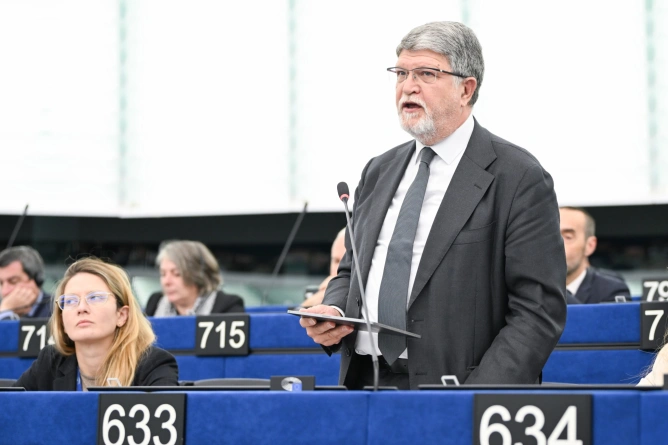
Tonino Picula, a Croatian S&D MEP and Parliament co-rapporteur from the Committee on Security and Defence, presented AGILE before the vote as a programme that places small firms at the centre of European defence innovation. He stressed that the agreement retains the EUR 115 million budget, its focus on SMEs and the four-month grant-award target, while linking projects more directly to capability needs identified by member states.
Ivars Ijabs, a Latvian Renew Europe MEP and co-rapporteur from the Committee on Industry, Research and Energy, emphasised the integration of innovative firms into a European defence ecosystem and cooperation with Ukraine. In his plenary intervention, he argued that start-ups and SMEs are often where new technological solutions emerge, but they must be able to reach military users quickly enough to ensure that the technological advantage is not lost.
This is the central difference between AGILE and some existing European programmes. The European Defence Fund supports longer-term collaborative research and development, whereas AGILE is designed for shorter cycles and for companies that already have technologies with relatively rapid use potential. The Commission describes the objective as reducing the period between innovation and operational use from years to months, where the nature of the project allows this.
The programme will use “challenges” or technology challenges defined together with the member states. Rather than funding only general research themes, AGILE can start from a capability problem identified by the armed forces and seek companies capable of rapidly developing or adapting a solution.
The technologies targeted may include artificial intelligence, autonomous systems and robotics, drones and counter-drone systems, cybersecurity, quantum technologies, space solutions and other technologies with disruptive potential. The programme also allows the adaptation of technologies initially developed for the civilian market when they can meet a military need.
An important obstacle for small firms is not only funding. A company may have a functioning prototype but lack ranges, laboratories, certification infrastructure or access to military users to demonstrate that the product works under operational conditions. The AGILE agreement therefore provides accelerated access to testing and experimentation facilities.
The programme also seeks to address the relationship between start-ups and large defence companies. In many sectors, European industry is dominated by a limited number of prime contractors that integrate complex systems and maintain contractual relationships with defence ministries. A small company may develop a high-performing sensor, algorithm, drone or component without having access to this market.
AGILE will organise dedicated matchmaking mechanisms between SMEs and these major contractors, so that funded technologies can be integrated more quickly into existing defence products and systems. The aim is therefore not only to award a grant, but also to create a commercial and industrial pathway once the grant ends.
The agreement also simplifies the procurement of products developed with the programme’s support. This component is important because one recurring problem with innovation programmes is the existence of demonstrator projects that receive public funding and are successfully tested but subsequently fail to reach a procurement contract.
The EUR 115 million budget is small compared with the major European defence programmes. For this reason, AGILE should be viewed as a pilot, not as the main European source of military innovation funding. Parliament and the Council want to test whether a faster and less bureaucratic model can produce results good enough to be expanded in the next multiannual financial framework.
The programme is scheduled to operate during 2027, at the end of the current 2021–2027 MFF. The experience will be used by the Commission, including in designing support for defence innovation in the next multiannual budget and in the future European Competitiveness Fund.
An important dimension is Ukraine’s participation. The Commission says the agreement allows member states and countries associated with the programme, including Ukraine and the EEA-EFTA states, to participate. For AGILE, cooperation with Ukraine is especially relevant because the war has produced very rapid cycles of development, testing, modification and use of technologies such as drones, electronic warfare and counter-drone systems.
Ukraine’s participation does not mean, however, that the EUR 115 million budget is primarily intended for Ukrainian companies. The programme’s objective remains to strengthen Europe’s defence innovation capacity and reduce strategic dependencies on non-associated third countries, while beneficiaries must comply with eligibility and control requirements.
AGILE therefore also emphasises the security of supply chains and the control of funded companies and technologies. European support for a military technology can create a vulnerability if the beneficiary is structurally dependent on components, intellectual property rights or decisions by a third country that may subsequently restrict the product’s use.
The programme’s requirements seek to ensure that funding develops a defence technological and industrial base capable of responding to the needs of member states and associated partners without introducing new critical dependencies.
On 6 October, Parliament approved the provisional agreement negotiated in July with the Irish Presidency of the Council. The voting transcript confirms that the proposal to reject the Commission initiative was rejected, while the negotiated agreement was adopted by roll-call vote, concluding Parliament’s first reading. The numerical result of the vote does not appear in the transcript available for drafting and is not included here without the official roll-call voting document.
Parliament’s adoption does not mean that companies can immediately apply for funding. The Council must formally complete adoption of the agreed text after legal-linguistic verification. The regulation will enter into force on the twentieth day after publication in the Official Journal, while the Commission identifies 1 January 2027 as the date on which the programme is expected to become operational.
The difference between this date and the actual award of a grant is important. The four-month target refers to accelerating the selection and funding-award process once AGILE calls and challenges are launched. It does not mean that all companies will receive money four months after the regulation enters into force, nor that a funded product will automatically become a military capability within the same period.
The programme’s test will be whether it can reduce actual timelines. If a start-up receives funding quickly but then spends years obtaining access to testing, certification or public procurement, the model will not meet its objective. That is why the agreement addresses rapid grants, testing, relations with prime contractors and the possibility of subsequent procurement together.
For small European companies, AGILE opens a separate pathway from traditional defence research programmes. For EU institutions, the EUR 115 million represents a test: if relatively limited funding can demonstrate that new technologies can be identified, tested and introduced into defence systems within a much shorter period, the model can be expanded after 2027.
Latest News
22:55
22:48
22:22
22:14
21:54
See more news
NEWS ON THE SAME TOPICS