Diesel announces an economic storm. 9 lei today, 10 lei at the end of the month




Always see our news on Google
Romania enters a new stage of fuel price increases, and the alarm signal comes from the most sensitive area of the economy: diesel. The psychological threshold of 9 lei per liter has already been exceeded, and the market dynamics show that the level of 10 lei is no longer an exaggerated hypothesis, but a possible scenario in the immediate future.
The accelerated increase in diesel is not coincidental. It reflects the geopolitical tensions in the Middle East and the impact of the conflict surrounding Iran on global energy markets.
When such crises arise, the first fuel to react is diesel. The reason is simple: Europe, including Romania, has a structural deficit of diesel and depends more on imports for this product than for gasoline.
At the same time, there is a technical delay in transmitting the price increases from the oil market to the pump. Refineries process crude oil purchased a few weeks earlier, and this creates a temporary window in which gasoline remains relatively stable, while diesel is already starting to reflect the tensions in the market. Hence the growing difference between the two prices.
In the short term, this gap will continue to grow. Diesel will remain the pressured fuel, as it is essential for freight transport, agriculture, and logistics. The demand for it is rigid: trucks cannot switch to another fuel overnight, and the real economy depends on every liter consumed.
This evolution has much broader consequences than just the simple increase in pump prices. Diesel is, in fact, the fuel of inflation. Any increase is quickly transmitted to transportation prices, then to the cost of food, construction materials, and almost all goods in the economy. When diesel rises sharply, the entire cost structure of the economy begins to shift upwards.
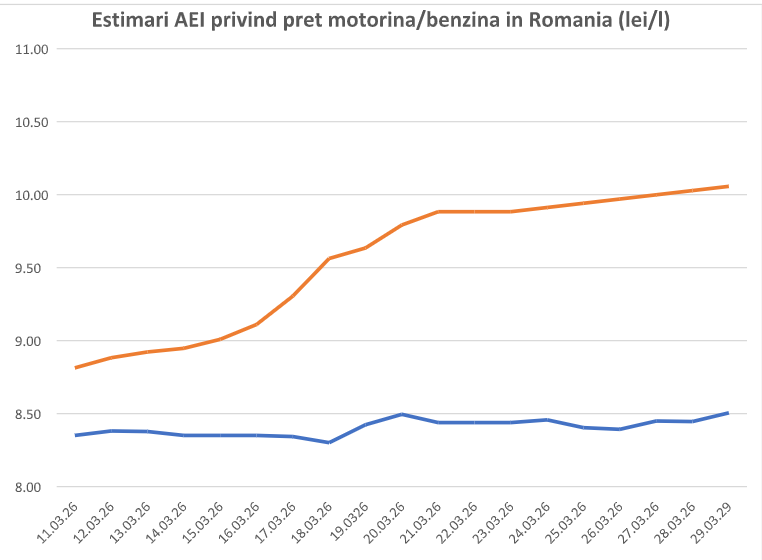 That is why the threshold of 9 lei is not just a symbolic number. It marks the entry into a zone where the pressure on the economy becomes visible to everyone: transporters, farmers, traders, and ultimately, consumers.
In the very short term, it is possible to witness a paradoxical situation: diesel may rise rapidly, while gasoline remains temporarily cheaper. But this balance is fragile. As refineries begin to process crude oil purchased at higher prices, gasoline will also catch up with its increase.
In reality, the question is no longer whether we will see fuels at 10 lei per liter, but how quickly this will happen and how long this phase of the market will last. The AEI estimates that by the end of March we will have diesel at 10 lei/l.
Energy crises have a clear pattern: they appear suddenly, transmit in a chain, and are felt first in the fuels that drive the economy. And diesel is exactly this fuel.
Latest News
07:59
07:52
07:42
07:33
07:32
See more news
NEWS ON THE SAME TOPICS
.webp)
.webp)