The end of crisis measures and the truth behind the pump prices




Always see our news on Google
Yesterday, the measures instituted during the state of crisis in the fuel market expired, and the first effects were immediately seen at the pump. Diesel prices increased by up to 38 bani per liter, while gasoline recorded modest increases or none at all, depending on the company. Beyond the natural reaction of consumers, the figures show that the real story is not about excise duties, but about how companies choose to set their prices.
The AEI study "Evolution of diesel and gasoline prices during the state of crisis in Romania" probably provides the most detailed analysis of the Romanian fuel market in recent years and debunks one of the frequently repeated myths: Romania is not entirely dependent on imported oil.
In the case of diesel, about 16% of the diesel is produced from crude oil extracted in Romania, while about 84% comes from imported crude oil refined in the country. The situation is, however, different for gasoline, where 35% comes from domestic crude oil production, and 65% from imported crude oil refined in Romania.
This difference is essential. If a significant part of the raw material is produced locally, then fuel costs cannot theoretically follow every fluctuation of international quotations. There is a natural buffer represented by domestic production, and this should limit the amplitude of price increases.
Starting from the actual costs of extraction, refining, transport, distribution, and marketing, the AEI study presents three scenarios regarding theoretical prices.
The first scenario, based solely on the actual costs estimated by AEI and a commercial margin of 10%, indicates that we should have an average price of approximately 8.58 lei/l for diesel and 8.31 lei/l for gasoline.
The second scenario takes into account the normal lag between the purchase of raw materials and the sale of the finished product (up to one month), using the quotations of petroleum products from about 30 days ago. The result is an average price of 9.01 lei/l for diesel and 8.69 lei/l for gasoline.
The third scenario uses the current international quotations for gasoline and diesel, resulting in a theoretical price of approximately 9.99 lei/l for diesel and 8.88 lei/l for gasoline.
Comparing these values with what is happening today at the pump is revealing. On July 1, 2026, OMV and MOL increased the diesel price to 9.60 lei/l, exactly by 38 bani. Of this increase, 36 bani represent the return of the excise duty to the level prior to the crisis measures, and approximately 2 bani can be explained by the removal of the cap on the commercial margin. Gasoline was also increased by 2 bani, up to 8.68 lei/l, with the motivation possibly being the same.
Petrom chose a different strategy. Diesel reached 9.54 lei/l, an increase of only 32 bani, which means that the company absorbed approximately 4 bani of the fiscal impact. In the case of gasoline, the price remained unchanged at 8.62 lei/l.
Rompetrol and Lukoil did not change their prices, at least until the time of the analysis, compared to the previous day.
These decisions demonstrate that the market does not operate uniformly and that increases are not dictated solely by taxes or international costs. There is room for commercial maneuvering, and each operator uses it differently.
Even more interesting is the comparison between current prices and those estimated by AEI in the three scenarios.
Diesel sold at 9.54–9.60 lei/l is approximately 1.02 lei above the estimate based on actual production costs and about 59 bani above the scenario built on supply costs from 30 days ago. In contrast, it is very close to the maximum scenario, based on current international quotations.
Gasoline, however, tells a different story. Prices of 8.62–8.68 lei/l are only about 20 bani above the effective cost scenario, but are below the estimate resulting from the quotations of petroleum products from a month ago and even slightly below the level justified by current international quotations.
The result is clear: the diesel market reacts much more aggressively to external developments than the gasoline market.
The explanation lies not only in the supply structure but also in demand. Diesel is the fuel of the real economy. Road transport, agriculture, construction, and logistics primarily depend on diesel. Consequently, any price change produces ripple effects on transport costs and, subsequently, on inflation.
Therefore, the difference between theoretical costs and practiced prices raises legitimate questions regarding the competitive mechanisms in the market.
The fact that Petrom absorbed part of the fiscal impact, while Rompetrol and Lukoil have not yet made increases, demonstrates that there is commercial space for different decisions. In other words, not all price increases are inevitable, and not all are dictated solely by the international market.
In the coming period, it will be seen whether competitive pressure will lead to downward adjustments or whether operators will prefer to keep prices at current levels. The expiration of crisis measures does not only mean the return of excise duties or the removal of the cap on the commercial margin. It also represents a test for the functioning of the market. If the differences between economic costs and final prices remain high, then the discussion must be about taxation, competition, transparency, and accountability to consumers.
And this is probably the most important message of the AEI analysis: not every high price is inevitable, and not every increase can be explained solely by the evolution of international quotations.
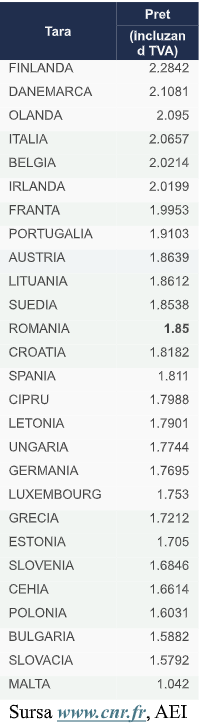
Romania, with the second highest domestic crude oil production in the EU, has prices comparable to those of Western countries.
Latest News
16:53
16:45
16:44
16:42
16:32
See more news
NEWS ON THE SAME TOPICS
.webp)
.webp)
.webp)