The army, between a national symbol and an institution of the "system"



Always see our news on Google
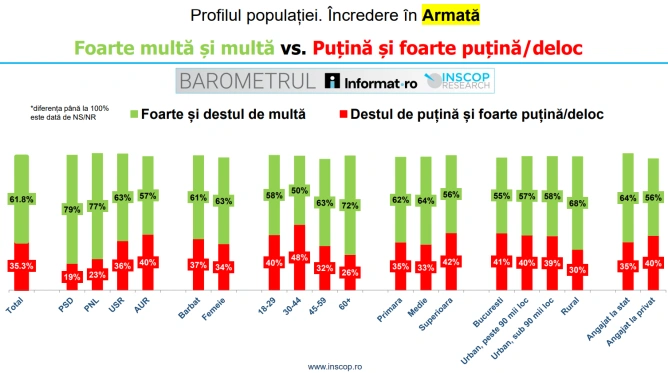
The data from the latest BAROMETER Informat.ro – INSCOP Research shows that 61.8% of Romanians have a lot or quite a lot of trust in the Army, placing it second, after the Church, in the ranking of national institutions. However, beyond this figure, when looking at the data broken down by political options, significant differences emerge.
Thus, while 79% of PSD voters and 77% of PNL voters declare high trust in the Army, the percentage drops to 63% among USR voters (a level close to the average) and to just 57% among AUR voters. Even though the majority of AUR's electorate still has a positive attitude towards the Army, the difference compared to voters of mainstream parties is significant and seemingly surprising. Considering that AUR defines itself as a sovereignist party, and the Army is often viewed as a national benchmark, we would have expected AUR voters to be among the strongest supporters of the military institution.
The explanation lies precisely in AUR's ideology. The nationalism promoted by the party led by George Simion is not institutional, centered on the state and its mechanisms, but rather one that is identity-based and emotional, constructed in opposition to the "system." In this type of discourse, the Romanian state is often presented as weakened and captured by a political class subordinate to external interests. The Army, as an institution of the state deeply integrated into Euro-Atlantic structures, thus comes to be viewed with certain reservations, even if it is not directly contested.
The war in Ukraine has most likely accentuated these reservations. For part of AUR's electorate, the military and logistical support provided by Romania to Ukraine represents involvement in an external conflict, decided under the pressure of NATO and the European Union. In this context, the Romanian Army is no longer seen exclusively as a guarantor of national security, but also as an institution incorporated into a geopolitical architecture accused of limiting Romania's sovereignty.
In a period where security has returned to the center of the public agenda, it is precisely the electorate of the party that speaks most often about sovereignty and national interest that views the military institution with more distrust than voters of other parliamentary parties.
Methodology: The data from the 7th edition of the BAROMETER Informat.ro – INSCOP Research were collected between January 12-15, 2026. Research method: interview via questionnaire. The data were collected using the CATI method (telephone interviews), with a simple stratified sample volume of 1100 people, representative of significant socio-demographic categories (gender, age, occupation) for the non-institutionalized population of Romania, aged 18 and over. The maximum allowable error of the data is ± 3%, at a confidence level of 95%.
Latest News
22:55
22:48
22:22
22:14
21:54
See more news
NEWS ON THE SAME TOPICS
.webp)