The Battle for Second Place


Always see our news on Google
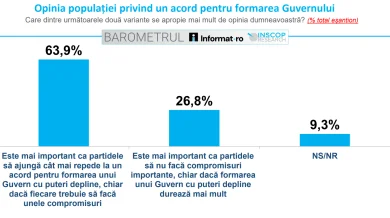
We look at the figures published here by INSCOP over the past week and note a few interesting things. 64% of Romanians say that the parties need to reach a compromise quickly in order to form a government. If we look at the breakdown by voting intention, we see that PNL and USR voters are more reluctant to compromise than those of PSD or AUR. So there is a core of PNL/USR voters who genuinely follow the respective parties’ line, although it is not clear what the solution might be for getting out of the deadlock that has effectively lasted since May. Has the idea of snap elections fully entered the strategy of PNL and USR?
There is a theory among our center-right parties that AUR should be allowed to govern so that it runs into the real world and its voters get tired of them too. I will not discuss all the nuances of this grand idea, but I would point out that at its center is not AUR, but the quarrel between the center-right parties and PSD. The battle for second place in the polls and the race over who has 18 and who has 16%.
Which brings us to the second subject, the picture regarding Romanians’ hypothetical voting options at this moment, according to our poll. You know, there is a saying: no news is good news. Not necessarily. This picture has undergone minor changes over the past year and a half. AUR has always been between 38 and 40%, while PNL and PSD have swapped places, like in the joke about the people admitted to a psychiatric hospital (it is not nice to call them that, but it is more vivid). “The good news is that today you are changing your clothes; the bad news is that you are changing them with each other.”
We have kept talking about this melodrama of forming the government, and these small shifts between our two old parties depend strictly on the development of that scenario. As soon as one comes up with a more credible excuse, the hierarchy reverses by 2–3 percentage points. Then comes the other’s moment of glory, and so on, from spin to spin, as the Americans say. The interesting thing in recent months is that we have a very strong parallelism between the public’s theoretical choices and the choices of the mobilized public (which is more likely to vote if there were elections tomorrow). When the sovereignist parties were just entering our political scene, the difference between a general preference and willingness to vote was visible. It follows that the story that high turnout at the polls helps mainstream parties may no longer be a plausible scenario.
At the time of Nicușor Dan’s election, the mainstream’s legitimacy came from the narrative of unity in the face of danger. The first party in the coalition to attack that narrative, exactly one year after that moment, was PSD. Then PNL, USR, etc. If they do not urgently resolve the political crisis, now that they have all returned from vacation, I am afraid that rebuilding trust will no longer be possible with political consultants, but perhaps with psychotherapists.
Latest News
16:19
16:07
16:07
16:06
15:54
See more news
NEWS ON THE SAME TOPICS

.webp)