DOC Tilcayo, the new wild cat species discovered in the Bolivian Andes



Always see our news on Google
A wild cat found by chance in Bolivia has been identified as a distinct species, more than a century after the last description of a new feline. The animal, named Leopardus tigrinus tilcayo, could change how scientists view one of the most difficult-to-study branches of the cat family.
A discovery that began with “a strange cat”
The story began in 2016, when a wildlife sanctuary in Bolivia received a specimen described by locals as “a strange cat.” The animal had been found as a kitten by the side of a road near a forest. The person who discovered it took it home, believing it was an unusual domestic cat.
After about a year, the owner realized that the animal was wild and could not live properly in a home. That is how it came to Senda Verde sanctuary, located on the subtropical slopes of the Bolivian Andes.
There, it was seen by Paola Nogales-Ascarrunz, a Bolivian biologist and researcher who founded the Bolivian Wild Cat Research Program. The first impression was striking: the feline had a small, apparently “wrinkled” muzzle, short, rounded ears, long whiskers, and fur covered in leopard-like rosettes. The researcher photographed it extensively, unaware at the time that the animal would come to represent the first new felid species described in more than 100 years.
How it was confused with a known species
At first, the researcher assumed that the animal belonged to the species Leopardus tigrinus, commonly known as the tigrina, oncilla, tigrillo, or “small spotted cat.” This species had been described in 1775, based on a single illustration made from an animal observed in French Guiana.
For a long time, scientists believed that this feline occurred across much of Central and South America, including Bolivia. However, in 2019, while preparing a guide to Bolivia’s wild cats, Nogales-Ascarrunz noticed that the specimen she had photographed did not sufficiently resemble reference images from Brazil.
The difference was especially visible in the fur pattern: the rosettes on the Bolivian animal’s body were much larger than those of tigrinas known from neighboring regions. This detail raised the question of whether researchers were actually looking at a distinct form that had previously gone unnoticed.
The genome provided the answer
Outward appearance was not enough to confirm the existence of a new species. Small wild cats are difficult to identify in the field, and the differences between them can be subtle. Even photographs taken by camera traps may not provide sufficient clues.
To clarify the situation, researchers analyzed complete genomes from 38 specimens in the genus Leopardus. The study was conducted by an international team led by Paola Nogales-Ascarrunz, Eduardo Eizirik, a geneticist at the Pontifical Catholic University of Rio Grande do Sul, and Jonas Lescroart, from the University of Antwerp.
The results showed that the Bolivian feline occupies a distinct position in the evolutionary tree of cats. It diverged from the other tiger cats approximately 1.4 million years ago, an evolutionary distance comparable to that between modern lions and extinct cave lions.
The researchers proposed the name Leopardus tigrinus tilcayo. “Tilcayo” is the name used by local people. When scientists asked where the word came from, the answer was simple: their grandparents used it, and the tradition was passed down. The term does not appear to have a clear meaning in either Spanish or Quechua.
It is not a domestic cat
Although the specimen was raised for a time in a household, L. t. tilcayo is not a domestic cat breed and should not be confused with a companion animal.
It is a wild feline adapted to life in the forest. The fact that a kitten can be taken home and cared for by people does not change its behavior, biological needs, or status. Wild cats need large territories, naturally obtained food, shelter, and environmental conditions that a home cannot reproduce.
The case of the Senda Verde specimen also shows how easily a small wild animal can be mistaken for an unusual domestic cat. Its small size and familiar appearance conceal an entirely different biology.
Where it lives
So far, researchers have confirmed the presence of this feline in Bolivia’s Yungas region, a forested area on the eastern slopes of the Andes. The Yungas is characterized by steep terrain, subtropical forests, and rapid changes in altitude and climate.
This type of habitat offers numerous hiding places for small felines but makes research extremely difficult. Dense forests, rugged terrain, and the animals’ elusive behavior limit direct observations.
Information about the life of L. t. tilcayo remains scarce. Scientists do not yet know with certainty what prey it prefers, which are its main natural enemies, how large an individual’s territory is, or how reproduction takes place. The total population size is also unknown.
What sets it apart from other cats
The identification of the new feline is not based on a single external feature, but on the combination of appearance, distribution, and genetic data.
Among the elements that drew attention are:
rosettes larger than those found on other tiger cats;
a small, compact face;
short, rounded ears;
long whiskers;
adaptation to forests on the eastern slopes of the Andes;
deep genetic separation from the other forms in the genus Leopardus.
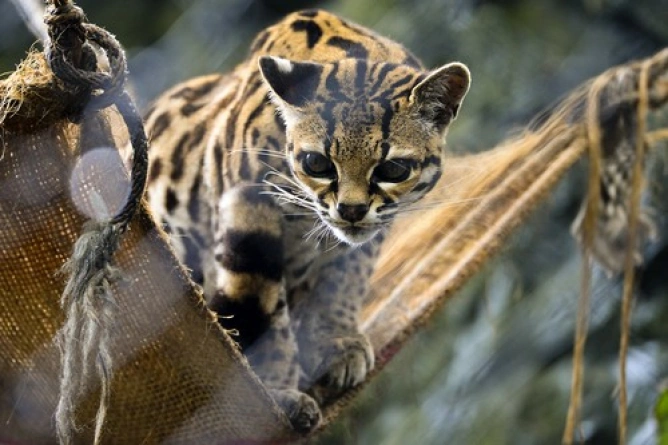
However, specialists warn that field identification will not be simple. Some small, spotted cats, such as the margay or other forms of tigrina, may have a similar appearance. In some cases, even museum specimens have been misclassified. A specimen initially considered a margay was later reclassified as a tiger cat after the direction of the hair on the nape was analyzed.
One species that turned out to be several
The discovery does not concern only an isolated feline. It is part of a broader reassessment of the genus Leopardus.
Genetic research in recent years has suggested that what was considered a single tiger cat species is actually a species complex. In 2013, scientists presented evidence that Leopardus tigrinus included two distinct species. In 2024, another genetically different form was proposed as a separate species. With tilcayo, the number of recognized tiger cat forms reached five, according to the study cited by National Geographic.
The research also provides indications of a possible new subspecies in Peru, Leopardus tigrinus andinus. Moreover, the analysis raises the possibility that the margay, previously considered a single species ranging from Mexico to Argentina, may include four distinct species. Specialists emphasize, however, that this hypothesis requires additional genetic studies.
Why it matters for conservation
Classifying a population as a separate species is not merely an academic matter. It can radically change assessments of extinction risk.
If all tiger cats across a vast area of South America are treated as a single species, the total population may appear large enough not to be considered threatened. If that same population is divided into five species, each group may have far fewer individuals and a limited geographic range.
In this case, conservation must be assessed separately for each species. A population that appears stable at the continental level may actually conceal small, isolated, and vulnerable groups in certain regions.
For tilcayo, the urgency is heightened by the lack of information. Researchers still do not know exactly how many specimens exist, how fragmented the habitat is, or to what extent human activities are affecting the Yungas forests.
A window into hidden biodiversity
The discovery of the tilcayo feline challenges the idea that large mammals are already well known. Insects, microorganisms, and other small organisms usually dominate lists of new species because they are easier to overlook and less studied. But the case of the Bolivian cat shows that even a mammal weighing only a few kilograms can remain undescribed by science.
Modern genomics allows researchers to observe differences that photographs, maps, and traditional descriptions cannot capture. The same methods could lead to the identification of new wild cat species in Africa and Asia.
At the same time, naming a species does not mean that the mystery is over. For Leopardus tigrinus tilcayo, the simplest questions remain unanswered: what does it eat, where does it rest, how far does it travel, and how many specimens still live in Bolivia’s forests?
The feline that was mistaken for a pet has thus become a symbol of a surprising reality: the natural world is still far less known than it seems, and protecting it first depends on people’s ability to recognize its inhabitants.
Latest News
18:51
18:50
18:49
18:42
18:36
See more news
NEWS ON THE SAME TOPICS