ANALYSIS Bolojan Budget 2026: a weaker social state, a friendlier state towards big capital




Always see our news on Google
Bolojan's budget project for 2026 marks a pivot towards a pro-business fiscal policy, focused on gradual relaxation for capital and strict discipline in the area of social spending and the budgetary apparatus, within a framework that accepts a still large, but slightly declining deficit compared to the peak of the electoral years 2024-2025.
What does the Bolojan government aim for fiscally in 2026
The declared goal is to maintain the deficit around 6-6.2% of GDP, in a context of GDP over 2,000 billion lei and inflation slightly above 4%, which means that the government is not entering austerity brutally, but rather a slow consolidation, politically betting on "economic relaunch".
The policy package for the business environment is centered on tax credits for investments, accelerated depreciation for machinery, support schemes targeted in areas with trade deficits, and guarantee schemes through the Investment and Development Bank – a clear signal that the main engine of growth must be private investment, not state-funded consumption.
In parallel, the government is preparing the ground for 2027 by announcing the elimination of IMCA (minimum tax on turnover), the "pillar tax" and other taxes considered burdensome for large companies, which is reflected in the budget revenue projections that drop by about 2 percentage points of GDP after 2026.
Overall logic
In the short term (2026), a high level of revenues is maintained, including through the retention of some newly introduced/increased taxes in the years 2024-2025, but the focus shifts from tax increases to selective fiscal incentives for investments.
In the medium term (2027 and beyond), the 2026 budget project is designed as a "bridge": a future revenue gap is accepted to deliver the political promise of fiscal debureaucratization for multinationals and large players, hoping that the tax base will widen through economic growth and investments.
How it positions itself against the 2023-2025 budgets
Macro framework and deficit
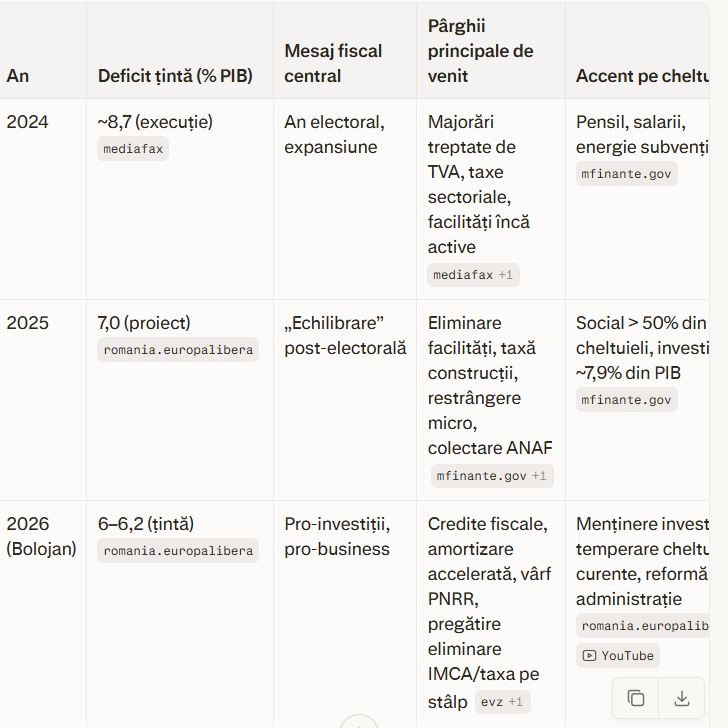
In 2024, Romania exited the electoral year with a cash budget deficit of approximately 8.7% of GDP, a shortfall of about 30 billion euros, under conditions of a populist mix (major increases in social spending) and a stretched consolidation in the future.
The 2025 budget was built still on a "soft post-electoral" logic: revenues of ~668 billion lei (34.9% of GDP) and expenditures of over 802 billion lei (41.9% of GDP), with a deficit of about 7% of GDP – thus a minimal adjustment compared to 2024.
In comparison, the target of 6-6.2% for 2026, assumed by Bolojan, marks the first clearer step towards reducing the deficit, but still far from EU rules (3%), which shows that the government is betting more on growth and investments than on brutal cuts.
Revenue structure and fiscal policies
The 2025 budget also increases revenues by about 50 billion lei compared to 2024 through: the elimination of tax facilities in agriculture, construction, and IT, lowering the threshold for micro-enterprises, introducing a special construction tax, and better collection by ANAF – an evident mix of fiscal tightening, including for SMEs and privileged sectors.
In 2026, the narrative changes: the government no longer talks about "new taxes", but about tax credits for investments and accelerated depreciation; the announced tax increases are marginal and specific (higher excise duties on tobacco and sugary drinks, from April 2026), while massive relaxations are scheduled for large taxpayers after 2026.
If 2025 was a budget in which the share of tax revenues and social contributions rose due to these measures (tax revenues ~28.8% of GDP in 2024, on a growth trend), the Bolojan project for 2026 explicitly accepts a future decrease in these revenues when additional taxes on companies will be eliminated.
Expenditures and sectoral priorities
The 2025 budget clearly indicated that the bulk of expenditures remains social: social assistance (including pensions) 30.2% of total expenditures, personnel expenditures 21.1%, investments ~18.7%, with a "Romanian fiscal" through which defense appears at over 5% of GDP if we add commitment credits to budgetary ones.
The execution of 2025 and the analysis of the Fiscal Council show, however, a serious credibility problem: overestimated revenues, weak execution on European funds, many delayed payments (including energy subsidies) that push pressure into 2026.
The 2026 budget project, as presented publicly, insists on the peak of PNRR absorption (over 10 billion euros by August) and on the role of investments (public and private) in the growth of over 2,000 billion lei GDP, which suggests the intention to maintain high investments but to tighten the screw on current expenditures (budgetary salaries, social transfers), including through reforms in administration.
Who wins
Large companies and capital-intensive investors: gain the most from the 2026-2027 architecture, through accelerated depreciation, tax credits, support schemes for large investments, and the prospect of eliminating the minimum tax on turnover and the special construction tax.
Exporters and sectors with added value: the relaunch package explicitly targets areas with trade deficits and exports, which means dedicated schemes for those who can substitute imports or increase exports of goods and services.
The financial-banking sector and the capital market: if the 2026 budget manages to at least partially consolidate the deficit and provide predictability on the elimination of special taxes from 2027, the perception of country risk can improve, which reduces financing costs for the state and, indirectly, for the economy.
Administrations and firms capable of running PNRR: the peak of over 10 billion euros by August 2026 transforms eligible projects into a major winner, provided there is implementation capacity.
Who loses
Pensioners and social benefit recipients: after a 2024-2025 marked by increases and indexations, the pressure for consolidation in 2026-2027 pushes the government towards freezes or indexations below inflation, as was already done in 2025 to save tens of billions of lei; the current political signal is that the space for new increases is limited.
Public employees with medium and low incomes, especially in central and local administration: the reform of administration is part of the "package 3" of fiscal and budgetary measures, and Bolojan's and experts' messages point towards staff reductions and rationalization of the apparatus, after in 2025 the automatic indexing of salaries was already abandoned to save 9 billion lei.
SMEs that have already borne the tightening in 2023-2025: micro-enterprises and small firms have been hit by the lowering of the threshold and increases in contributions, while the relaxation package for 2027 targets especially large companies; for them, 2026 risks being yet another year of fiscal pressure, with limited benefits from the new architecture.
Consumers with low incomes: the increase in excise duties on tobacco and sugary drinks disproportionately affects low-income categories, which means that the adjustment of state revenues will be borne mainly by mass consumption, while large capital prepares for relaxation.
Sectors with weak execution on investments (e.g., environment, education): the experience of 2025 shows that, although budgets have increased significantly nominally – especially from European funds – the absorption capacity is low; in a Bolojan budget that rewards efficiency and consolidation, ministries that do not deliver execution risk losing budget credits at the first adjustments.
Overview
The Bolojan government uses the 2026 budget as a repositioning tool: from a redistributive state, over-indebted to finance pensions, salaries, and energy compensations, towards a state that assumes to lose fiscal revenues in the medium term in favor of large capital, betting that private investments and European funds will maintain economic growth and will make a still high deficit manageable.
Analysis conducted with the support of Perplexity
Latest News
15:45
15:40
15:39
15:38
15:29
See more news
NEWS ON THE SAME TOPICS



.webp)