SPECIAL Informat.ro / The early elections, from technical hypothesis to political stakes: how the discourse has changed after May 5




Always see our news on Google
After the fall of the Bolojan Government on May 5, the topic of early elections quickly transitioned from a theoretical scenario to a tool of political pressure and a possible way out of the institutional deadlock. The public discourse has shifted in recent weeks from the idea that early elections "make no sense" to their acceptance as a variant that can no longer be excluded. On the other hand, voices have emerged these days suggesting that early elections would be difficult to implement, while others accuse that there are no real impediments.
What does the Constitution say
The Constitution of Romania treats the dissolution of Parliament as an exceptional measure, not as a usual procedure. Article 89 paragraph (1) states that the president can dissolve Parliament after consulting the presidents of the two Chambers and the leaders of the parliamentary groups, but only if the Legislature has rejected at least two requests for investiture within 60 days. Article 89 paragraphs (2) and (3) show that Parliament can be dissolved only once in a year and cannot be dissolved in the last six months of the presidential term, nor during a state of mobilization, war, siege, or emergency.
In short, there is no mechanism by which Parliament "votes for early elections." Instead, there is a chain of political and constitutional steps that can ultimately lead to dissolution and the organization of new elections.
Procedure in brief
In simple terms, the procedure begins when a government cannot be formed. The president conducts consultations, proposes a prime minister, and Parliament votes on the investiture; if two proposals are rejected within 60 days, Parliament can be dissolved. After dissolution, elections must be organized within a maximum of three months.
The president of the Permanent Electoral Authority, PSD member Adrian Țuțuianu, explains that, beyond the constitutional conditions, a rapid legislative adjustment is also needed, as the current electoral law is designed for regular elections, not for early ones. He states that derogatory deadlines for submitting candidacies, voting by correspondence, and other logistical operations would be necessary so that electoral rights are not affected.
Țuțuianu invokes CCR Decision no. 51/2020, which showed that an electoral regulatory framework adopted in a very short time can affect the effective exercise of electoral rights.
In Țuțuianu's formulation, the issue is not whether early elections are possible in principle, but whether the state can organize them legally and correctly, without limiting access for voters or candidates. In other words, the Constitution opens the door, but the electoral law must be restructured for the procedure to function in practice.
Other jurists and analysts, however, point out that this "impossibility" is more of an interpretation by the AEP than a unanimous conclusion: Press analyses and expert opinions show that the text of the Constitution does not condition early elections on the existence of a special chapter in the electoral law, but only on the dissolution of Parliament, and that the current law can be applied with deadlines adjusted through normative acts within permitted limits.
Some articles criticize Țuțuianu's position, suggesting that the argument "nothing can be done" has a political component, especially since it comes from the PSD.
In this fragment: In Țuțuianu's formulation, the issue is not whether early elections are possible in principle, but whether the state can organize them legally and correctly, without limiting access for voters or candidates. In other words, the Constitution opens the door, but the electoral law must be restructured for the procedure to function in practice.
Voices such as political science professor Cristian Preda assert that "it is not true" that early elections cannot be organized without an emergency ordinance, since the pre-term election must be regulated by law, and Parliament can convene at any time to do this. He further suggests that the project should provide for shortening electoral deadlines and a clear regime for exceptional states during the dissolution of Parliament. Additionally, Diana Buzoianu from USR goes even further: she accuses Țuțuianu of trying to politically justify the impossibility of early elections, stating that Parliament can adopt the necessary rules and that the AEP should not block the idea for procedural reasons.
What does the head of state and the prime minister say about early elections
Nicușor Dan has recently shifted from a cautious rejection of early elections to a calculated reserved position: he does not desire them, but he no longer completely excludes them. The president says "he does not see their purpose" because a new election would prolong uncertainty and would not fundamentally change the balance of power in Parliament, forcing the same parties to resume negotiations almost from the same point.
Ilie Bolojan stated that "early elections can be taken seriously" if parliamentary parties fail to reach an agreement to overcome the current political crisis. He specified that, in European democracies, early elections are a solution used when a stable government can no longer be formed.
He speaks of a lack of "wisdom and responsibility" as a premise that would inevitably push the discussion towards such a scenario.
How the parties position themselves
PSD: pragmatic opposition
PSD does not officially reject early elections, but views them more as a risk than as a solution. The party leader, Sorin Grindeanu, says that the scenario of early elections cannot be excluded and that it could lead to elections "somewhere in late autumn" of this year, but would create political and economic instability; moreover, he warns that PSD will enter elections based on reciprocity if PNL and USR say they will no longer form majorities with social democrats. Daniel Zamfir warned that early elections would benefit AUR and could even lead to the appointment of a prime minister from this party. (source informat). In the same line, Lia Olguța Vasilescu says that she does not believe there will be early elections and invokes the lack of a legislative framework, technical difficulties, and the lack of interest from parliamentarians to vote for them.
The PSD message is double: on one hand, the party claims it is not afraid of early elections; on the other hand, all its explanations show that it sees the scenario as risky and potentially disadvantageous.
USR and PNL: a more open support
In the liberal-reformist area, the topic is treated more as a solution for unblocking than as a danger.
USR more openly supports early elections than other pro-European actors. The leader of the formation, Dominic Fritz, says that the chances of a new government until the end of July are very small and that early elections would be the best solution to get out of the deadlock.
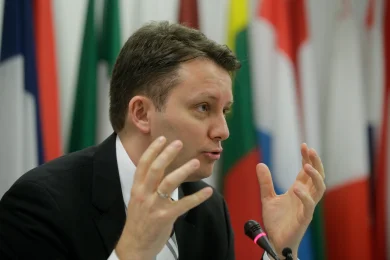
In the PNL area, Siegfried Mureșan says that early elections "are not an exception in Europe" and that if the political deadlock cannot be overcome through current formulas, "returning to the people" is a natural solution. He also stated that if elections were to take place, they could happen in the autumn of this year.
AUR: explicit support
AUR is the party that pushes the topic of early elections the hardest. George Simion stated that he treats early elections as an assumed political objective, not just as a solution for unblocking. In his interventions, the AUR leader openly states that he wants early elections and links them to changing the balance of power in Parliament, which positions him as one of the most consistent promoters of the scenario. In the same direction, Petrișor Peiu states that early elections are the only solution for getting out of the crisis.
Additionally, Dan Dungaciu insists that AUR wants early elections and presents them as the only solution for "rebalancing Romania" and for bringing political representation back in line with citizens' opinions.
The real stakes - who wins, who loses
From the data collected by the media monitoring platform NewsVibe Romania, it appears that public support for early elections is significant, but not necessarily because people believe in the constitutional solution, but because they want a change in the political game. An IRES survey commissioned by PSD shows that 64% of respondents see early elections as a solution to the crisis. At the same time, voting intention places AUR at 40%, PSD at 21%, PNL at 17%, and USR at 10%.
The director of INSCOP, political scientist Remus Ștefureac, emphasizes that early elections represent a legitimate and democratic mechanism in situations of crisis and deep political deadlock, especially when elected representatives can no longer reach compromises. According to his analysis, a potential election would clearly strengthen AUR, but would not guarantee a stable majority, as the fragmentation in Parliament would remain and would again force parties to negotiate among themselves.
Here lies the central paradox of the issue: early elections are desired as a reset, but the balance of power could reproduce the deadlock in an even more complicated form. Thus, no party would have the resources alone to form a stable majority, and a new coalition would still need to gather actors in opposition.
Conclusion
In the evolution of the discourse after May 5, early elections have transitioned from an improbable idea to a negotiation tool and a possible way out of the political crisis. Nicușor Dan tolerates them as a hypothesis, Ilie Bolojan conditions them on the failure to form a government, AUR openly supports them, while PSD essentially rejects them, although it claims it is not afraid of them.
***Synthesis made with the help of a data monitoring flow provided by the media monitoring platform NewsVibe Romania. The analysis, data, and images presented have been enhanced with the help of Machine Learning and Artificial Intelligence tools.
Latest News
22:52
22:48
22:43
22:38
22:20
See more news
NEWS ON THE SAME TOPICS

.webp)