ANALYSIS Salaries in the public vs. private sector, in the EU. Romania, between the regional exception and the European rule




Always see our news on Google
In the European Union, the average salary in the public sector is often higher than that in the private sector, but the difference does not automatically mean unjustified privileges. It reflects the structure of jobs, the level of education, the proportion of women, job stability, and how salaries are negotiated. Romania is among the countries where the advantage of the public sector has become particularly visible, but raw comparisons hide a more nuanced reality.
A comparison that is never simple
The ratio between public and private salaries cannot be reduced to a single question: "Who earns more?" Average salaries are influenced by occupation, age, education, seniority, region, working norm, economic sector, and the proportion of women and men in each sector.
In Romania, public data indicates a persistent salary advantage for the budgetary sector. In 2023, the average net salary was estimated at 4,843 lei in the public sector, compared to 4,520 lei in the private sector, which meant an advantage of approximately 7.1% for state employees. For 2024, an analysis cited by Avocatnet indicates an average net salary of 5,923 lei in the public sector and 4,665 lei in the private sector, which means a ratio of approximately 1.27 to 1.
However, it is important to note the difference between the "public sector" and "state-owned companies." In the IMF's analysis of Eastern Europe, Romania appeared with a very large gap between employees of state-owned companies and those in private firms: for 2016, salaries in state enterprises were over 80% higher than the average in the private sector. This category is not identical to public administration, teachers, doctors, or civil servants, and mixing them can exaggerate the perception of "salary in the state."
Romania, a case with a high gap
Romania has gone through several stages. In the years following the financial crisis, public salaries were even below those in the private sector, but after 2011 the ratio reversed and the difference gradually increased. The period 2017–2021 was marked by a rapid expansion of budgetary salaries, and by 2020 the net difference between the two sectors had reached approximately 31% in favor of the state.
The gap subsequently narrowed, partly because private salaries rose rapidly amid labor shortages and inflation. Nevertheless, the difference remained positive: in 2022, the average gross public salary was 7,297 lei, compared to 6,216 lei in the private sector, an advantage of 17.4%.
Romania also stands out for the size of the salary advantage relative to the average economy. An analysis by the Fiscal Council cited in the economic press estimated that Romanian public servants earned about 56% above the average salary in the economy, the highest level among the Central and Eastern European countries analyzed, such as Hungary, Poland, the Czech Republic, Bulgaria, and Slovakia.
Different models in the European Union
European studies on the public-private wage gap show that the public sector is not better paid in all countries and that the advantage varies significantly by region and occupation. In some states, public salaries are higher; in others, private employees earn better, especially in competitive industries and high-productivity occupations.
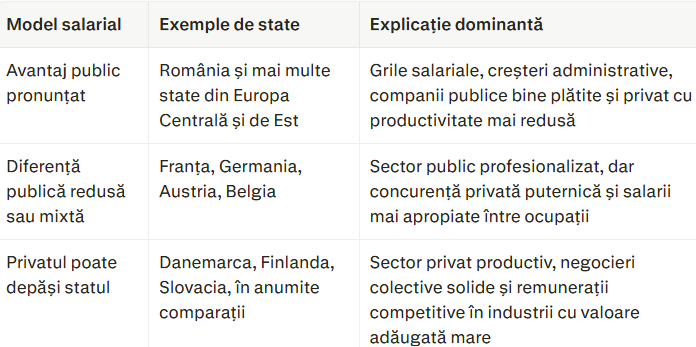
A European analysis of the wage gap would show that, in unadjusted comparisons, public employees often benefit from a salary premium, but the size of this premium changes substantially after controlling for education, occupation, experience, and job characteristics. In some states, the apparent advantage of the public sector diminishes significantly when comparing employees with similar profiles.
The Nordic examples are relevant. In Denmark and Finland, public salaries do not necessarily exceed private incomes, and in certain comparisons, public servants earn less than employees in companies. In these economies, the difference is influenced by the high productivity of private firms, collective bargaining, and the fact that many private careers offer bonuses or higher earning prospects.
Education changes the image
One of the most important reasons why the average public salary is higher is the level of education. Administration, health, education, justice, and public services require, to a significant extent, formal qualifications, exams, professional licenses, or university studies.
If a sector concentrates more university graduates, the comparison between average salaries will reflect not only the employer but also the human capital of the employees. An economist in administration, a doctor in a public hospital, and an engineer in a state company cannot be accurately compared with the average of all employees in the private sector, which also includes low-paid occupations, seasonal work, commerce, hotels, restaurants, or small firms.
On the other hand, higher education does not automatically guarantee a higher public salary. In fields such as IT, consulting, finance, telecommunications, or energy, private companies can pay more than public institutions. Therefore, economic research usually separates the "unadjusted public salary premium" from the remaining difference after comparing individuals with similar education and occupations.
Gender equality and the "average" salary
The gender structure is another essential factor. The public sector employs, in many European countries, a higher proportion of women, especially in education, health, and administration. At the same time, women are overrepresented in occupations such as caregiving, primary education, or administrative work, which may have lower salaries than managerial positions or technical specialties.
Eurostat defines the unadjusted gender pay gap as the difference between the average gross hourly earnings of men and women, expressed as a percentage of the average earnings of men. The indicator does not directly measure wage discrimination for the same work, as it includes differences in occupation, industry, working norm, experience, and hierarchical position.
In 2023, the gender pay gap at the EU level was approximately 12%, according to Eurostat statistics on hourly earnings. It varies significantly between states: it can be reduced in countries with high female employment, salary transparency, and developed public services, but is higher where women more frequently work part-time, occupy lower-paid positions, or face barriers to access leadership roles.
The high presence of women in the public sector can have two opposing effects. On one hand, grids and uniform rules can limit salary differences between women and men. On the other hand, if women are concentrated in public fields with lower salaries, the average of the sector may remain below that of some private industries dominated by men and well-paid.
Stability versus performance
The public sector generally offers a different combination of salary and benefits. Job stability, income predictability, pensions, vacations, and greater protection against dismissal can sometimes compensate for a lower salary than in the private sector.
The private sector operates with a greater salary dispersion. A technology firm, a bank, or an energy company can pay well above the public average, while a small trader or a restaurant offers salaries close to the legal minimum. Consequently, the private average can be pulled down by the large number of small enterprises and low-productivity sectors.
In the public sector, payment is more standardized and often depends on function, seniority, professional grade, and bonuses. In the private sector, salary depends more on the productivity of the firm, the employee's bargaining power, profitability, and skills deficit. This difference explains why the state can have a higher average, but also why some specialists in the private sector earn much more than their budgetary equivalents.
Productivity and economic structure
A high public-private gap can have legitimate causes, but it can also indicate resource allocation problems. If public salaries grow faster than productivity and tax revenues, the pressure shifts to the budget, taxes, and borrowing.
In Romania, the problem is amplified by the structure of the private sector: many firms have low productivity, operate with small margins, and have limited access to financing. At the same time, some state companies may benefit from dominant positions, subsidies, monopolies, or salary rules that do not strictly reflect economic performance.
The IMF has drawn attention to the situation of Romanian state companies, where remuneration was much above the average in the private sector. This observation does not mean that any public salary is excessive, but that budget-funded institutions must be separated from state-owned commercial enterprises.
What the average salary does not show
The average salary is a useful but incomplete indicator. It does not say how many people are below average, how high the median salary is, how many hours are worked, or how much bonuses and allowances represent.
In Romania, the comparison can be distorted by the inclusion of allowances, bonuses, and other components of salary earnings. Recent analyses emphasize that the gross or net average hides significant differences between occupations, sectors, qualifications, and bargaining power.
A more accurate comparison should track:
the median salary, not just the arithmetic mean;
hourly earnings, to control for the working norm;
total gross salary and extra-salary benefits;
education, experience, and occupation;
differences between regions;
the proportion of women and men;
the size of the firm and productivity;
the difference between public administration and state-owned companies.
Romania compared to Europe
Romania is not the only country where public employees earn, on average, more. The difference exists in many EU states, but its magnitude and causes are different. In Northern Europe and in Western economies, the private sector can offer higher salaries in competitive sectors, while the public sector compensates through stability and benefits.
In Romania, the public advantage has been fueled by legislatively established salary increases, grids and bonuses, high salaries in some state companies, and the still low level of remuneration in many private activities. In 2024, the estimated public salary premium of approximately 13% was presented as being close to the European average of about 10%, although Romania had had considerably larger differences in previous years.
Therefore, the correct question is not whether "the state pays too much" or whether "the private sector pays too little," but whether salaries in both sectors correspond to the competencies, productivity, and responsibilities required. An underpaid administration may lose specialists, but an administration paid without regard to performance may become unsustainable. Similarly, a private sector with low salaries cannot sustain either consumption or the financing of public services in the long term.
Conclusions
The difference between public and private salaries in the EU is the result of the interaction between education, occupation, gender, productivity, collective bargaining, job stability, and salary policies. Romania is in the group of states where the advantage of the public sector has been strong, especially in certain periods and in state-controlled companies.
A serious interpretation must avoid both the myth of the "privileged budgetary" applied to all public employees and the idea that any public-private difference is justified. Data shows a stratified reality: some public employees are better paid than their private counterparts, some private employees earn much more than the public sector, and the average difference largely reflects the different structure of the two labor markets.
Analysis conducted with the support of Perplexity
Latest News
22:58
22:44
22:41
22:21
22:08
See more news
NEWS ON THE SAME TOPICS