Is art for identity or consumption?




Always see our news on Google
At the end of last week, the Barometer of informat.ro by INSCOP published a set of data in the context of the Brâncuși Nocturne Festival in Tg. Jiu. Of course, the data was about our current public's perception of the Brâncuși phenomenon. There weren't many questions, but they were very well formulated. One initial observation that this set of questions provided me is one regarding notoriety in general. Although it seems like an easy thing to measure, notoriety is still a complicated matter – and you don't see this until you start evaluating brands and cultural products. Essentially, notoriety doesn't just refer to what people know or who they know, but rather to what people believe they know. It is not excluded that notoriety may be due to mistaken reasons, to more or less false impressions, if not to myths or completely erroneous information. Now I realize that if you want to understand the fake-news phenomenon, for example, an interesting exercise would be to study what constitutes the notoriety of various personalities, events, brands, or products. We might have great surprises regarding the common stock of knowledge.
So is it ours or not? This is the question about Brâncuși, of course, viewed not from his perspective, not from the perspective of critics or art historians, from here or abroad, but from the perspective of today's public in Romania. In short, people say they have seen works by Constantin Brâncuși, about 40% in reality (in museums, exhibitions in the country or abroad, in the ensemble at Târgu Jiu), about 42% know them only from photographs, TV, the internet, books, etc., thus without an empirical, direct experience. Is it good, is it bad? Only subsequent questions can tell us...
What appears here, however, is that 13-14% do not remember if they have ever seen, in any way, directly or indirectly, something like that. Most likely, these are people who do not know what it is about, or even who it is about. Unfortunately, young people (18-29 years) are overrepresented in this segment.
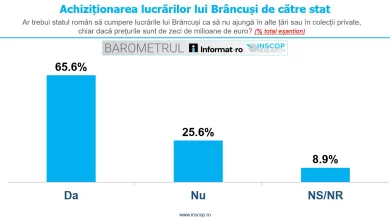
Should the state buy Brâncuși's works if this opportunity arises and we can take them from foreign museums, private collections? Two-thirds of Romanians would say yes, a quarter rather no, the rest we don't know. At first glance and for certain segments of the public, we are dealing with a test of loyalty towards our cultural values, with the recognition of a landmark and with the understanding that, in a world where money no longer holds much value, a symbolic and established investment deserves consideration. But there is also a small and inverted image, as opticians say, that needs to be analyzed. Although our public's attachment to Brâncuși's works seems to be a certainty and a majority from each socio-demographic category supports the potential purchase by our beautiful republic of these works, we cannot help but observe, strictly based on the survey data, a small phenomenon. The appetite for this cultural investment is greater among voters of AUR and PSD than among those of USR or PNL, greater as the level of education decreases, greater in rural areas than in urban ones, greater as age increases. In principle, at least in three of these socio-demographic variables (voting, education, residential environment), the desire for the state to get involved by purchasing these works seems greater among those who know less than among those who know more about Brâncuși (we report this finding also to the way these categories responded to the first question). Maintaining, of course, the above observation, how on each side we have the majority of people rather agreeing with the acquisition of the respective sculptures than opposing it. But the nuances are relevant.
The debate is current. Let us not forget that in May of this year, a sculpture by Brâncuși (Danaida) became the second most expensive sculpture ever sold on this planet at an art auction. Of course, Brâncuși is Romanian, but he manages well with his universality. And I am very afraid that most of our fellow citizens take pride in him for the wrong reasons – for example, because they have heard that he is "great". But is he not great because he was and, subsequently, what he created remained in the "good world" of contemporary sculpture? Including because he is appreciated by these art scholarships? Is it not from this cosmopolitan recognition that his status as an ambassador of Romanian culture comes?
Ultimately, if the state literally sends a few trains with money for art objects that it only deposits and does not know how to use, it is hard to say if we have anything to gain from this. We must also be sure that the great project does not stop at this point and that there is the capacity to manage it further. Because we have two scenarios that we cannot help but be afraid of: the one described in the previous sentence, in which a cultural object left in a museum no longer produces cultural effects, nor image effects, and, practically, its value decreases; and the second, in which it is poorly circulated, like the famous golden helmet of the Dacians. Although international theft has somehow increased its notoriety.
Latest News
10:03
10:02
09:56
09:52
09:48
See more news
NEWS ON THE SAME TOPICS