INSCOP survey: Almost two-thirds of Romanians want the state to purchase the works of Brâncuși



Always see our news on Google
According to BAROMETER Informat.ro – INSCOP Research, almost two-thirds of Romanians support state intervention in the acquisition of works by Constantin Brâncuși, in order to prevent their alienation to private collections or other countries.
The survey about the work of Constantin Brâncuși was conducted in partnership with the Docuart Association as part of the Brâncuși Nocturne Festival project.
BAROMETER Informat.ro – INSCOP Research is a monthly opinion poll conducted by INSCOP Research on behalf of the news platform Informat.ro in partnership with the Strategic Thinking Group think tank. The BAROMETER Informat.ro – INSCOP Research aims to bring to public attention topics of interest to stimulate national conversations about various subjects and essential public policies for the present and future of Romania, based on the opinions of Romanians in partnership with prestigious think tanks and academic institutions. It is an initiative through which we aim to contribute to the strengthening of democracy by using scientific and credible tools that bring the voice of citizens to the forefront of public debate.
Methodology: Data was collected between July 13-16, 2026. Research method: interview via questionnaire. Data was collected using the CATI method (telephone interviews), with a simple random sample volume of 1,100 people, representative of significant socio-demographic categories (gender, age, occupation) for the non-institutionalized population of Romania, aged 18 and over. The maximum allowable error of the data is ± 2.95%, at a confidence level of 95%.
Graphical presentation of the data is available here.
Remus Ștefureac, director of INSCOP Research: "The data indicates that Brâncuși occupies a solid place in the symbolic heritage of Romanian society, being perceived not only as a cultural landmark but also as a defining element of national identity. The broad support for state involvement in preserving his work in the national heritage shows that Romanians attribute a strategic dimension to cultural value, surpassing strict financial logic and treating culture as a resource of prestige and national continuity. At the same time, the fact that Brâncuși is predominantly associated with Romanian identity, without denying his international recognition, suggests the existence of a mature form of cultural patriotism, in which the affirmation of national roots is compatible with the recognition of universal value. The results outline the image of a society that sees great cultural personalities as markers of collective identity and essential tools for affirming Romania in the world."
The works of Constantin Brâncuși
41.9% of respondents claim that they have not seen any work by Constantin Brâncuși in reality, only in books, albums, on TV, or online. 36.2% say they have seen a work by the artist in reality in Romania at a museum or exhibition in Târgu Jiu, 13.6% declare that they do not remember having seen a work by Brâncuși, and 3.6% affirm that they have seen a work in a museum or exhibition in another country. 0.4% do not respond. The highest percentages of respondents who declare that they have not seen any work by Brâncuși in reality, but only in books, albums, on TV, or online are recorded among AUR voters, people with primary education, residents of the capital, and those from rural areas.
Supporters claim to have seen Brâncuși's works in Romania in a significantly higher proportion than the average: PNL and USR voters, people with primary education, and residents of large urban areas.
PSD voters, young people under 30, people with primary education, and residents of rural areas report a much higher percentage than the average that they do not remember having seen a work by Brâncuși.
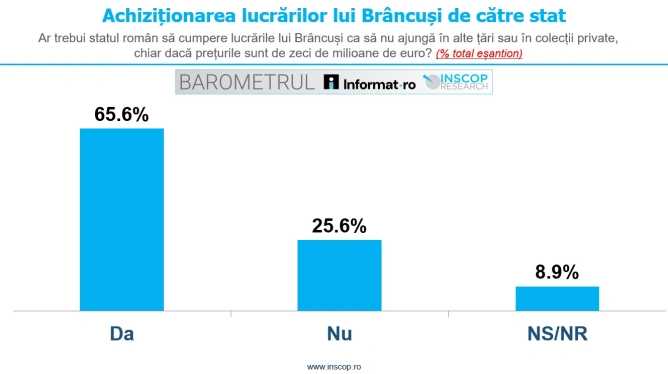
PNL voters, people with higher education, and residents of Bucharest affirm that they have seen a work by Constantin Brâncuși in a museum/exhibition in another country at a significantly higher percentage than the rest of the population. The acquisition of Brâncuși's works by the state is supported by 65.6% of Romanians who believe that the Romanian state should buy Brâncuși's works so that they do not end up in other countries or in private collections, even if the prices are in the tens of millions of euros. 25.6% do not agree with this statement, and 8.9% do not know or do not respond.
I believe that the Romanian state should buy Brâncuși's works in a significantly higher proportion than the average: PSD and AUR voters, people over 45 years old, those with primary education, and residents of rural areas. PNL and USR voters, people aged 18 to 44, those with higher education, residents of Bucharest, and employees in the private sector represent the socio-demographic categories where there are significantly above-average percentages of respondents who reject such an idea.
What kind of artist is Constantin Brâncuși
67.7% of those interviewed believe that Brâncuși is a Romanian artist, 22.6% recognize him as a universal artist, and 1.4% consider him a French artist. The proportion of non-responses is 8.3%.
Supporters claim that Brâncuși is a Romanian artist in a much higher proportion than the average: PSD voters and people over 60 years old. Among PNL and USR voters, people with higher education, and residents of Bucharest, the highest percentages compared to the average of respondents who believe that Brâncuși is a universal artist are recorded.
Latest News
09:25
09:02
08:56
08:38
08:19
See more news
NEWS ON THE SAME TOPICS