ANALYSIS Romanian film – an industry approaching one billion euros




Always see our news on Google
Romanian directors have won major awards – Palme d’Ors, Bears, Lions and Leopards – with films that shocked the genre industry in other countries. Budgets of 500,000 euros (well below the cost of an episode of a modest international series) or one million euros (in fortunate cases) defined the cost of making a Romanian art film for years on end. Recently, budgets have increased significantly, as has the complexity of productions. But art films still have budgets below 10% of what is internationally classified as “indie”.
Even under these conditions, Romania’s film industry is a segment experiencing significant growth, tending toward one billion euros. The heavy lifting is done by advertising creativity, participation in international productions and, last but not least, the development of the OTT segment. That is, online streaming through channels such as Netflix, HBO’s VoD, Disney+ and others. Art films generate prestige, while the other segments of the film industry generate profits.
An industry, after all
Beyond the red carpet, cinema is an industry. An extremely profitable one – if we look at macro indicators. A median profitability of over 20% (according to ANAF) is an enviable rate for many economic sectors. Book publishing has only 11%. Even some of the most prosperous financial segments are below these rates. Most of the economy is at 2–3%.
Such success is based on three pillars: creativity, a high degree of professionalization and abundant cutting-edge technology.
Nominally, the industry’s turnover is 772 million euros. But this is only a financial indicator which, for a proper understanding, requires two important adjustments. First, part of this figure is generated by companies operating exclusively or predominantly in television production. Second, it does not include the OTT segment, which is the most dynamic part of the film industry. Thus, we have massive declines (television) and massive increases (streaming) radically reshaping the total.
A problematic economic classification
At one time, cinema was viewed as a niche of television. Economic classifications are still beholden to that model. They probably will not even need to be updated, because the relationship is changing, and television is tending to become a niche of film production.
In economic classifications, all activity is included in the CAEN 591 code group. Here we find film production, post-production, distribution and cinema exhibition.
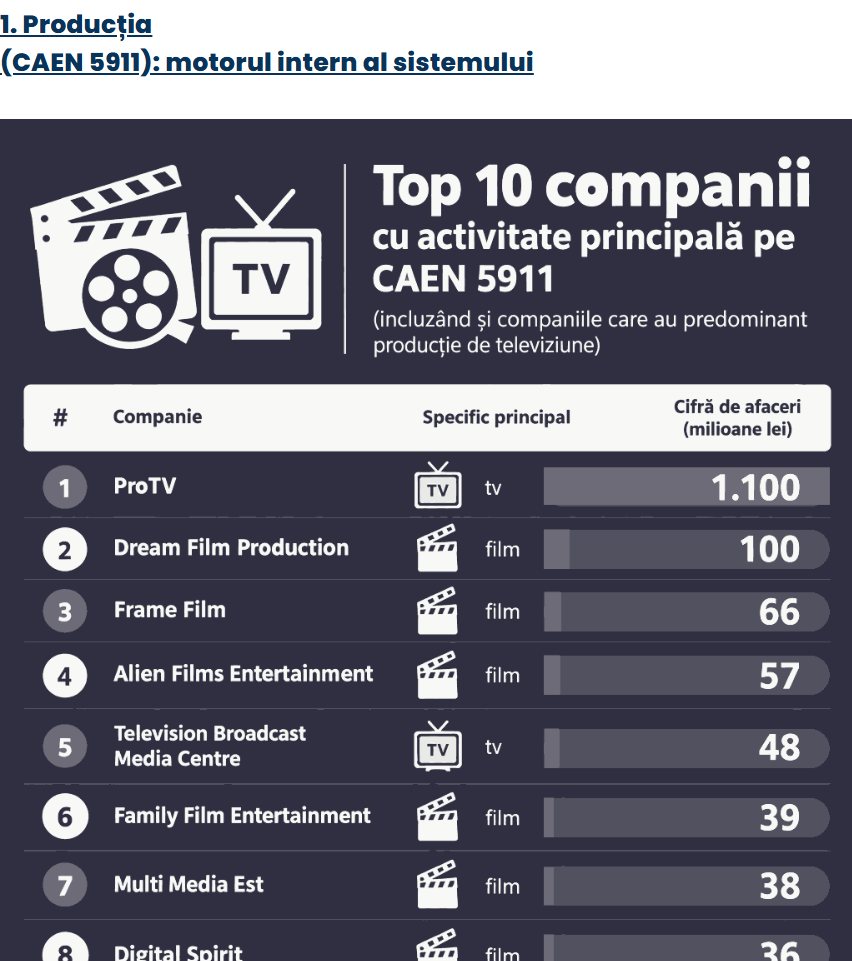
However, the first code in the group, 5911, includes television production alongside film production. Automatic separation of the segment is not possible. Individual assessment of the companies with the highest turnover indicates a relatively equal division between film and television, both in terms of the number of companies and turnover. It follows that, in order to determine the value of the film segment, the nominal figure must be reduced by almost 300 million euros.
But it is not only reduced; it is also increased. Streaming networks operate almost entirely from outside Romania. Netflix subscriptions are paid to a company in the Netherlands, HBO subscriptions to a company in the Czech Republic, etc. These figures do not appear in ANAF statistics for companies in Romania. According to PwC’s assessment, Romania’s OTT market amounted to 276 million euros last year. This must be added.
Methodology, methodology, methodology
The imprecision of tax reports
In summary, a pertinent estimate of the film industry is approximately 750 million euros. But it must also be borne in mind that the reports of ANAF and the Ministry of Finance, which include only the primary CAEN code, are problematic and introduce a margin of error. As in all other cases, there are companies operating in this sector without having this code as their primary one; and there are companies that have this code, but whose actual business has an entirely different profile.
Some examples are astonishing. Buftea Studios, once the largest entity in the Romanian film industry, are currently operated by a company whose business activity is real-estate transactions. Conversely, among film and television producers are companies with respectable turnovers that operate online portals or even physical stores and have abandoned their initial intention to engage in video production.
Nevertheless, when analyzing the activity of the large companies, which concentrate the largest share of turnover, the influence of these reporting inaccuracies is minor and affects the overall picture only to a very limited extent.
What film production (still) means
It is not only business classification that is marked by asterisks and requires additional notes. Cinematic activities themselves have diversified and continue to diversify, making a rigid definition counterproductive. Many film studios with remarkable cinematic productions support themselves by creating advertising spots. Others provide limited services for international productions, sometimes predominantly technical ones. Others focus on video production for social media (including YouTube), which they monetize in this way. Even TV series, when they are low-budget, raise questions about how they should be classified among cinematic productions.
A definition that excluded all of these would eliminate almost every company in the film sector.
The analysis in this article considers any video creation with an essentially artistic character or content to be film production.
The four engines: Production, post-production, distribution and cinemas
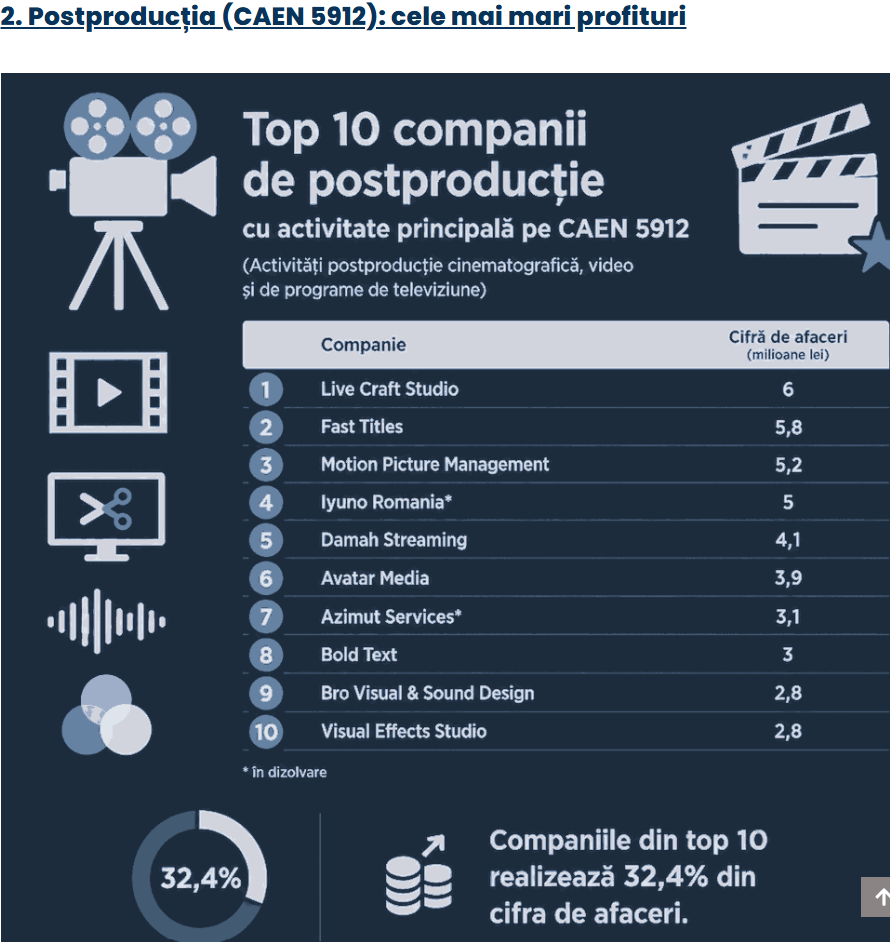
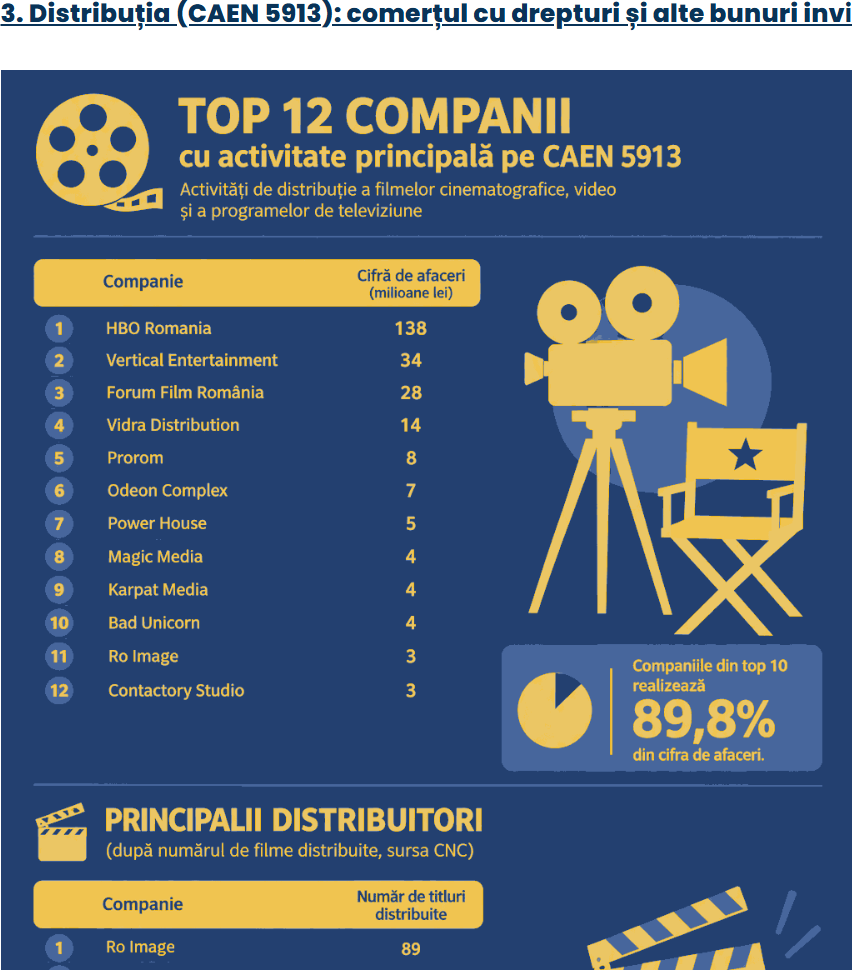
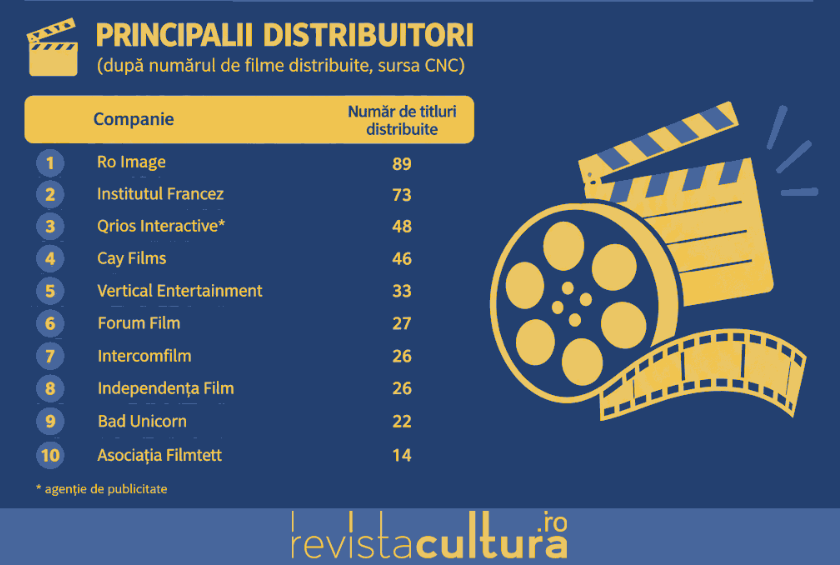
The economic universe of cinema operates on four clearly delineated pillars, each with a completely different business dynamic.
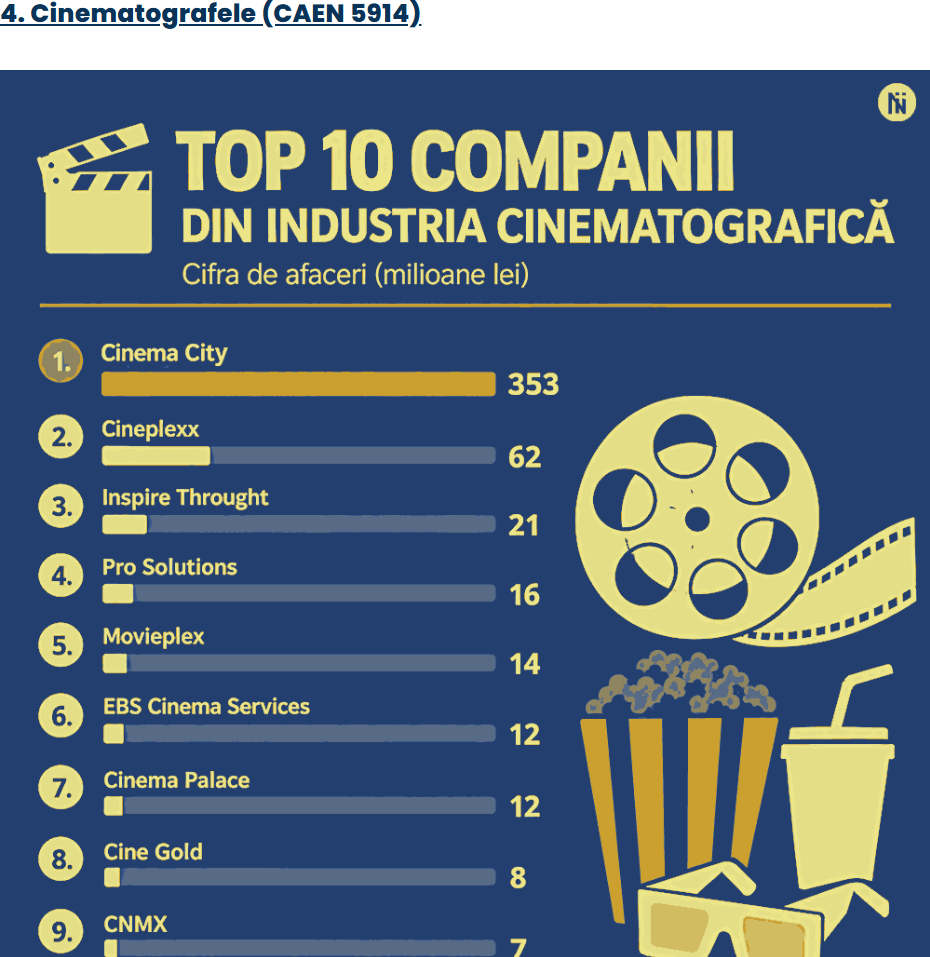
An easily imaginable territorial concentration
Taking all four sections into account, it comes as no surprise to anyone that Bucharest dominates this industry. The major studios are in the city or its suburbs, and the major companies are headquartered in the Capital. So are the clients – whether we are talking about film distribution or the contracting of advertising services. This is also where the most cinema screens, the most viewers and the most cinema employees are found.
More than 82% of the sector’s turnover is generated by companies registered in the Capital (almost 639 million euros). Ilfov, with Buftea at the forefront, adds 37 million. This is where the largest profits and the greatest capitalization are found: approximately 200 million of the 300 million nationwide. Of the 5,300 employees in the industry, 4,000 are in Bucharest + Ilfov.
The rest of the country shares modest financial volumes, but with several notable emerging centers. Cluj, supported by festival vibrancy and a dynamic creative community, is the main regional hub, followed at a distance by Prahova, Dolj, Iași and Brașov.
Profile of the typical company: Between studio giants and micro-studiosThe industry’s large figures can create the illusion of general abundance. In reality, the landscape is deeply polarized. Alongside a few private giants – studios capable of attracting major international productions worth tens of millions of euros or large cinema chains – the vast majority of the sector consists of microenterprises.
If we look at the median company (the firm positioned exactly in the middle of the ranking, representative of the typical operator), its annual turnover is around 21,000–25,000 euros. This is the reality of small auteur production houses, small editing workshops or project-based companies: flexible entities, often run by one or two people, which activate their resources according to the funding cycles of the National Cinematography Center (CNC) or seasonal orders.
Regarding financial health, over 60% of companies in the sector report a profit, but one-third of operators function at the limit of economic subsistence, accumulating losses or negative equity – evidence of the inherent risk involved in any artistic and commercial venture in audiovisual production.
An ecosystem reaching maturity
Romania’s film industry is currently at an unprecedented point of maturation. It has moved beyond the model of precarious survival and learned to combine authors’ artistic vocation with the economic rigor of international service provision, high-audience television production and new digital post-production technologies.
The balance nevertheless remains delicate. Dependence on the Capital shows an acute need for cultural decentralization and support for regional creative communities. At the same time, the polarization between large infrastructure studios and small auteur companies is a reminder that film cannot be viewed exclusively through the lens of turnover: its vitality ultimately depends on this complex economic mechanism’s ability to support creators’ freedom to tell stories that matter to audiences at home and everywhere.
Latest News
08:05
07:50
07:35
07:21
22:52
See more news
NEWS ON THE SAME TOPICS