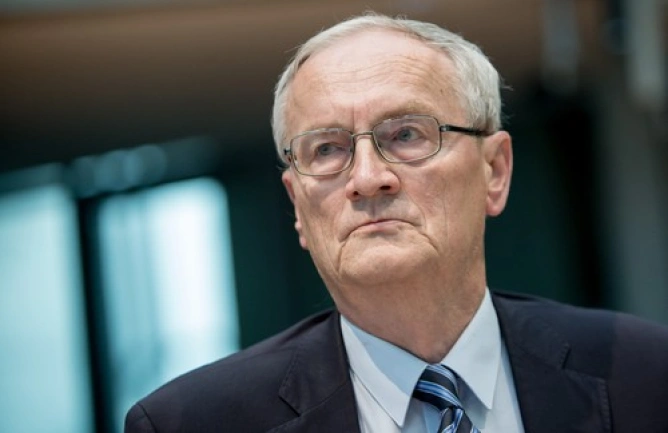
Sever Voinescu: On the matter of statues. The Goga case. The Păunescu case.



Always see our news on Google
At the end of July this year, the Institute for the Investigation and Research of the Crimes of Communism and the Memory of the Romanian Exile requested the competent authorities to remove from public space the monument (bust) dedicated to the poet Adrian Păunescu, which is now in Icoanei Garden Park. The request came shortly after the Association for the Prevention and Combat of Antisemitism and Legionaryism in Arad requested and obtained the removal of the bust of the poet Octavian Goga from the Copou park in Iași. Both cases have sparked discussions, controversies, and frustrations. It is hard for me to compare and say which was more noisy. But the cases deserve to be discussed together, as they stem from the same fundamental question: what statues do some want and others do not want to be taken down? Those of poets? Those of politicians? Those of public figures? Both were, in very different times, a bit of everything, but they remain in the collective memory, especially as poets. I am not discussing tastes now – whether we like the poetry of one or the other or both or neither is of little importance. The fact is that both have a right to citizenship in any history of our literature and that both have real success with the Romanian reader, as he is.
We do not ostracize poets, obviously. When, in 2011, the celebration of 50 years since the death of Louis-Ferdinand Céline was removed from the annual calendar of official festivities of the French Ministry of Culture, which was led by Frédéric Mitterrand, he justified: no one will ever take him out of literature, he can be published, read, taught in school, loved, reviewed, discussed, but the French state cannot celebrate a French citizen who called for the death of other French citizens. Céline actually did that. It is true that the brilliant French prose writer – the only French novelist of the last century who can compete with Proust in terms of posthumous literary influence – no matter how great he is, has no statue in France. Of course, you can tell me that France is full of statues, it does not lose much – you are right. However, in Romania, the statues are few and, as can be seen, shabby.
It is enough to look at the names of the organizations that requested the removal of the monuments to understand the motives: Goga was wanted down by an organization that deals with antisemitism, while Păunescu was wanted down by an organization that deals with communism. The reproach against Goga is that he led a party with Nazi sympathies, antisemitic, and that, during his short term as prime minister, he signed one of the most horrible antisemitic laws that deprived over two hundred thousand Romanian Jews of their Romanian citizenship, with extremely serious consequences for them. The reproach against Păunescu is that he became a bard of the communist regime, with heavy odes dedicated to the dictator and, in general, to the dictatorship which, deceitfully, he presented as an age of freedom. He is also reproached for having contributed to the cult of personality of Ceaușescu through the "Flacăra" Cenacle and for having skillfully manipulated an entire generation of Romanians, deceiving them that they were free when in fact they were not. Obviously, both poets have their defenses: Goga was a promoter of Romanianism in occupied Transylvania, he fought so strongly for the cause of the oppressed Romanians in Transylvania that he even went to prison in Szeged, and was even sentenced to death for treason by the Budapest authorities. Well, the hero of the liberation struggle of Romanians from Transylvania became, starting in the 1920s, an antisemitic and delirious pro-Nazi. And if he had remained just a publicist with such orientation, it would still have been horrible, but Goga was Minister of the Interior and then, briefly, Prime Minister, putting into political and administrative action his beliefs. It is one of the most disturbing cases of the downfall of a man who, until a certain moment, had all the data to become a true national hero for Romanians. The good and the evil in Goga's political life can be easily demarcated: good until a certain moment and evil from that moment onward. Unfortunately, he is not the only case in which someone leads an exemplary life until maturity and, towards old age, completely goes off the rails.
Adrian Păunescu was not a dignitary of the communist state, but just a friend of it. Moreover, those whom he did good to and, especially, those who enjoyed the "Flacăra" Cenacle are alive and have a good opinion of him. If in Goga's case we can easily distinguish the two periods of his socio-political activity, that of a fighter for freedom and that of a supporter of horror, in Adrian Păunescu's case the matter is more complicated. Păunescu mixed good with evil all the time. He himself defined himself as a contradictory, volcanic nature and had, of course, a genuine talent for contortion. He wrote openly heavy odes for the communist leadership of the country and secretly launched samizdat poems like the famous "Analfabeților". On the first page, he brought "homage" and on page 10 he slipped in a jab. He induced the spectators of the cenacle the illusion of freedom, like a kind of drug sold under the table, through poetry and rock, through performances that went on until after midnight in a country that the regime closed at 10 PM, proclaimed manifestos of love and became a kind of pharaoh of the folk movement, in which many singers manifested, some of whom had real talent. But the drug of false freedom was, however, poisonous – to say in the 1980s that Romania was a free country was a mere absurdity. Especially when you say it to young people born and raised in communism.
But the speed with which the authorities reacted to the Goga case and the mute inaction in the Păunescu case cannot be explained only by the difference in rank of the two in the regimes they served. It is about the memory of the two political tragedies of the last century – Nazism/Fascism and Communism – which we, as good Europeans, have begun to institutionalize according to fashion and not according to our own history. We no longer remember history as we lived it, but we remember history as we are told to remember it. Although both regimes were genocidal, although both were in strict, I would even say consubstantial connection between them, although they must be considered in binomial, as faces of the same evil, Fascism/Nazism and Communism receive different treatments. A lot has been written about this with a clear conclusion: ultimately, we have metabolized Auschwitz and the Gulag differently. Unforgiving with Nazism and Fascism, lenient, understanding, almost forgiving with Communism.
I think, for example, about how today's generations view some exponents from that broad category of intellectuals who, when young, contributed to Romanian Stalinism, to socialist realism in culture and to the cause of the working class, at a time when repression was at its peak. In the 1960s-1970s, they became a bit more aware. Then they began to distance themselves from their beloved party because younger allies came along or because their Stalinist past was unacceptable for the Ceaușescu present. Then, in the 1980s, towards the end, when hunger and cold came, they also said that they were hungry and cold in various tones, but without disavowing the cause, on the contrary, saying that they were defending the true one. They were not on the road to Damascus, not at all – they were just disappointed that their beautiful communist ideals had been tarnished by those who pushed them aside. Well, the fact that they survived into old age saved them definitively – they are adored and remembered with emotion. In contrast, the generation before them, with Eliade and Noica at the forefront, remains unforgivable. Youth articles that glorified Stalin are overlooked, youth articles that glorified the Captain bury you. That's about it, that's how we are...
https://www.dilema.ro/tilc-show/in-chestia-statuilor-cazul-goga-cazul-paunescu
Latest News
20:53
20:50
20:40
20:34
20:30
See more news
NEWS ON THE SAME TOPICS