Why is everyone talking about Omnibus I



Always see our news on Google
Omnibus I marks the most extensive recalibration of European sustainability rules in recent years. The package promises simplification and competitiveness, but raises serious questions about the future of the EU's ESG ambitions. The analysis follows how this compromise was reached, what changes it brings for companies, and where the vulnerabilities of a legislative shift with major implications arise.
Omnibus I is intended to be proof that Brussels can change policies quickly and flexibly. Or at least that is the impression everyone wants to leave after the recent compromise between the Council and Parliament. What is less said or avoided is the fact that, in reality, we are discussing the joy of annulling regulations that Brussels itself invented. Yesterday they were good, today they must be eliminated. It is neither good nor bad, but the truth is that we will have to be patient for a definitive conclusion on Europe's ability to become globally competitive only through a subtle deregulation imposed rather by public discourse, which focuses on regulations as the main source that hinders European companies from coping in an increasingly unpredictable global economy.
What is certain is that, in recent months, the subject has returned obsessively to discussions, briefings, press conferences, and internal documents in Brussels. The names sound technical and obscure. However, the legislative package has become a symbol of a change in direction in how the European Union understands the relationship between competitiveness and sustainability. For those outside the European ecosystem, the question is natural: what is, after all, this Omnibus I and why does it deserve so much attention?
Let us allow recent history to explain institutional "bruxellization"
Omnibus I is a legislative proposal through which the EU modifies four key directives: the Accounting Directive, the Audit Directive, the Sustainability Reporting Directive (CSRD), and the Due Diligence Directive (CS3D). The European Commission presented the package as a simplification aimed at reducing bureaucracy for companies.
But to understand why Omnibus I has become the main subject of European debates, the broader context must be considered. Europe is simultaneously experiencing multiple crises. It is facing a persistent economic slowdown, stagnant productivity for nearly two decades, increasingly aggressive global competition, and a war that has reconfigured the budgetary priorities of member states. In the famous report presented by Mario Draghi in 2024, perhaps the most influential document that any European official swears they printed and kept under their pillow at night, it is stated without circumlocution that regulation is one of the major issues weighing on European companies.
The diagnosis, although it does not bring anything unknown to the European public, coincided with a rise in accumulated grievances from the European business environment. It has often been openly stated that the volume of ESG requirements is growing too quickly and without sufficient technical support. Valdis Dombrovskis, Vice President of the Commission, summarized this wave of feedback in an interview with Bloomberg, stating that "we must also listen and recognize the concerns that various partners around the world have and reflect on the implications."
At the same time, external criticisms have become increasingly strong. The American administration, international investors, and several think tanks have warned that the EU risks becoming a global exception due to the severity of its rules. From the assertion that the EU due diligence directive would impose obligations that no other major economy requires, to the idea that Europe cannot regulate more than China and cannot provide more subsidies than the United States, much has been written on this topic. The warning was clear: if Europe maintains a level of regulation far above that of global competitors, the risk of losing investments increases significantly.
Why do these regulations scare so many people
Large companies have looked with concern at the new reporting and due diligence directives because they fundamentally change the way they operate, both within the organization and in relation to global supply chains. CSRD imposed the collection and auditing of a very large volume of ESG data, from climate impact and biodiversity to social risks, governance, and exposure to incidents in the value chain. For many companies, compliance meant investments of millions of euros in IT systems, internal procedures, specialized personnel, and extensive relationships with hundreds or even thousands of suppliers. At the same time, CSDDD introduced unprecedented legal obligations, including monitoring the value chain, percentage penalties, and the possibility of being sued for abuses committed outside the EU.
Another reason for concern was legal exposure. The due diligence directive, in its initial form, created a significant risk of cross-border litigation and forced large companies to be accountable for the actions of suppliers, including indirect ones. In a context of geopolitical instability and complex global supply chains, many companies feared they could not sufficiently control risks upstream or in countries with low transparency standards. Additionally, the mandatory disclosure of data on emissions, social impact, and governance could affect ESG ratings and financing costs, leading companies to perceive CSRD not just as an administrative obligation, but as a strategic factor with direct effects on investments and reputation.
Everything starts from money
Against this backdrop, the emergence of Omnibus I no longer seems surprising. It is the Union's response to the accumulation of economic, political, and geopolitical pressures. The Commission has tried to maintain a balance. The Parliament sought to protect SMEs, recognizing that many of the obligations introduced in recent years have evolved too quickly. The Council, under pressure from governments and industry, sought a radical relaxation of the rules to stimulate investments at a difficult time. Each did what they could, hoping for at least a positive outcome, if not outright grandiose.
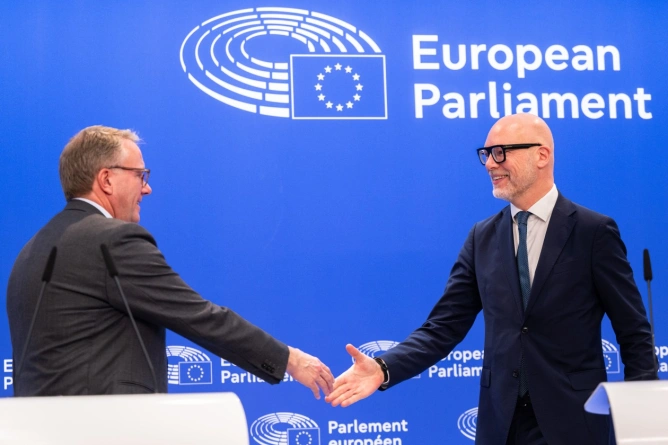
The press conference following the trilogue agreement between the Council and Parliament made the change in tone visible. Jörgen Warborn, the Parliament's rapporteur, was direct in stating that "Europe remains behind in terms of growth, and too much bureaucracy has held companies back. We cannot afford to weaken the economy, but we also cannot take a step back in terms of sustainability. The task has always been to find the right balance." Alongside the satisfaction of political actors in the face of a moment considered historic, we also see a new type of discourse about European competitiveness, in which reducing regulation becomes a condition for economic survival.
In essence, the discussion about Omnibus I is the discussion about Europe's economic identity. Will the Union continue to be a global leader in sustainability while maintaining the cost of a high administrative burden, or will it choose to reduce its ambitions to attract investments and compete with global economies? Omnibus I is the first major political signal that the balance is beginning to tilt towards competitiveness through deregulation.
From this perspective, it is easy to explain why Omnibus I dominates public conversation. Not because it modifies legislative texts in itself, but because it could be the first step through which the future direction of the Union is redefined. Whether this change will bring a healthier balance or create new vulnerabilities depends on how the package will be implemented and on Europe's ability to protect what it has built in recent years.
How did we get here and where are we in reality
For the European Commission, Omnibus I was designed as a responsible simplification. The executive insisted, even from the text of the proposal, that "the proposal aims to balance these perspectives, maintaining the integrity of CSDDD while simultaneously introducing changes that simplify and streamline the Directive." The idea was to reduce bureaucracy, not to abandon the ESG architecture built in recent years. The Commission did not intend to radically reshape the directives, but to respond to criticisms regarding excessive complexity and overlapping standards.
The Council, on the other hand, came up with a much more direct approach. Member states, pressured by companies or their own economic agendas, pushed negotiations towards a drastic reduction of obligations. In the press conference, Danish Minister Morten Bødskov directly articulated this viewpoint when he said that "We see Europe losing ground in terms of investment, and why? Because of burdensome legislation, administrative burdens, procedures, waiting times, adoption processes, all of these things." For some governments, sustainability legislation had become not just an administrative burden, but a risk to competitiveness, a possible explanation for the relocation of investments, and a factor that reduces the flexibility of the European industry.
The European Parliament adopted a mediating role in the negotiation. The institution recognized that some rules had been implemented too quickly and that SMEs risked being disproportionately burdened. Although some MEPs would have preferred to maintain the ESG ambitions in full, the majority accepted the idea that sustainability and competitiveness must be balanced in a new way.
The resulting compromise was not a technical one, but a deeply political one. The four key decisions that define Omnibus I reflect this. The first is the massive increase in thresholds for both CSRD and CS3D, through which hundreds of thousands of European companies are exempted from ESG obligations. Jörgen Warborn, the European Parliament's rapporteur, summarized this change by explaining that, if initially the Commission estimated that about 80% of companies would be excluded, the changes agreed upon by Parliament and Council push this percentage even higher. The second is the complete removal of climate transition plans from the due diligence directive, one of the most visible concessions made to industry. The third is the abandonment of a harmonized civil liability regime, leaving member states to create a difficult-to-navigate legal mosaic. The fourth is the narrowing of necessary due diligence to direct suppliers, a change that helps "companies no longer have to map the entire value chain."
This compromise did not arise in isolation. It reflects the structural tension of Europe in 2025, a Union that wants to remain a global leader in sustainability but is facing unprecedented economic and political pressures. That is why the official narrative has been strongly oriented towards competitiveness, with formulations such as the largest deregulation package for companies in the history of the European Union and the idea that Europe must stop losing investments in favor of more agile economies.
In short
• Reduction of the scope: only the largest companies remain targeted. For CSDDD, the threshold becomes 5,000 employees and 1.5 billion EUR in turnover, while for CSRD it is 1,000 employees and 450 million EUR in turnover.
• Elimination of climate transition plans from CSDDD, one of the most important obligations provided in the initial form of the directive.
• Without a unified European civil liability regime in CSDDD: liability remains at the member state level, which maintains significant differences between jurisdictions.
• Changing the approach to risk identification in CSDDD (Article 8): companies will no longer have to identify all potentially severe or theoretical risks, but only actual impacts, which reduces unjustified administrative pressure.
• Cap on penalties at a maximum of 3% of global turnover in CSDDD.
• Protecting the integrity of trade secrets in CSRD, to limit the disclosure of sensitive information.
• Exemption for financial holding companies in CSRD, limiting the application of reporting obligations.
• Complete exemption for subsidiaries of large companies in CSRD, if reporting is covered at the group level.
• Creation of a single digital portal for sustainability reporting in CSRD, aimed at simplifying access to requirements and procedures.
Where the balance of Omnibus I can break
Although Omnibus I is presented as a necessary solution to protect the competitiveness of the European economy, the package also hides a series of structural vulnerabilities that could affect the Union's credibility in the long term.
The first critical point concerns the climate dimension of the legislation. By completely eliminating climate transition plans from CS3D, the Union is giving up one of the strongest links between the European economy and the climate goals assumed through the Paris Agreement. Critics argue that the EU sends a contradictory message, as it supports the green transition at the discursive level but eliminates legal tools meant to accelerate it.
Even more problematic is the impact on global supply chains. By limiting necessary due diligence only to direct suppliers, the directive ignores a reality known to all specialists in the field: the most severe human rights violations, from forced labor to deforestation, often occur in indirect supply chains, where European companies generally have the weakest visibility. Through this change, the Union risks weakening a policy built over years and allowing companies to declare formal compliance without identifying real systemic risks.
Another major risk arises from the absence of a harmonized civil liability framework at the European level. The Commission proposed a common framework, but the Council rejected the idea, a decision that could create profound legal fragmentation. Companies operating in multiple member states will navigate different legal systems, with different risks and high compliance costs. Thus, what should have been a simplification package paradoxically produces a higher degree of complexity for cross-border companies.
There is also an important paradox: although ESG legislation is relaxed, European financial institutions remain strictly regulated through Taxonomy and SFDR. This means that banks, investment funds, and insurers will continue to require detailed ESG data from companies, even if the law no longer explicitly obliges them to produce it. The ESG pressure does not disappear, but simply shifts from legislation to the market. For companies, the situation is confusing and may create a new form of indirect burden, especially in the equation of voluntary reporting versus mandatory financial requirements.
Do the risks merit a change in direction?
Omnibus I represents one of the most significant moments of recalibration of European legislation in recent years. It is a correction that many economic actors consider necessary. Thousands of European companies will escape costly reporting obligations, large companies will be able to operate under clearer rules, and SMEs finally receive the protection they have been demanding for years. For supporters, this is proof that the Union can still listen to the voice of the business environment and adapt to changing economic realities.
Omnibus I brings to the forefront the fundamental dilemma of Europe: how can the Union remain competitive without abandoning the green transition and social standards that have become defining for the European model? In recent years, the emphasis has been heavily placed on sustainability, and now economic pressure has pushed the balance in the opposite direction. This tension is not a failure, but a reflection of a complex reality, in which public policies must simultaneously serve economic, ecological, and social objectives.
It remains to be seen whether Omnibus I represents that smarter balance or a step back too abrupt. The near future will show whether this reform will contribute to revitalizing the European economy or whether it will create long-term vulnerabilities.
https://2eu.brussels/ro/analize/de-ce-toata-lumea-vorbeste-despre-omnibus-i
Latest News
18:31
18:10
18:00
17:53
17:39
See more news
NEWS ON THE SAME TOPICS