The European Parliament demands that Serbia provide concrete evidence of commitment to the values of the European Union.



Always see our news on Google
The European Parliament's Committee on Foreign Affairs warns that Serbia must demonstrate through concrete actions that joining the European Union is a real strategic objective, not just a political formula declared by the government in Belgrade.
The report adopted by the MEPs identifies a persistent gap between Serbia's legislative alignment with EU standards and the effective implementation of reforms, a gap that continues to affect the country's progress towards accession.
In short, the European Parliament's Committee on Foreign Affairs calls for measurable and sustainable progress in Serbia's reforms related to EU accession.
MEPs point to issues in the rule of law, elections, combating corruption, judicial independence, press freedom, and the functioning of democratic institutions.
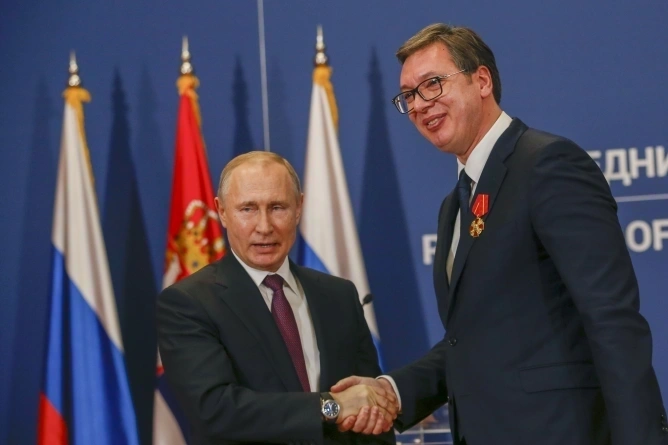
The report criticizes Serbia's close ties with Russia and calls for full alignment with the EU's common foreign and security policy.
MEPs want any regressions in reforms to be reflected in the financial support given to Serbia through pre-accession instruments.
The report was adopted with 51 votes in favor, 14 against, and 10 abstentions and will be submitted to a vote in the plenary of the European Parliament.
The report states that Serbia's accession negotiations must advance only based on measurable and sustainable progress. MEPs mention the rule of law, free and fair elections, combating corruption and organized crime, judicial independence, press freedom, public administration reform, and the functioning of democratic institutions.
The Committee on Foreign Affairs criticizes what it considers to be a too conciliatory approach towards Serbia and calls on the European Commission to take into account any significant regression in the pace and intensity of reforms when providing financial support through pre-accession instruments.
MEPs also state that constructive engagement in normalizing relations with Kosovo is a condition for support under the Reform and Growth Plan. The message thus links European financial support to concrete political and institutional results.
The report criticizes Serbia's close relations with Russia, which raise questions about the country's strategic orientation. MEPs assert that full alignment with the EU's common foreign and security policy remains a non-negotiable requirement for accession, including alignment with restrictive measures against Russia.
The Committee on Foreign Affairs specifies that each candidate country must be evaluated on its own merits and that no state should be linked to another or treated as part of a package. This wording targets the logic of the enlargement process, in which the technical and political progress of each country must be assessed separately.
The report draws attention to the low level of support for EU accession in Serbia. MEPs link this to an anti-EU narrative promoted by government-controlled media, as well as by some high-ranking officials and members of the ruling party.
In this context, MEPs call on the European Union to strengthen its cooperation with non-governmental organizations in Serbia to enhance democratic resilience and combat hybrid threats.
The report also mentions the political crisis in Serbia, against the backdrop of massive protests taking place in the country since November 2024. MEPs assert that the solution to overcoming the crisis is to organize truly free and fair elections.
Rapporteur Tonino Picula, S&D MEP from Croatia, stated that Serbia cannot credibly claim that EU accession is a strategic objective while undermining democratic standards, neglecting reforms and recommendations regarding electoral integrity, and not aligning with the EU's foreign and security policy.
"The country's path to the EU will remain blocked until its political leadership demonstrates a real commitment to the values and obligations of accession," Picula said.
Serbia has been a candidate country for the European Union since 2012, and accession negotiations were opened in 2014. The report from the Committee on Foreign Affairs shows that political support for Serbia's accession remains conditional on the implementation of reforms, geopolitical alignment with the EU, and the democratic functioning of institutions.
Latest News
17:18
17:16
17:16
17:11
17:03
See more news
NEWS ON THE SAME TOPICS