European Parliament calls for trade reciprocity with China and proportionate measures if Beijing does not open its market



Always see our news on Google
The European Parliament adopted by 454 votes in favour, 86 against and 110 abstentions a recommendation on EU relations with China, calling for fairer conditions for European companies, reduced strategic dependencies, and the protection of critical technologies and infrastructure. The text is a political position addressed to the other European institutions and does not automatically introduce new tariffs, sanctions, or trade restrictions.
The European Parliament called on the EU to pursue a more balanced economic relationship with China and to be able to respond with proportionate measures if Beijing does not improve European companies’ access to its market. The recommendation on EU-China political relations was adopted on Wednesday, 7 October, by 454 votes in favour, 86 against and 110 abstentions.
In brief
1.The Parliament calls for fair conditions for trade and investment and supports proportionate EU measures if access to the Chinese market does not improve.
2.MEPs want to reduce European dependencies in areas such as critical raw materials, medicines, batteries, electric vehicles, semiconductors, and information and communications technologies.
3.The recommendation links relations with China to Russia’s war against Ukraine, economic security, Taiwan, human rights, and cyber and hybrid threats.
4.The Parliament maintains the EU policy of “one China” and rejects any unilateral change to the status quo in the Taiwan Strait by force or coercion.
5.The text is a political recommendation. The Parliament’s vote does not, by itself, introduce tariffs, sanctions, or other new trade restrictions.
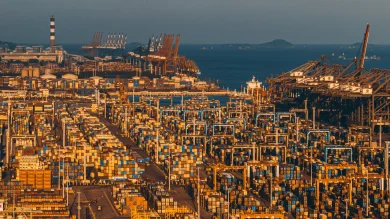
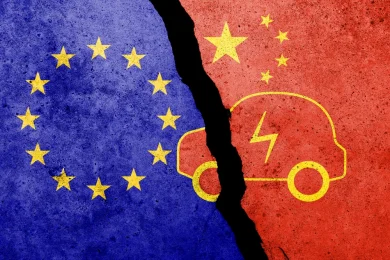
In economic terms, the Parliament identifies China’s industrial overcapacity, state subsidies, and the restrictions faced by European companies in the Chinese market as increasingly important problems for the Union’s economy. MEPs call for fair conditions for trade and investment and support the possibility of proportionate European measures if Beijing does not open its domestic market further. However, the recommendation does not establish the level of any potential tariffs, the instruments that should be used, or a timetable for introducing them.
The adopted position extends the issue of trade reciprocity to economic security. The Parliament calls for reducing the risks created by European dependencies on critical raw materials, medicines, batteries, electric vehicles, information and communications technology, and semiconductors. It also calls for stricter investment screening and stronger protection for critical technologies, strategic infrastructure, and supply chains.
Reducing these dependencies is not presented as a severing of economic relations with China. The recommendation supports maintaining dialogue and cooperation where the interests of both sides allow, but calls for the EU to protect its economic and security interests more firmly.
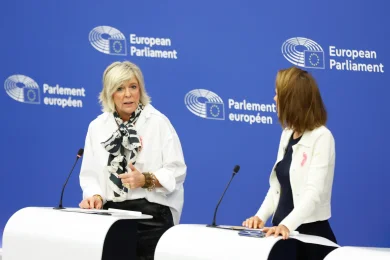
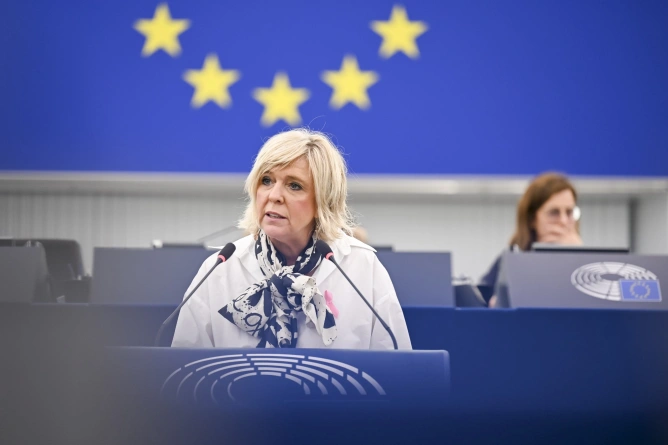
“We want cooperation with China wherever possible, while remaining firm on our security and values,” said Hilde Vautmans, a Belgian Renew Europe MEP and the Parliament’s rapporteur for the file, after the vote.
Vautmans described the majority obtained as a turning point for European policy towards China. This is the rapporteur’s political assessment, not a legal effect of the vote. The recommendation was adopted under a Parliament own-initiative procedure and is addressed to the Council, the European Commission, and the EU High Representative for Foreign Affairs and Security Policy.
The economic relationship is also linked in the text to Russia’s war against Ukraine. The Parliament calls for coordination with the United States, the G7, and other partners and asks China to use its influence over Russia to help bring the war to an end.
MEPs also express concern over reports that the Parliament describes as verified, according to which the Chinese military may have trained Russian soldiers for the war in Ukraine. The Parliament’s recommendation is the source of this claim. 2EU has not independently verified the original reports on which the assessment is based.
Regarding Taiwan, the Parliament reaffirms the EU policy of “one China” and opposes any unilateral alteration of the status quo by force or coercion. The position does not represent a change in European policy towards Taiwan.
The security dimension also includes a call for the EU to strengthen its ability to respond to cyberattacks, foreign interference, espionage, and hybrid threats. The recommendation does not, through this wording, attribute individual incidents to China without specific evidence and does not create a new European legal mechanism for defence against these risks.
On human rights, the Parliament calls for continued pressure on Beijing over political repression, forced labour, and the situation in Tibet and Xinjiang and calls for the unconditional release of political prisoners. MEPs also express concern about China’s law on promoting ethnic unity and progress and about the risk, in the Parliament’s assessment, that it may reinforce assimilation policies.
The recommendation simultaneously calls for strengthening Global Gateway partnerships, particularly in Africa and Latin America, as a credible European alternative to China’s Belt and Road Initiative. The text sets a political direction without announcing new financial allocations for Global Gateway through this vote.
The vote comes at a time of a gradual resumption of parliamentary contacts with Beijing. Three European Parliament delegations visited China between March and June 2026, and another visit is planned for October. Direct contacts with the Chinese authorities resumed in 2025, after parliamentary relations had been practically frozen since 2021 following sanctions imposed by China on some MEPs in response to EU sanctions over human rights violations.
The recommendation adopted on 7 October turns the draft debated the previous day into an official position of the European Parliament. It is not binding legislation and does not automatically produce trade measures against China. Concrete decisions on trade instruments, possible sanctions, or other Union measures must be taken separately, within the applicable European competences and procedures.
Latest News
07:14
07:10
22:55
22:48
22:22
See more news
NEWS ON THE SAME TOPICS