


ANALYSIS Brexit without profit: London seeks reconciliation with the EU



Always see our news on Google
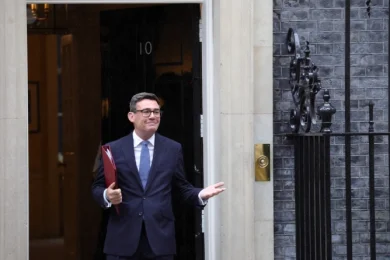
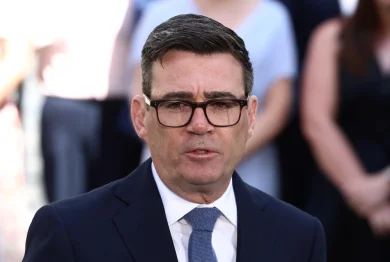
After a decade of Brexit, Prime Minister Andy Burnham declared that Britain had “lost more than it gained” and is preparing a reconciliation with Brussels. Full reintegration into the EU, however, remains a conditional scenario dependent on an electoral mandate, a change in Labour’s red lines, and the unanimous approval of all 27 member states — not an imminent decision.
Why the subject is resurfacing
The central reason is economic: Brexit reduced, according to estimates cited by the prime minister, trade with the EU and is said to have cost Britain between 4% and 8% of GDP. A "UK in a Changing Europe" report estimates a loss of 2–6% of GDP compared with the scenario of remaining in the EU, while a limited “reset” would add at most around 0.5 percentage points over 15 years.
Burnham argues that Brexit failed to deliver on its promises — control over borders, laws, and the economy — and that Britain’s isolation weakens Europe in a context of global protectionism and Russian pressure on Western unity. He compares the situation to the fairy tale “The Emperor’s New Clothes”: a reality that political elites allegedly refused to acknowledge.
Who supports reintegration and why
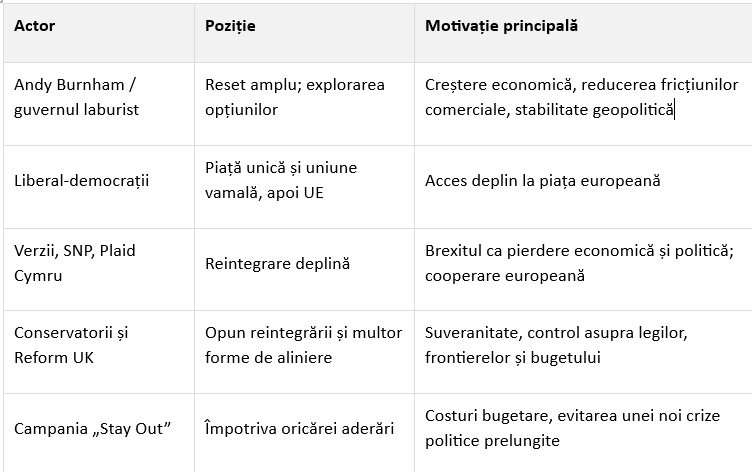
Support for reintegration comes mainly from the liberal and pro-European left: the Liberal Democrats propose a gradual approach toward the single market and customs union, while the Greens, SNP, and Plaid Cymru ((translated from Welsh, the Party of Wales, is a Welsh nationalist political party with a center-left to left-wing orientation) explicitly support returning to the EU. Their argument is economic growth, access to the single market, youth mobility, and cooperation on security, energy, and climate.
For now, Prime Minister Burnham is not officially calling for immediate accession. He speaks of “options” for the long-term relationship — a customs union, single market, or, at the limit, full reintegration — and says that Brexit has done “more harm than good”.
What it would mean for Britain
A return would restore access to the single market and customs union, reducing barriers to trade, services, work, and mobility. But it would entail accepting EU rules without the possibility of unilaterally changing them, budget contributions, and, very likely, giving up some pre-Brexit privileges.
The greatest political barrier is not Brussels, but British public opinion. A YouGov poll cited by Politico shows that 55% of Britons want to reverse Brexit, but support falls to 35% if accession were to involve the euro and Schengen - 43% would oppose it in this scenario.
What the EU would gain — and what it would demand
For the EU, Britain’s return would strengthen the European economy, financial markets, security, and the bloc’s global standing. But it would also bring back a large, often demanding member, with a history of strained relations and the risk that a future British government might reopen the dispute over membership.
Brussels appears open to flexibility: two EU officials told Politico that Britain would not necessarily be required to join the euro or Schengen immediately if it applied for membership. However, the EU has no formal position, since London has not submitted an application, and any opt-out would have to be negotiated and unanimously approved.
What are its actual chances
The chances of full reintegration in the short term are slim. Until the next general election, Burnham remains bound by the commitment inherited from Keir Starmer not to reintroduce the customs union, single market, or free movement of people.
However, the door is not closed. The next general election must take place by July 2029 at the latest, and Burnham has suggested that the chosen option could be included in the Labour manifesto; in his view, an immediate referendum would be premature.
The EU procedure is clear: an application under Article 49 TEU, accession negotiations, unanimous agreement by the Council, the opinion of the European Parliament, and ratification by all member states. In practice, Britain’s existing alignment could shorten the process, but it cannot make it automatic or politically painless.
When it could materialize
The most likely path is not a lightning-fast return, but a gradual “ladder”:
2026–2027: signing and implementation of reset agreements concerning food, energy, emissions, and youth mobility.
By 2029: public debate and, possibly, inclusion of a more ambitious option — a customs union or single market — in the Labour manifesto.
After 2029: only if Labour wins a clear mandate, changes its political red lines, and obtains sufficient public support could Britain officially submit an application for membership.
Effective reintegration would therefore be a years-long process, dependent on negotiations, ratifications, and political consensus in all EU capitals.
Verdict
Britain is not preparing, at this moment, to “rejoin the EU” — it is preparing to acknowledge, after ten years, that hard Brexit carried a high economic and strategic cost. Full reintegration is a real possibility in the medium or long term, but contingent on a major change in British domestic politics and on a less romantic understanding: the EU would not take back a partner with the same exemptions and the same bargaining power as before.
Analysis prepared with the support of Perplexity
Latest News
16:56
16:49
16:44
16:29
16:14
See more news
NEWS ON THE SAME TOPICS






.webp)





