ANALYSIS The Kerch Bridge, between Putin’s symbol and Crimea’s supply route. The stakes of the Ukrainian attacks



Always see our news on Google
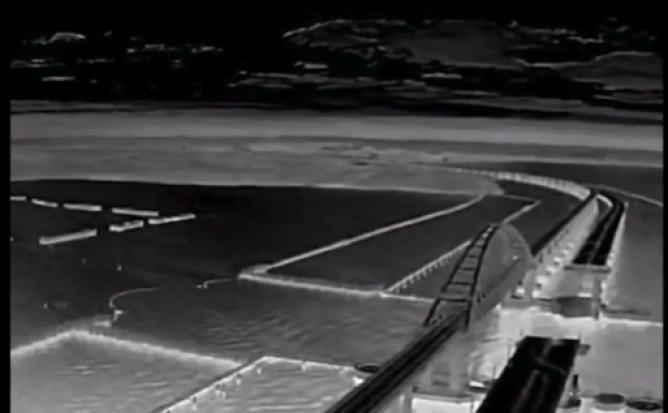
The Kerch Bridge, which links Russia to the occupied Ukrainian peninsula of Crimea, was attacked for the second consecutive day, on November 17, and traffic was suspended, according to the Moscow-installed authorities. Defense România reports that the main arch of the road section collapsed into the water. Although the extent of the destruction has not yet been established, damage to the Kerch Bridge has been a constant Ukrainian objective since the beginning of the war, and blocking this vital access route would represent a major logistical and symbolic blow to Russian President Vladimir Putin.
Built at a cost of approximately $3.6 billion, according to Reuters, the bridge is one of Vladimir Putin’s signature investments and an important supply route for Crimea. The two attacks this week bring to five the number of major Ukrainian operations recorded against it since 2022.
What is known about the November 17 attack
Sergey Aksyonov, head of the Russian-installed administration in Crimea, announced the suspension of traffic and the deaths of two people in attacks on the peninsula. Reuters does not locate these deaths on the bridge. At the time of the agency’s report, Ukraine had not immediately commented on the operation, and the severity of the damage remained unclear.
Defense România describes the collapse of the road arch and sections of roadway, based on images shared on social media and information from monitoring channels. The publication also reports the suspension of rail traffic, while noting that the extent of the damage to this component was still being assessed. Ukrainian reports make the same distinction between images of the collapsed road structure and the lack of full official confirmation of the damage.
The attack came after the strike on November 16. At that time, the Kremlin described the damage as minor, and Russian authorities announced the resumption of traffic on one lane in alternating directions after approximately 17 hours. Trains were running normally, according to the same authorities. The new strike thus interrupted only a partial return to normal operations.
A billion-dollar project directly linked to Putin
The bridge is 19 kilometers long and comprises two parallel structures, one for road traffic and one for rail traffic. In the area intended for ships to pass through, they use wide spans supported by metal arches. This configuration explains why the destruction of the road arch does not automatically mean the destruction of the railway bridge as well.
Construction followed Russia’s annexation of Crimea in 2014. Putin inaugurated the road component in May 2018, driving a truck across the strait; the railway link became operational in 2019. Reuters puts the cost at approximately $3.6 billion, while reports at the inauguration cited 228 billion rubles, equivalent to approximately $3.7 billion at the time.
The project was carried out by a company belonging to Arkady Rotenberg, an ally of the Russian president. The investment represented more than transport infrastructure: it created a direct connection between the Russian network and the peninsula, becoming a material expression of Moscow’s claimed control over Crimea.
Military effects: more difficult supply, not automatic isolation
The bridge’s importance stems from the overlap of civilian and military uses. It transports fuel, food, and other goods to Crimea, where Sevastopol is the historic base of the Russian Black Sea Fleet. After the full-scale invasion in February 2022, it also became a major route for Russian troops operating in southern Ukraine.
A prolonged interruption of traffic would force Moscow to redistribute shipments. Russia also has the land corridor through the Ukrainian territories occupied along the Sea of Azov. Therefore, taking the bridge out of service would reduce logistical options, without by itself proving that the peninsula or Russian forces had become completely isolated.
The consequences depend decisively on the condition of the railway. A destroyed road section, with trains still able to run safely, produces a different effect from the interruption of both components. Until a technical assessment is made, the preventive suspension of rail traffic should not be confused with the destruction of the structure supporting it.
If the interruption of both links continues, pressure on alternative routes will increase. The military effect is measured not only in kilometers of damaged bridge, but also in the duration of the interruption, the remaining transport capacity, and Russia’s ability to compensate for the loss of this connection. The existence of the alternative corridor therefore limits conclusions about a “definitive severing” of Russian logistics.
Possible consequences for navigation and the population
Defense România states that the remains of the road arch are blocking the passage of large vessels between the Black Sea and the Sea of Azov. If confirmed, the effects would extend beyond transport across the bridge: clearing the shipping channel would become a separate issue from rebuilding the roadway.
For the population, the immediate consequence is the interruption of direct travel. Defense România reports that the authorities in Sevastopol asked those intending to leave for mainland Russia to cancel their plans. In the longer term, the impact on civilian supplies will depend on the duration of the restrictions and the capacity of alternative routes to take over the shipments.
How many times the bridge has been hit
Anton Herashchenko, a former adviser and former deputy minister within Ukraine’s Ministry of Internal Affairs, lists five episodes. The same sequence appears in the reports consulted.
October 8, 2022. The explosion of a truck loaded with explosives caused sections of the roadway to collapse and tanker cars to catch fire. The bridge’s capacity was limited for several months.
July 17, 2023. Sea Baby naval drones struck the bridge in an operation attributed to Ukraine’s SBU security service and navy, damaging the road section.
June 3, 2025. The SBU announced the detonation of charges equivalent to 1,100 kilograms of TNT at the underwater supports. The severity of the damage claimed by Ukraine was not independently verified; traffic resumed after several hours.
November 16, 2026. A new attack caused traffic restrictions and damage that Moscow described as minor.
November 17, 2026. The second consecutive attack halted traffic again, amid reports of the collapse of the road arch.
A symbolic blow amplified by the circulation of information
Beyond transport, the attacks affect the image of a project personally associated with Putin. Their repetition shows that the infrastructure remains vulnerable, despite the protective measures introduced by Russia. NewsVibe monitoring for the search term “Kerch Bridge, crimean bridge,” during November 16–17, shows an explosion in media mentions, of which 93% were classified as negative. The visible sources included Romanian, British, and Ukrainian publications. These data describe the media circulation and tone of the content. Russia’s stake is therefore twofold: maintaining an important supply route and defending a symbol of control over Crimea. The collapse of the road arch, if independently confirmed, would worsen both losses. The scale of the military effect nevertheless remains tied to three unknowns: the condition of the railway, the duration of repairs, and the capacity of alternative transport.
Summary prepared with Perplexity.
Latest News
12:34
12:33
12:33
12:32
12:28
See more news
NEWS ON THE SAME TOPICS





.webp)