



European Parliament to vote on October 7 on recommendations for a firmer relationship with China



Always see our news on Google
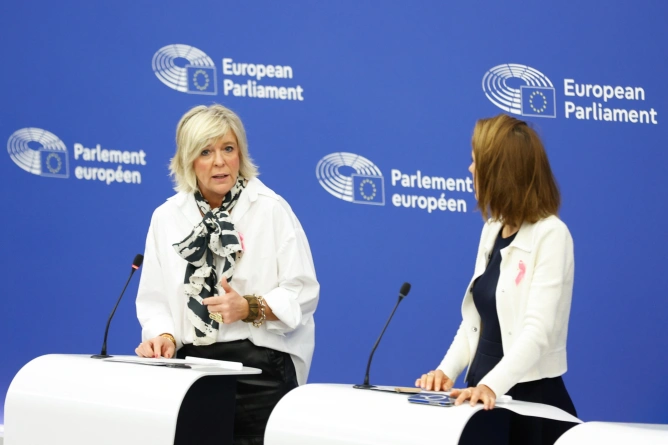
The European Parliament is due to vote on Wednesday, October 7, on its recommendation concerning political relations between the European Union and China, following a debate scheduled for October 6. The report prepared by Hilde Vautmans, a Belgian MEP from Renew Europe and the Parliament’s rapporteur for the dossier, proposes a relationship in which cooperation with Beijing continues but is accompanied by firmer requirements on trade reciprocity, reducing dependencies, securing European infrastructure and technologies, support for Russia, and respect for human rights.
In brief, the European Parliament will vote on October 7 on report A10-0237/2026 concerning EU-China political relations, prepared by Hilde Vautmans in the Committee on Foreign Affairs. The recommendation calls for a more balanced and reciprocal relationship, reduced strategic dependencies, stronger controls on risks related to investments, technologies and sensitive infrastructure, and the use of European trade defence instruments when necessary. The dossier addresses security separately, including China’s relationship with Russia and stability in the Taiwan Strait, as well as human rights in Hong Kong, Tibet and Xinjiang. In the second quarter of 2026, the EU imported goods worth EUR 153.6 billion from China and exported goods worth EUR 50.3 billion to China, resulting in a trade deficit of approximately EUR 103 billion. The vote concerns a political recommendation from Parliament to the Council, the Commission and the High Representative. Its adoption would not automatically introduce tariffs, sanctions, investment bans or other legally binding obligations.
The dossier reaches the plenary after the Committee on Foreign Affairs (AFET) voted on it on September 10, and the report was tabled for plenary on September 16. The procedure is an own-initiative procedure by Parliament, meaning that MEPs are not voting on a European law that would enter into force directly, but can establish a detailed political position to be conveyed to the Council, the European Commission and the High Representative for Foreign Affairs and Security Policy.
This distinction is particularly important for the report’s economic elements. Parliament can call for stronger use of trade instruments, tighter investment screening or protection for certain technologies, but the October 7 vote alone does not impose new customs duties or automatically ban Chinese investments in the European Union. Implementing such measures depends on existing legal instruments and on any subsequent decisions or proposals by the competent institutions.
Valérie Hayer, president of the Renew Europe group, said before the vote that relations with China must be treated simultaneously as an economic, security and foreign-policy issue. In her group’s assessment, dialogue with Beijing remains necessary, but the EU must reduce dependencies considered vulnerable and defend fair competition, European economic interests and human rights more clearly.
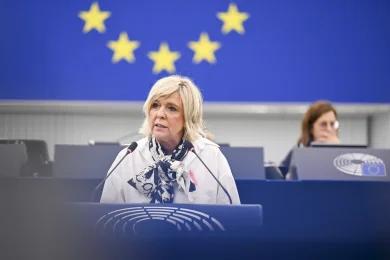
Hilde Vautmans structured the presentation of the report around three dimensions: the economy, security and values. On the economic component, she calls for more effective use of trade defence instruments when unfair trading practices are identified, stronger investment screening and protection for sensitive technologies. The rapporteur places particular emphasis on reducing Europe’s dependence on China for critical raw materials.
The discussion is taking place against a backdrop of substantial imbalance. The latest Eurostat data show that, in the second quarter of 2026, China was the EU’s largest supplier of goods, with European imports worth EUR 153.6 billion. EU exports to China amounted to EUR 50.3 billion in the same quarter, bringing the trade deficit with China to approximately EUR 103 billion, the highest quarterly level since 2022.
The data do not in themselves demonstrate dumping in any particular sector, and a trade deficit is not equivalent to a finding of unfair trading practices. Vautmans nevertheless cited electricity, electric vehicles, steel and solar products in the discussion about pressure on European industry and argued that the EU must be prepared to use its trade defence instruments when investigations and legal conditions justify it.
This position forms part of a broader shift in European policy towards China. The EU’s strategic framework describes China simultaneously as a cooperation partner, an economic competitor and a systemic rival. In recent years, the European focus has increasingly shifted towards reducing economic risks, without completely decoupling from the Chinese economy.
The European Commission has simultaneously established new mechanisms for dialogue with Beijing. Following trade consultations in June 2026, the EU and China agreed on a joint mechanism to monitor trade flows, as part of a broader consultation structure on trade and investment. The two sides’ teams were then tasked with working until October on concrete outcomes concerning trade imbalances, exports and other points of friction.
Parliament’s vote therefore comes at a time when economic relations are not frozen and the EU institutions maintain channels of negotiation with Beijing. The report does not propose ending dialogue, and Vautmans said that confrontation with China is not the objective. Her point is that a functioning relationship requires reciprocity, respect for rules and the Union’s ability to limit vulnerabilities when economic or security interests are affected.
Security is the second major pillar. The report links relations with Beijing to Russia’s war against Ukraine and European concerns regarding dual-use goods and companies that may contribute to the supply chains of Russia’s military-industrial complex. For Parliament, policy towards China can no longer be treated separately from European security.
EU institutions have repeatedly raised this issue in dialogue with Beijing. The European External Action Service said during security consultations in March that China’s position on Russia’s war continues to affect EU-China relations and called on Beijing to use its influence over Moscow to help bring the war to an end.
The report also addresses the situation in the Indo-Pacific. Vautmans identified stability in the Taiwan Strait as a direct European interest, while the EU’s existing position opposes any unilateral change to the status quo through force or coercion. Along the same lines, Parliament is monitoring developments in the South and East China Seas and their impact on international security and trade.
The third dimension concerns human rights. Vautmans said that economic interests must not lead the EU to abandon its positions on Tibet, Xinjiang, Hong Kong and other individual cases. The report thus continues the line taken by the European Parliament, which in recent years has adopted several critical positions on the situation of fundamental rights in China.
Political contacts between Parliament and the Chinese authorities resumed after a period of freeze. The first interparliamentary meeting in China after Beijing lifted the restrictions imposed on the European Parliament took place in May 2026. An AFET delegation then travelled to Beijing and Shanghai in July, where it discussed trade relations, Ukraine, human rights and the situation in the Indo-Pacific with Chinese authorities.
This resumption of contacts also explains the dual nature of the recommendation now coming to a vote. Parliament is seeking to maintain institutional dialogue with China while combining it with stronger risk-reduction mechanisms and more explicit political conditions concerning security and human rights.
Manfred Weber, president of the European People’s Party Group, separately argued at his conference on October 6 that the EU must use its single market and trade instruments more forcefully in relations with Beijing. He also welcomed Franco-German cooperation to strengthen European economic defence instruments, presenting the China issue as one of the main challenges for Europe’s industrial base.
France and Germany formally called in July for the rapid and systematic use of existing trade instruments and the development of additional instruments to reduce dependencies in critical and strategic sectors. This initiative is, however, separate from Parliament’s report and should not be presented as part of the text that MEPs will vote on October 7.
Another point Vautmans stresses is investment screening. The issue is not the presence of every Chinese investment in Europe, but the risk that the acquisition or control of strategic assets could provide access to sensitive infrastructure, technologies or information. Parliament has long called for economic openness to be accompanied by an assessment of such risks.
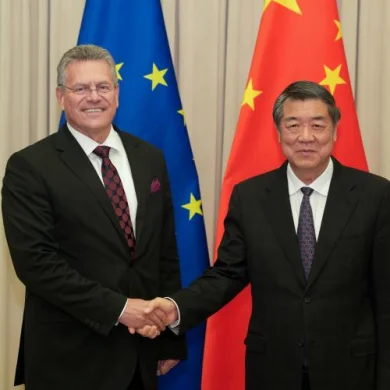
The report also comes ahead of important trade contacts between the Commission and Beijing. The Commission and China launched a new consultation framework on trade and investment at the end of June, and the Commissioner responsible for trade and economic security, Maroš Šefčovič, identified October as the deadline for assessing progress achieved by the working groups.
The October 7 vote will determine whether the plenary supports the political recommendation prepared by AFET and in what form, including any amendments adopted in plenary. For this reason, the wording of the tabled report and the positions presented by political groups must be distinguished from the text that will actually result after the vote.
If the report is adopted, Parliament will have an updated political position for EU-China relations, but implementation of the recommendations will fall to the other institutions within the limits of their powers. For readers, the essential distinction is that October 7 may change the political direction Parliament calls for in relations with Beijing, not the legal regime governing EU-China trade overnight.
Sources

Latest News
20:05
19:50
19:49
19:45
19:38
See more news
NEWS ON THE SAME TOPICS






.webp)


