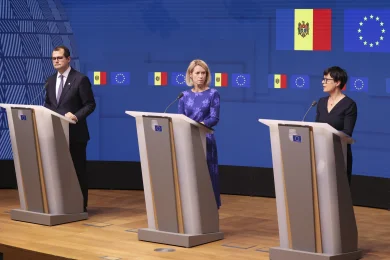
EU: the elections in Moldova were competitive, but Russian interference and disinformation reached unprecedented levels.




Always see our news on Google
The EU report on human rights and democracy shows that the parliamentary elections in September 2025 were well administered and provided voters with clear alternatives. However, the election took place against a backdrop of Russian interference and disinformation that the EU describes as unprecedented.
The parliamentary elections in the Republic of Moldova in September 2025 were well administered, competitive, and offered voters a clear choice between political alternatives, but they were held against a backdrop of Russian interference and disinformation of unprecedented scale, according to the EU report on human rights and democracy. The assessment shows that pressures on the electoral process were accompanied by the intimidation of journalists, disinformation campaigns, and attempts at electoral corruption, while Moldovan institutions continued to adapt legislation and response capacity.
In short The EU assesses the parliamentary elections in September 2025 as well administered and competitive, with voters having the opportunity to choose between clear political alternatives. The report states that the election was marked by an unprecedented scale of Russian interference and disinformation. Moldova has strengthened legislation to combat electoral corruption, but the EU says it must continue to align with European standards. The intimidation of journalists increased during the electoral cycle and disinformation campaigns, even though legislation to protect the press has been strengthened.
In 2025, Moldova completed the screening process of EU legislation, and the Commission considered all clusters ready for opening, while European support for integration, democracy, and the rule of law continued to grow. The EU's annual report describes the legal and institutional framework for fundamental rights in Moldova as largely functional, but identifies persistent problems in areas such as detention conditions, the capacity of human rights institutions, and the protection of vulnerable individuals. At the same time, the year 2025 was politically dominated by the parliamentary elections and external pressures on the electoral process.
The EU appreciates that the September elections were managed properly, were competitive, and offered voters the opportunity to choose between political alternatives. However, the report highlights the exceptional nature of the environment in which the election took place, stating that the elections were marked by an unprecedented scale of Russian interference and disinformation.
Moldova responded to these risks by strengthening legislation to combat electoral corruption. The EU assessment specifies, however, that these norms must continue to align with European standards and that the electoral authority needs sufficient resources, including for monitoring online campaigns.
Information pressures have also affected the media environment. Moldova amended the Audiovisual Media Services Code and introduced new provisions in the Penal Code to strengthen the protection of journalists, and the Media Subsidy Fund became operational to support independent journalism. However, the report finds that the intimidation of journalists has increased, especially in the context of elections and disinformation campaigns.
The EU considers that additional measures regarding media ownership transparency are necessary, especially for the print media and online publications. Supporting independent and pluralistic media and combating disinformation remained in 2025 among the areas directly monitored by the Union in its relationship with Moldova.
The report shows that civil society operates in a generally favorable environment and is involved both in the decision-making process and in the technical preparation for EU accession. However, issues related to the protection of human rights defenders and the financial sustainability of civic organizations persist, and the reduction of USAID funding has highlighted their dependence on international donors.
Moldova has also made progress in the field of gender equality. The report mentions the seventh place occupied in 2025 in the Global Gender Gap ranking by the World Economic Forum, which placed the country for the first time among the top ten worldwide. In other rankings, Moldova ranked 35th in the World Press Freedom Index, 68th in the World Justice Project Rule of Law Index, and 80th in the Corruption Perceptions Index.
The EU accession process has advanced in parallel with these developments. Moldova completed in September 2025 the analytical examination of European legislation, and the Commission assessed all clusters, including the one regarding fundamentals, as ready for opening. In December, member states provided a direction for moving to technical negotiations regarding clusters one, two, and six, awaiting their formal opening by the Council.
The political dialogue between the EU and Moldova has intensified through the first EU-Moldova summit, held on July 4, 2025, as well as through the Association Council and subcommittee meetings held throughout the year. Fundamental rights, freedom of expression, elections, and combating hybrid interference remained part of this dialogue.
European financial support included the Moldova Growth Plan, worth 1.9 billion euros for the period 2025-2027, which supports economic transformation and European integration. Other projects have funded justice reform, the assessment of judges' integrity, access to justice for vulnerable groups, civil society, and independent media.
The report also notes unresolved issues in the institutional domain. Conditions in prisons continue to be affected by overcrowding, insufficient medical services, and cases of ill-treatment, while institutions for equality and the protection of human rights remain under-resourced.
The assessment of the 2025 elections places external interference and disinformation among the most significant democratic challenges of the year. The EU links these risks to the security of the electoral process, the functioning of independent media, and the capacity of Moldovan institutions to protect political competition during the accession process.
The Republic of Moldova is a candidate state for accession to the European Union, and accession negotiations were formally launched in 2024. The assessment of fundamental rights and the functioning of democratic institutions is part of the "fundamentals" area, which plays a central role in the entire accession process.
The EU report for 2025 thus combines the assessment of the internal situation with monitoring progress towards accession. In the case of the parliamentary elections, the conclusion is twofold: the electoral process remained competitive and well administered, but it was subjected to external pressure that the Union describes as unprecedented.
https://2eu.brussels/ro/news/ue-alegerile-din-moldova-au-fost-competitive-dar-ingerinta-si-dezinformarea-rusa-au-atins-o-amploare-fara-precedent
Latest News
14:30
14:15
13:59
13:43
13:23
See more news
NEWS ON THE SAME TOPICS
.webp)