The EU opens 17 accession chapters with Moldova covering the internal market and competitiveness



Always see our news on Google
The European Union and the Republic of Moldova have formally opened two new negotiating clusters, covering 17 chapters, from the free movement of goods and services to taxation, social policy, digitalisation and industry. However, the EU’s common positions show that several transition requests submitted by Chișinău, including those concerning the purchase of agricultural land, financial services, VAT and the application of certain digital legislation, are not automatically accepted and will continue to be negotiated.
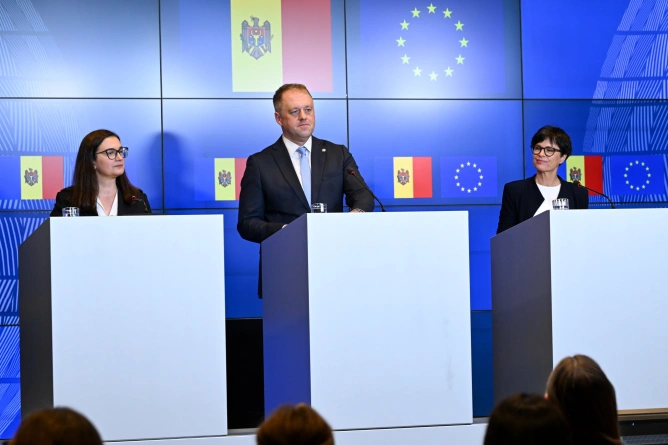
The European Union and the Republic of Moldova formally opened negotiations on clusters 2, “Internal Market,” and 3, “Competitiveness and Inclusive Growth,” at the accession conference on 13 October. The two clusters bring together 17 negotiating chapters and move the accession process towards some of the areas with the most direct impact on companies, workers and consumers, but opening them does not mean that Moldovan legislation is already considered compliant with EU rules or that these chapters are close to being closed. 2EU_Dosar_in_lucru_2026-10-12_a…
The negotiating documents also show where the first sensitive issues arise. The Republic of Moldova has requested transition periods in several areas, from the purchase of agricultural and forestry land to financial services, state aid, VAT and the application of European digital legislation. The EU position does not automatically grant these derogations: in several cases, the Member States are requesting additional information, revised timetables or continued alignment before making a decision.
In brief
Cluster 2, “Internal Market,” comprises nine negotiating chapters, while cluster 3, “Competitiveness and Inclusive Growth,” comprises a further eight.
The negotiations cover areas such as the movement of goods, workers, services and capital, company law, competition, financial services, consumer protection, digitalisation, taxation, economic policy, social policy and employment.
The Republic of Moldova has requested, among other things, a 30-year transition period for certain rules concerning the acquisition of agricultural and forestry land. The EU is requesting additional information and has not accepted this request at this stage.
For the competitiveness cluster, issues remain open regarding alignment with the AI Act, the application of the Cyber Resilience Act, VAT and excise duties, free economic zones, IT parks and the independence of the central bank.
Opening a chapter allows the conditions and necessary reforms to be negotiated. Provisional closure comes later and depends on meeting the benchmarks established by the EU.
The internal market cluster is one of the broadest in the entire accession process. It covers the free movement of goods, the free movement of workers, the right of establishment and the freedom to provide services, the free movement of capital, company law, intellectual property, competition policy, financial services, and consumer and health protection. For the Republic of Moldova, negotiating these chapters means systematically examining how legislation and institutions can operate in a market where products, services, capital and, under certain conditions, people move between states.
However, the free movement of workers does not mean immediate and unconditional access for Moldovan citizens to all EU labour markets. The European common position specifies that any transitional measures concerning access for workers from the Republic of Moldova will be examined during the negotiations. Such arrangements may become part of the accession conditions, and opening the chapter does not prejudge their outcome.
One of the most sensitive points concerns the free movement of capital. The Republic of Moldova is requesting a 30-year transition period regarding certain restrictions on the acquisition of agricultural and forestry land. The EU does not accept this period merely by opening negotiations and is requesting additional information before finalising its position. 2EU_Dosar_in_lucru_2026-10-12_a…
This difference is essential for interpreting the accession documents. A request entered by the Republic of Moldova in its negotiating position does not become a European derogation. It opens negotiations in which Chișinău must explain the measure’s necessity, duration and effects, while the 27 Member States must accept any eventual outcome.
Other requests concern financial services and competition policy. Council documentation indicates that transition periods have been requested for certain financial-services rules, some extending until 2035, as well as periods for certain schemes or measures falling under state-aid rules. Here too, the European common position keeps the assessment open and requests further justifications or adaptations.
Cluster 3 shifts the negotiations towards the economic and institutional infrastructure needed for an economy integrated into the EU to function. The eight chapters include information society and media, taxation, economic and monetary policy, social policy and employment, enterprise and industrial policy, science and research, education and culture, and the customs union.
In the digital field, the EU position records that the Republic of Moldova’s alignment with the Artificial Intelligence Act has not yet been completed. For the Cyber Resilience Act, Chișinău has requested a six-year transition or until the end of 2035, while the EU is requesting an implementation timetable that would allow a concrete assessment of the requested delay. The document does not already grant this period.
Taxation opens another group of practical negotiations. The Republic of Moldova is requesting the temporary maintenance of certain VAT and excise-duty exemptions or reduced rates, while some arrangements relating to free economic zones and IT parks must also be discussed. For the EU, the issue is not only the level of a tax, but the compatibility of the entire system with the tax acquis and with competition and state-aid rules.
In the economic and monetary chapter, the EU is calling for continued reforms guaranteeing the central bank’s effective independence. Accession to the Union does not automatically mean simultaneous accession to the euro area, but monetary legislation and institutions must be prepared for the obligations entailed by membership status.
The opening of the two clusters also establishes the benchmarks on the basis of which each chapter may be provisionally closed. The process therefore operates in two distinct stages: the EU first agrees to open negotiations after assessing the level of preparedness, then monitors the adoption and, above all, the effective implementation of legislation before agreeing to provisional closure.
This stage differs from the one reported by 2EU at the beginning of October, when opening the two clusters was still presented as a possibility for the next accession conference. The Council’s statement of 13 October now confirms the formal result: clusters 2 and 3 have been opened, and the EU’s common positions set out the conditions from which the negotiations begin.
For the Republic of Moldova, expanding the negotiations to these 17 chapters makes the accession process much more concrete. The discussion is moving from general political objectives to rules that will affect who may provide services, how banks are supervised, what conditions companies must meet, how consumers are protected, which tax rules must be changed and at what pace European digital legislation can be implemented.
None of these negotiations sets an accession date, however. A chapter may remain open until the EU considers that the legislation, institutions and implementation meet the necessary conditions, and its closure remains provisional until final agreement on the entire accession treaty.
Latest News
16:41
16:27
16:17
16:17
16:13
See more news
NEWS ON THE SAME TOPICS

.webp)