Marta Kos expects the opening of the final two negotiating clusters with Moldova; Sandu aims to conclude negotiations in early 2028




Always see our news on Google
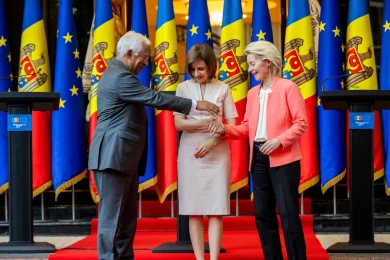
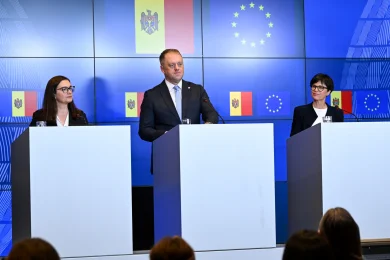
European Commissioner for Enlargement Marta Kos stated on Monday, 9 November 2026, at the annual EU enlargement conference in Chișinău, that she expects the Council to open the last two negotiating clusters with the Republic of Moldova. President Maia Sandu reaffirmed the objective of concluding negotiations by early 2028 and called for 2027 to deliver concrete results in implementing reforms. The timetable is conditional on reforms and the decisions of the member states and does not represent an accession date.
In brief
The Republic of Moldova has four of the six negotiating clusters open. The green agenda and sustainable connectivity, as well as resources, agriculture and cohesion, remain. Kos said she expects the Council’s decision to open them.
Chișinău is aiming to conclude negotiations by early 2028. The Commission considers the objective ambitious but achievable if the pace of reforms is maintained. Accession subsequently requires institutional approvals and ratification of the treaty.
Sandu presented 2027 as a year of concrete results, particularly implementation. The Commission calls for lasting results in justice and the fight against corruption, including investigations, prosecutions and final rulings in high-level cases.
The Commission’s roadmap indicates the possibility of provisionally closing 25 chapters in 2027. The timetable is indicative, and progress depends on meeting the rule-of-law criteria and the conditions for each chapter.
Marta Kos’s visit from 8–10 November includes discussions on accession, the business environment and digital connectivity. Separately, the Commission is preparing dialogues on the gradual integration of candidate countries for the first quarter of 2027, which remains conditional and reversible.
Kos said that the Republic of Moldova had advanced towards the European Union and that 2027 would be crucial for achieving results. Her remarks at the opening of the conference were reported by UNIMEDIA. The Commissioner identified the Council as the institution from which the opening of the two remaining clusters is expected; the statement does not announce a decision already adopted by the member states.
The two clusters are “Green agenda and sustainable connectivity” and “Resources, agriculture and cohesion”. The first covers transport, energy, trans-European networks, the environment and climate, while the second covers agriculture, food safety, fisheries, regional policy and the contribution to the EU budget. In the roadmap presented on 4 November, the Commission calls for their opening by the end of 2026.
The Commission’s favourable technical assessment does not by itself open the negotiations. The EU common position requires the agreement of the member states, and the formal step takes place at an intergovernmental conference with the candidate country. Opening a cluster allows negotiations on the respective areas, without meaning that the legislation is already fully aligned or that the closing criteria have been met.
The Republic of Moldova formally began accession negotiations on 25 June 2024 and completed the analytical examination of its legislation, known as screening, on 22 September 2025. In 2026, the cluster on fundamentals was opened on 15 June, and the one on external relations on 14 July. The conference on 13 October opened the clusters on the internal market and competitiveness and inclusive growth, bringing the total to four.
The EU’s 33 thematic chapters on legislation and policies are organised into six clusters. The cluster on fundamentals includes the rule of law, the functioning of democratic institutions and public administration, and determines the overall pace of negotiations. To move towards the provisional closure of chapters, Moldova must meet the interim rule-of-law benchmarks, and the Commission assesses compliance and transmits its assessment to the Council.
The Commission notes an intensification of legislative alignment and progress in justice, the fight against corruption and administrative reform. However, the assessment does not amount to fulfilment of all accession conditions. November documents call for the effective implementation of reforms and the consolidation of results concerning the investigation of corruption, prosecutions and final court rulings, including in high-level cases. The vetting of judges and prosecutors is a component of the reform, alongside the independence and operational capacity of institutions.
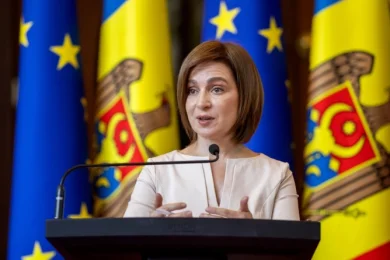
In her speech, Maia Sandu called for 2027 to be a year of concrete results, particularly in implementation. She thanked the institutions preparing the reforms, Parliament, civil society, the business community and local authorities. The President argued that Moldova had continued to advance despite Russia’s war against Ukraine, energy crises and attempts at destabilisation.
Sandu also called for rules to protect the rule of law and the continuity of reforms after accession. Her position refers to the European debate on the functioning of a larger Union and respect for common values. It is not an announcement of a new mechanism already adopted for the Republic of Moldova.
The objective for early 2028 is conditionally supported by the Commission. The enlargement communication describes it as ambitious but achievable if Moldova maintains the pace of reforms and strengthens its implementation capacity. This assessment does not oblige the member states to close chapters by a certain date and does not guarantee the outcome of the negotiations.
For 2027, the roadmap sets out an initial timetable for the provisional closure of 25 chapters: nine in the first half of the year and 16 in the second. The plan may be revised depending on Moldova’s preparedness. Closing each chapter requires verification that the conditions have been met and agreement on any transitional periods; these stages are distinct from opening the last two clusters.
Concluding the negotiations does not automatically confer membership. Accession requires unanimity in the Council, approval by the European Parliament and a treaty establishing the conditions of admission. The treaty must be signed and ratified by all member states and by the Republic of Moldova, in accordance with their constitutional procedures.
The programme of the 8–10 November visit includes meetings with Maia Sandu, Prime Minister Vasile Tofan, Parliament President Igor Grosu and other officials, as well as an address to Parliament. Monday’s agenda includes the high-level meeting of the Connectivity Platform, dedicated to digital infrastructure and regional investment along the Middle Corridor, and an event of the European Business Association. The visit began on Sunday with participation in the inauguration of the Vulcănești–Chișinău line.
This economic dimension forms part of the policy of gradual integration before accession. The Commission announces dialogues with candidate countries for the first quarter of 2027 to assess existing measures and possibilities for deeper participation in the EU market and instruments. Access remains merit-based, conditional and reversible and does not replace accession negotiations.
Latest News
23:50
23:45
23:32
23:25
23:05
See more news
NEWS ON THE SAME TOPICS

.webp)