



Moldova and the other candidate countries targeted for association with European cooperation against interference



Always see our news on Google
Michael McGrath announces the association of the countries in the enlargement process with the European Centre for Democratic Resilience, while the Irish presidency is preparing discussions in the autumn. Separately, Nathalie Loiseau proposes early access to the protection offered by digital rules, without this initiative automatically extending the DSA to Moldova.
The European Commission is preparing the association of candidate and potential candidate countries with the European Centre for Democratic Resilience, a framework for cooperation against information manipulation and foreign interference. Commissioner Michael McGrath’s announcement also concerns the Republic of Moldova, while the Irish presidency of the Council will organize discussions in the autumn about these countries’ participation.
In brief
1.The Commission is preparing the association of candidate and potential candidate countries with the European centre. McGrath announced this stage without specifying a date for Moldova’s actual participation.
2.The Irish presidency will organize discussions in the autumn. The cooperation seeks exchanges of experience, training for officials, and common methods for identifying information threats.
3.Metsola supports helping Moldova protect its elections, while Loiseau calls for candidate countries to benefit earlier from European digital rules. The proposal concerning the DSA remains separate from association with the centre.
4.Participation in the cooperation does not determine the automatic application of the DSA in Moldova. Legislative alignment and the relationship between supervisory authorities require separate steps.
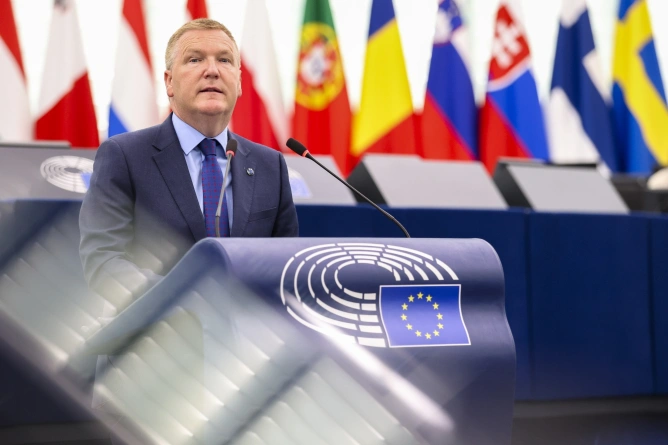
In the plenary session of the European Parliament in Strasbourg, McGrath said that all member states had joined the centre and that the countries in the enlargement process would soon be associated. The representative of the Irish presidency, Thomas Byrne, announced debates in the Council this autumn. Neither intervention indicated a date on which Moldova’s association would become effective.
Moldova had already participated in the technical meeting on 9 July in Brussels. According to the minutes, the candidate and potential candidate countries expressed an interest in becoming active associated partners. The document records support for a flexible, project-based approach and respect for common democratic values, without attributing an individual statement to Moldova. The Secretariat was to collect project proposals in preparation for the ministerial discussion.
The cooperation aims to enable authorities to identify threats more quickly and prepare common responses. McGrath listed projects involving the training of officials, the development of common concepts and methods for detection, and the preparation of a framework for responding to information manipulation and disinformation. Association would provide candidate countries with a framework in which to contribute their own experience and work with administrations in the EU.
The centre does not replace national authorities. Its mission statement provides for information exchanges, training, and coordination while respecting existing competences, including those of independent bodies. The same document calls for the defence of democracy to protect fundamental rights, including freedom of expression.
At the press conference following the vote on the report on the European Democracy Shield, Roberta Metsola supported including Moldova in European efforts to protect elections. The President of the Parliament referred to legislative alignment, cybersecurity, election monitoring, and cooperation between parliaments, as well as the need for resources for independent elections.
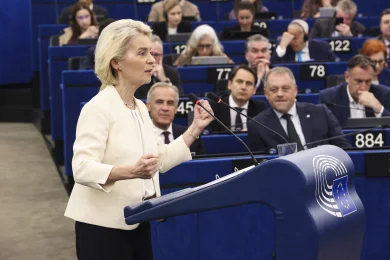
Nathalie Loiseau, chair of the special committee on the European Democracy Shield, proposed that candidate countries should be able to benefit earlier from the protection offered by rules such as the Digital Services Act, known as the DSA. She argued that it is difficult for a country the size of Moldova to negotiate alone with large technology companies.
This proposal does not make the DSA automatically applicable in Moldova. The Regulation establishes obligations for online services operating in the EU, while association with a cooperation centre does not, in itself, alter its scope. Bringing Moldovan legislation closer into line and cooperation between supervisory authorities entail separate steps.
In the joint declaration of the EU–Moldova summit on 22 June, the two sides agreed to continue aligning with European legislation on digital services and markets and support through the initiatives of the European Democracy Shield. This is a bilateral commitment to cooperation and legislative alignment; the document does not establish the specific conditions for Moldova’s association with the centre.
The European Centre for Democratic Resilience began operating in February 2026 as part of the European Democracy Shield. Associating candidate countries would extend cooperation beyond the member states, but the interventions in Parliament leave the details of participation and the timetable applicable to each country for subsequent stages.
Latest News
15:57
15:56
15:47
15:47
15:44
See more news
NEWS ON THE SAME TOPICS

.webp)



.webp)
.webp)


