The 2026 budget shows a pressured EU where funds are limited, but expectations are rising.



Always see our news on Google
Brussels, November 17, 2025 - The European Parliament and the Council have reached a provisional agreement on the Union's budget for 2026, at a time when pressures on European finances are increasing from all directions, from defense and Ukraine to the huge interest rates of the recovery plan. According to the announced compromise, the total level of commitment credits is set at 192.8 billion euros, and actual payments at 190.1 billion euros, with nearly 1.3 billion euros restored to the initial level proposed by the Commission, after member states cut them in the Council. Additionally, the Parliament secured another 372.7 million euros above the Commission's proposal for a list of programs deemed essential for competitiveness, security, and direct support for citizens.
The negotiations were tense precisely because this budget must reconcile two contradictory realities. On one hand, 2026 is the penultimate year of the current multiannual financial framework 2021-2027, a period marked by the pandemic, the war in Ukraine, the energy crisis, and an increasingly unstable geopolitical situation. On the other hand, the exceptional NextGenerationEU instrument is entering a phase where payments reach a peak, and financing costs have exploded with rising interest rates. The Commission confirms that only in 2026 the borrowing costs for NextGenerationEU are 4.2 billion euros above initial estimates, double the forecast made when the recovery architecture was designed. This element, invisible to the general public, is one of the major sources of friction between institutions, as it risks absorbing the budgetary space allocated for concrete programs, from Erasmus+ to health.
The agreement for 2026 attempts to reduce this tension through a so-called cascading mechanism, already agreed upon in discussions regarding the 2025 budget and now applied again. Instead of cutting directly from visible programs, the institutions decided that the interest surcharges should be covered gradually, first using the unused margins from certain budget lines, then special flexibility instruments provided in the financial framework, and only as a last resort, an exceptional instrument above the MFF ceilings, if no resources are found within the budget. The Commission specifies that for 2026 it combines the unallocated margin for resilience and values, the Flexibility Instrument, and the EURI instrument, financed from past decommitments, in order to avoid activating the so-called financial backstop. Politically, the message to member states and Parliament is clear: NGEU interest rates must not become a pretext for sacrificing flagship programs.
In this tight context, the Parliament focused on a few priority lines. In the area of research and competitiveness, Horizon Europe receives an additional 20 million euros, and transport and energy networks funded through the Connecting Europe Facility are boosted with 23.5 million euros to accelerate cross-border projects, deemed essential for the internal market and energy transition. The Erasmus+ program, one of the most visible to the public, receives an additional 3 million euros, a political signal that student mobility cannot be sacrificed during a period of budgetary pressure. In the area of environment and health, the LIFE instrument is increased by 10 million euros, and EU4Health by another 3 million, at a time when the debate about climate change and the resilience of health systems remains central.
Agriculture remains, in turn, a sensitive topic, both politically and socially. Beyond the 53.3 billion euros allocated to the Common Agricultural Policy as a whole, the Commission confirms that an additional 105 million euros are directed towards promoting European agricultural products, especially for young farmers, through the European Agricultural Guarantee Fund. This increase is possible due to revenues exceeding expectations and the carryover of unused funds, which shows how much budgetary space is played on the margins, not through actual increases in the overall ceiling. For political communication, however, it is important that MEPs can show a concrete gain for agriculture, during a period when farmers complain about rising costs and the competitiveness of imports.
Another package of adjustments directly targets the Union's capacity to respond to crises. The budget of the Civil Protection Mechanism and the RescEU component is increased by 10 million euros, in the context where the frequency and intensity of natural disasters, from wildfires to floods, are steadily increasing in European statistics. Military mobility also receives an additional 10 million euros, the program being considered essential for member states' ability to quickly deploy troops and equipment on Union territory in case of crisis. The management of external borders is also strengthened with 10 million euros, in line with a total budget of 2.7 billion euros for border management and 2.3 billion euros for migration, confirmed by the Commission for the year 2026.
The external dimension of the 2026 budget is strongly marked by the war in Ukraine and the crises in the neighborhood. The Ukraine Facility, the new multiannual support framework for Kyiv, benefits from 3.9 billion euros in grants and 7.2 billion euros in loans for the next year, to which are added 15.6 billion euros for the entirety of the external policy, from NDICI Global Europe to IPA III and the Western Balkans Investment Facility. Additionally, the Parliament pushed for an additional 35 million euros for the southern neighborhood, 25 million euros for the eastern neighborhood, and another 35 million euros for humanitarian aid, arguing that geopolitical instability and climate crises are pushing more regions into prolonged emergency situations.
After the adoption of the new defense package at the European level, funding for this area is starting to be seen in the annual budget. The Commission shows that two billion euros are allocated for defense in 2026, mainly one billion for the European Defence Fund, 621.3 million for the new European Defence Industry Programme, including the Ukraine Support Instrument component, and 261.3 million for military mobility. In parallel, through the SAFE instrument, adopted in May 2025, member states can access up to 150 billion euros in loans for investments in defense, guaranteed by the EU budget until 2030, marking a structural change in how the Union treats the industry and military capabilities. The annual budget does not directly cover these loans but creates the guarantee framework and suggests that budgetary pressure for defense will remain high in the coming years.
Looking at the overall distribution, the Commission presents the complete picture of allocations by headings. Almost 56.5 billion euros are reserved for natural resources and the environment, of which 40 billion represent direct payments and market expenditures in agriculture. Cohesion, resilience, and values reach 71.6 billion euros, with 56.6 billion for cohesion policy and 15 billion for resilience and values, a chapter that includes Erasmus+, culture, fundamental rights, and support for civil society. The heading for the internal market, innovation, and digital sums up to 22.16 billion euros, from which Horizon Europe, Digital Europe, InvestEU, and other programs that should support long-term competitiveness are financed.
Behind these figures, the political debate remains the same; the EU budget is relatively small compared to expectations. The Parliament reminds that 93% of the budget goes directly back into programs and projects in member states, and the total size of the annual financial framework, even together with NextGenerationEU, remains comparable to a national budget the size of Poland's, but for 27 countries and 450 million citizens. For the elected representatives, this comparison is an argument that there is no room for unlimited promises in Brussels, while for governments it is an additional reason for caution, especially as national contributions and borrowing costs increase.
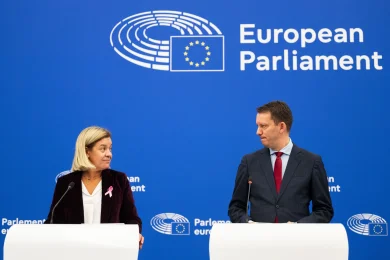
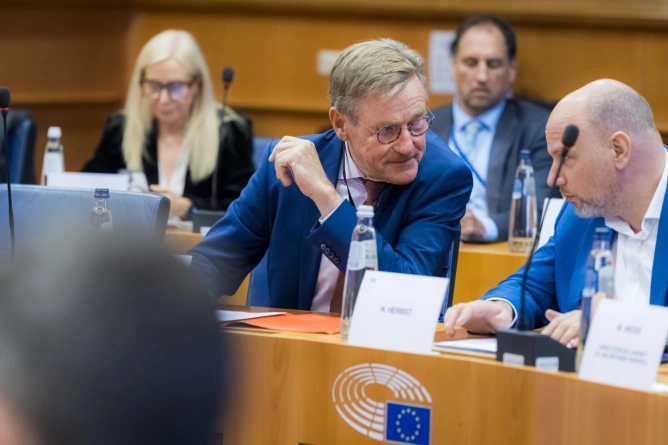
The political statements accompanying the agreement reflect this unstable balance. The Chair of the BUDG in the European Parliament, Johan Van Overtveldt, speaks about the need to respond to citizens' priorities, from research and security to borders and Erasmus+, but warns that the budget alone will not be enough to increase European competitiveness, requiring additional steps. The rapporteur for section III returning to the Commission, Andrzej Halicki, insists on the idea that the Parliament has secured additional funds for the security of citizens, for youth, farmers, and the business environment, highlighting the symbolic lines of the agreement. The Commissioner for the budget, Piotr Serafin, describes the outcome as a compromise that ensures predictability and allows for increased investment in external security, defense, and innovation, but also in programs that directly affect citizens, students, and farmers.
From a procedural point of view, the agreement remains provisional. The Council must formally adopt it, then the text will return to the Parliament's Budget Committee, and the final vote in plenary is scheduled for November 26, 2025, in Strasbourg. Only then will the 2026 budget become an official document and can be implemented from January 1. In parallel, however, discussions regarding the future financial framework after 2028 are already open, and the experience of these years, with successive shocks and maximum use of flexibility margins, fuels the argument that the next multiannual budget will need more elasticity and, probably, additional resources. The Commission explicitly states that the proposals for the new framework, presented in July, are based on the lessons of recent years, especially on the need to react quickly to unforeseen events.
Overall, the 2026 budget shows a Union that tries to do more with less, constantly recalibrating priorities between competitiveness, cohesion, climate, defense, and support for Ukraine, while paying the bill for the borrowing costs of the recovery plan. For the average reader, the figures may seem abstract, but behind them are Erasmus scholarships, infrastructure projects, grants for researchers, payments to farmers, and humanitarian aid in conflict areas. From the way these lines shift by a few tens of millions up or down, one can see both the limited maneuvering space of the Union and the institutions' attempt to show that they listen to citizens' priorities in an increasingly difficult economic and geopolitical environment.
Latest News
18:31
18:22
18:09
17:42
17:15
See more news
NEWS ON THE SAME TOPICS