Commission warns that Ireland’s EU budget proposal reduces joint crisis-response capacity



Always see our news on Google
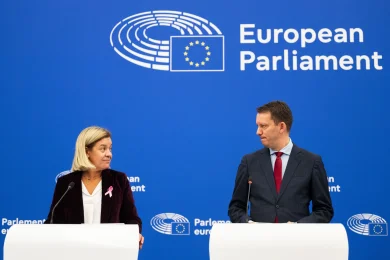
The European Commission warns that the new negotiating box prepared by the Irish presidency for the EU budget for 2028–2034 significantly reduces the Union’s ability to mobilise funds jointly when crises arise and risks diluting one of the central changes proposed for the next financial framework: more closely linking European payments to investments and reforms. Piotr Serafin, the European Commissioner for Budget, Anti-Fraud and Public Administration, voiced these objections following the discussion among European affairs ministers on 13 October. The Irish presidency, by contrast, argues that the document preserves sufficient flexibility and should be seen as a compromise between the positions of the 27 member states.
In brief The negotiating box presented by the Irish presidency on 10 October reduces the total value of the proposed commitments for 2028–2034 from approximately €1.985 trillion to approximately €1.826 trillion in current prices. The Commission believes that reducing resources managed flexibly at European level limits the EU’s ability to respond to wars, natural disasters, economic shocks or other priorities that cannot be anticipated seven years in advance. A second dispute concerns national and regional plans. The Commission’s proposal links funding to investments, reforms, milestones and targets, including the country-specific recommendations issued under the European Semester. The Irish presidency presents the document as a basis for compromise. The General Affairs Council did not adopt the budget on 13 October, and member states are continuing negotiations. EU leaders will discuss the negotiating box at the European Council on 15–16 October. Adoption of the multiannual financial framework requires unanimity among the member states and the consent of the European Parliament.
The dispute over flexibility stems from one of the problems the Commission sought to address when designing the new budget. Under the current financial framework, a large share of the money is allocated in advance for long periods, while changing its purpose during a crisis requires negotiations and legal adjustments. Russia’s war against Ukraine, the pandemic, the energy crisis, fires, floods and new security pressures have exposed the limits of an architecture in which most resources are already earmarked before unforeseen events occur.
The Commission’s proposal for 2028–2034 was designed precisely to leave more room for manoeuvre. The EU executive proposed broader budget categories, the possibility of reallocating funds more quickly between priorities and additional mechanisms for crisis situations. These include a mechanism that could mobilise nearly €400 billion in loans for member states in the event of severe crises. This instrument is different from ordinary budget spending and should not be treated as a permanently available grant envelope.
The Irish negotiating box retains the overall architecture of the future budget but reduces the value of several components proposed by the Commission. Total commitments for 2028–2034 would fall from approximately €1,984.9 billion to €1,825.5 billion in current prices. The reduction of approximately 8% had already been challenged by European Parliament negotiators, but the Commission’s intervention on 13 October highlighted a different consequence: a smaller budget with more limited common resources may have less room to respond when priorities change during the seven-year period.
This issue is not identical to the flexibility that states may have within their own plans. The Irish presidency argues that the new structure gives governments greater scope to adapt the use of funds and that the budget headings retain mechanisms for responding to new circumstances. The Commission, however, distinguishes between national flexibility and the Union’s ability to mobilise common resources for a crisis affecting several states or for a European priority that emerges after the budget has been adopted.
The difference becomes concrete in the case of an event that cannot be attributed to a single programme. A major fire may require civil protection, regional reconstruction and agricultural support. A security crisis may simultaneously require infrastructure, defence, energy and support for states on the external border. If most money is programmed into national envelopes or fixed priorities, the common response depends on the size of the reserves and instruments that can be mobilised without rebuilding the entire budget.
The second dispute concerns how most of the money flowing directly to member states will be spent. The Commission proposed introducing national and regional partnership plans, through which cohesion, agriculture, social policy, fisheries, migration, border management and security would be programmed within a common framework. The plans are not conceived merely as lists of projects. They must contain investments and reforms and address problems identified at European level.
Under the Commission’s proposed model, the country-specific recommendations issued annually under the European Semester would have a direct role. If, for example, a state is advised to improve its administration, reform part of its labour market, strengthen its judicial system or remove obstacles to investment, the European plan can combine investment funding with the reforms needed for the money to produce the intended result.
The mechanism draws partly on the logic used in the Recovery and Resilience Facility. Payments would not depend exclusively on invoices for projects, but on the achievement of agreed milestones, targets or results. In June, the Council established its partial position on this architecture and retained the principle of a link between reforms, investments and funding. The Commission would release the funds after the milestones and targets set out in the plan had been achieved.
For beneficiaries, this change may have contradictory effects. Linking money to results can increase pressure on governments to implement the reforms they have undertaken, but it may also create a risk that delays in a national reform affect investments or beneficiaries who do not control that reform. The Commission proposed safeguards so that regions would not lose funding because of problems for which they are not responsible, while the precise operation of these protections remains part of the negotiations.
The dispute is therefore not about whether reforms will exist in the national plans. The principle appears both in the Commission’s proposal and in the partial position adopted by the Council in June. The issue is how precisely the mechanism linking European priorities, country recommendations, milestones and payments will remain defined when the final text is negotiated between the states.
This conditionality also has a rule-of-law component. The Commission’s proposal for the future budget includes recommendations from the annual Rule of Law Report in the reference framework for national and regional plans. Reforms concerning the judiciary, the fight against corruption, media pluralism or institutional control systems could thus be supported through investments and milestones agreed with the states. These mechanisms are distinct from the Budget Conditionality Regulation, which continues to operate separately.
A third component of the conflict concerns the Union’s own resources. Serafin urged states to make progress in discussions on new own resources, because the next budget must finance new priorities while also covering repayment of the common debt contracted for NextGenerationEU. The Commission had proposed a package of new revenue sources that would generate an average of approximately €58.5 billion per year during the next MFF period.
The Irish presidency includes a number of own resources in the negotiating box, but the issue remains one of the most difficult for states because decisions in this area require unanimity and national approval procedures. The European Parliament has likewise linked its acceptance of the future budget to progress in finding additional European revenues, in order to avoid financing debt repayment and new priorities by compressing existing programmes.
Thomas Byrne, Ireland’s Minister of State for European Affairs and Defence, presented the negotiating box as a document intended to bring the positions of the 27 governments closer together. At the 13 October meeting, he stressed that the text was not an agreement and that negotiations were continuing. The presidency is seeking a political compromise by the end of 2026, so that programme legislation can be finalised in 2027 and funding can begin without interruption on 1 January 2028.
The next test will come at the level of European leaders. The European Council on 15–16 October will discuss the figures and political elements of the negotiating box, but a discussion at a summit does not automatically mean adoption of the financial framework. The multiannual financial framework requires the unanimous agreement of the member states in the Council, following the European Parliament’s consent.
The negotiations will therefore determine more than the budget’s overall size. They will establish how much money remains available for joint decisions during a crisis, how much freedom states receive within their own plans and to what extent access to funding will continue to be linked to reforms and results agreed at European level.

Latest News
20:30
20:24
20:24
20:22
20:07
See more news
NEWS ON THE SAME TOPICS