Irish proposal cuts the Global Europe heading by 17.4% as international aid declines



Always see our news on Google
The compromise proposal presented by the Irish Presidency for the EU budget for 2028–2034 significantly reduces the resources earmarked for the Union’s external action. In 2025 constant prices, the Global Europe heading falls from EUR 190 billion in the Commission’s proposal to EUR 156.936 billion, a difference of EUR 33.064 billion, or 17.4%. The Global Europe instrument within this heading would separately fall from EUR 176.830 billion to EUR 148.984 billion, representing a reduction of approximately 15.75%.
The difference between the two percentages is important for understanding the negotiation. The Global Europe heading represents the broader budgetary framework for external action, while the instrument bearing the same name is one of its components. A 17.4% reduction in the heading does not mean that every development project, partner country or EU external programme will automatically receive 17.4% less.
In brief, the Global Europe heading falls in the Irish Presidency’s proposal from EUR 190 billion to EUR 156.936 billion in 2025 constant prices, 17.4% below the Commission’s proposal. The Global Europe instrument separately falls from EUR 176.830 billion to EUR 148.984 billion, equivalent to a reduction of approximately 15.75%. Barry Andrews, chair of the European Parliament’s Committee on Development, warns that reduced external funding would weaken the EU’s ability to support partners at a time of international instability. Preliminary OECD data show that official development assistance from members and associates of the Development Assistance Committee fell by 23.1% in real terms in 2025, to USD 174.3 billion. The Irish document is a negotiating basis for the future budget, not an already adopted cut or a list of projects that will lose funding.
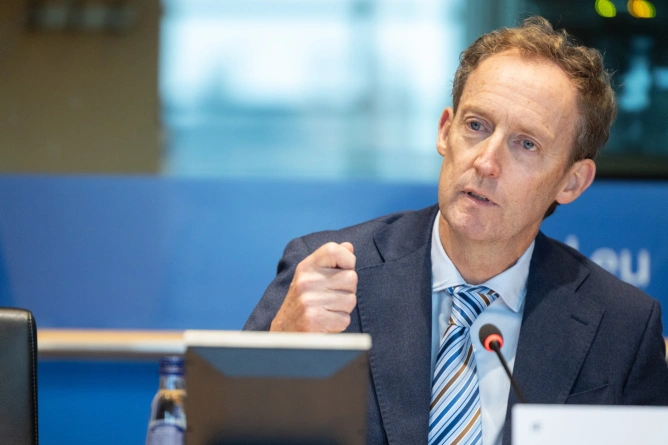
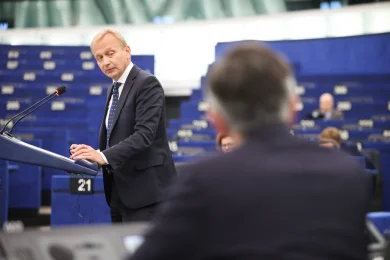
Barry Andrews, an Irish Renew MEP and chair of the European Parliament’s Committee on Development, calls the proposed reduction a mistake and argues that Europe would lose its capacity to act precisely at a time when conflicts, political instability and climate shocks are placing greater pressure on partner countries. His position is that of the parliamentary committee chair and does not, at this stage, represent a decision adopted by Parliament as a whole.
His argument also stems from the changing international context. Preliminary data published by the OECD show that official development assistance provided by members and associates of the Development Assistance Committee fell by 23.1% in real terms in 2025 compared with the previous year, reaching USD 174.3 billion. The reduction reported for the United States was 56.9%, which contributed substantially to the global decline in funding.
These data do not automatically demonstrate the geopolitical consequences invoked by Andrews, but they show that the European negotiation is taking place in an environment where international public resources for development are already more limited. If the trend continues, organisations and countries dependent on external funding may end up competing for fewer resources, while donors will have to choose more strictly between regions and priorities.
Global Europe is designed precisely to bring together several components of foreign policy that currently operate through distinct instruments and frameworks. The Commission’s proposal for 2028–2034 integrates development cooperation, neighbourhood policy, enlargement support and other forms of external cooperation into a common architecture, with the possibility of shifting resources more rapidly between priorities when crises or unforeseen needs arise.
This flexibility is one of the points on which member states want to retain stronger political control. In June, the Council agreed on a partial negotiating mandate for Global Europe, but left financial aspects and other horizontal elements outside the agreement, as they depend on the compromise on the entire multiannual financial framework. The states also called for a greater role in strategic direction, programming and oversight of the use of flexibility.
Therefore, the Global Europe negotiation concerns more than the size of the budget. It also concerns who sets the priorities, how quickly funds can be redistributed in the event of a crisis and how much influence national governments have over the Commission’s decisions on the use of funds in third countries.
The Commission’s initial proposal also includes a EUR 15 billion reserve within Global Europe for crises and unforeseen needs. Separately, the European executive proposes support of up to EUR 100 billion for Ukraine for the 2028–2034 period. These amounts form part of the proposed architecture for the next budget and do not represent payments already made or additional money beyond the support provided to Ukraine through current instruments.
Development cooperation must also be distinguished from humanitarian aid, even though the two frequently appear together in political debate. Development programmes can provide long-term funding for institutions, public services, infrastructure, education, healthcare or administrative capacity, while humanitarian aid primarily responds to emergency situations. A reduction in a future budget envelope does not make it possible, without programme documents, to identify the schools, hospitals, projects or countries that will actually lose money.
This is also why the 17.4% figure cannot automatically be applied to the Republic of Moldova, Africa, the southern neighbourhood or any other region. Future allocations will depend on the instrument’s rules, geographic and thematic programming, institutional negotiations and implementation decisions that follow the adoption of the budget.
Andrews argues that development funding contributes to crisis prevention, neighbourhood stability and the EU’s international influence. These are political arguments about the role of external cooperation. However, the available budget figures cannot be used to calculate a direct effect on migration, security or geopolitical influence for every billion euros added or withdrawn.
The discussion also differs from that concerning the efficiency of humanitarian aid, where member states and the Commission have recently examined joint procurement, transport and storage to reduce logistical costs. Operational savings and the size of the budget address different issues. A more efficient logistics system does not demonstrate that a funding reduction can be offset in the same proportion.
The real stakes of the negotiation will emerge when the budget ceiling is turned into programmes and allocations. A reduction of nearly EUR 28 billion in the Global Europe instrument compared with the Commission’s proposal could force the EU to prioritise more strictly between neighbourhood policy, enlargement, development, crisis response and other external objectives, but the Irish document does not yet establish how this difference will be distributed.
For this reason, the claim that the EU has already decided to cut development aid by 17% would be premature. What exists now is a negotiating proposal that reduces the resources available for the external action heading at a time when international development funding is already declining. The concrete scale of the impact on beneficiaries can be assessed only after the final ceiling and the rules for distributing the funds have been established.

Latest News
19:46
19:46
19:28
19:26
19:18
See more news
NEWS ON THE SAME TOPICS
.webp)