Parliament negotiators reject the 8% cut to the EU’s future budget proposed by the Irish Presidency



Always see our news on Google
The Irish Presidency of the Council has put before the member states a version of the EU budget for 2028–2034 that reduces by approximately 8% the overall ceiling previously proposed by the European Commission. Calculated at constant 2025 prices, the difference is approximately EUR 141 billion: from EUR 1,763.056 billion in the Commission’s proposal to EUR 1,622.011 billion in the new negotiating document.
The reduction is not distributed evenly. For the heading dedicated to competitiveness, prosperity and security, the proposal falls from EUR 522.205 billion to EUR 455.600 billion, a decrease of approximately 12.75%. For the Global Europe heading, which groups a large part of the EU’s external action, the ceiling falls from EUR 190 billion to EUR 156.936 billion, a decrease of 17.4%. These figures represent commitment ceilings over seven years, not money already spent or payments that would be reduced immediately.
In brief, the Commission’s proposal for the 2028–2034 MFF provided for commitments of EUR 1,763.056 billion at constant 2025 prices. The Irish version provides for EUR 1,622.011 billion. The difference is EUR 141.045 billion, equivalent to a reduction of approximately 8% compared with the Commission’s proposal. The “Competitiveness, prosperity and security” heading falls by approximately 12.75%, while the Global Europe heading falls by 17.4%. Siegfried Mureșan, Carla Tavares, Danuše Nerudová and Sandra Gómez López are challenging both the level of expenditure and the lack of progress on the EU’s new own resources. The Irish Presidency’s document is a basis for negotiations. The MFF cannot be adopted without unanimity among the member states in the Council and the agreement of the European Parliament.
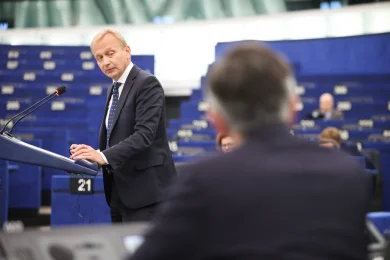
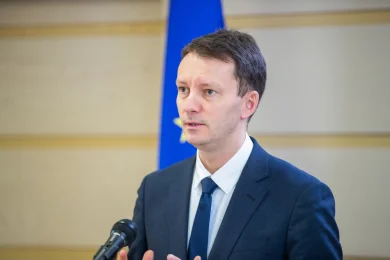
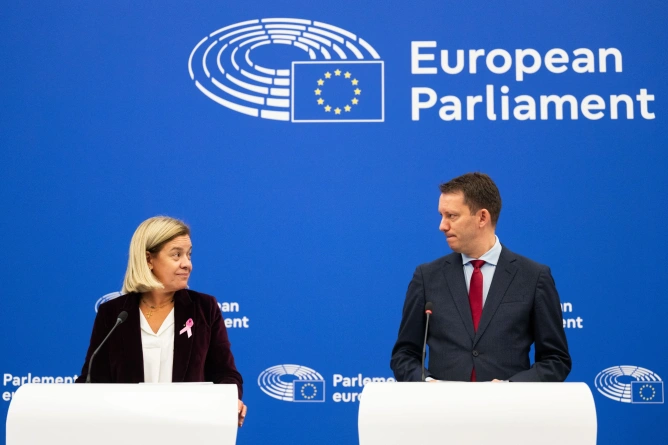
The Parliament’s two co-rapporteurs for the multiannual financial framework, Siegfried Mureșan, of the EPP, Romania, and Carla Tavares, of S&D, Portugal, reject the proposed level and say the reduction would limit the EU’s ability to finance competitiveness, defence, security, agriculture and regional policy simultaneously. Mureșan warns that “cuts that weaken Europe will not receive our support” and says Parliament is ready to negotiate, but not to accept a compromise based predominantly on reducing member states’ net contributions.
Mureșan’s position is relevant because of his role as Parliament’s co-rapporteur for the MFF, not as Romania’s official position. An 8% reduction in the overall ceiling does not mean that Romania’s future allocation would automatically fall by the same percentage. Distribution among states and programmes depends on the rules of each instrument, allocation criteria and the final outcome of the negotiations.
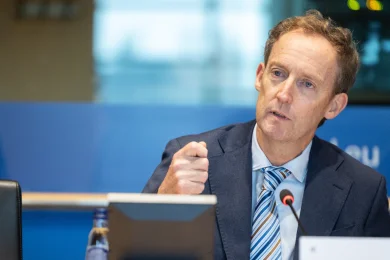
Carla Tavares focuses her criticism on the two areas where the difference from the Commission’s proposal is much greater than the average reduction. The “Competitiveness, prosperity and security” heading loses EUR 66.605 billion compared with the Commission’s proposal, calculated on the same price basis. For MEPs, the reduction comes at a time when the EU is simultaneously trying to close the investment gap, finance new industrial and technological capacities, and strengthen defence.
In the case of foreign policy, it is important to distinguish between the Global Europe heading and the legislative instrument with the same name. The entire heading falls from EUR 190 billion to EUR 156.936 billion, producing the 17.4% reduction cited by the rapporteurs. The Global Europe instrument within this architecture falls separately from EUR 176.830 billion to EUR 148.984 billion, a decrease of approximately 15.75%. A 17.4% reduction in the heading therefore does not mean that every development programme or every external beneficiary will automatically receive 17.4% less.
The four main figures are compared at constant 2025 prices precisely to avoid the effect of inflation over a period extending to 2034. The negotiating document also includes values at current prices, but specifies that these are presented for illustrative purposes. Mixing the two bases could create the impression of a different increase or reduction from the one resulting from a comparison made at the same prices.
The dispute over the size of the budget is also complicated by the obligations that the next MFF will have to finance. These include repaying the debt incurred for NextGenerationEU, meaning that part of the future budget’s resources will be used for obligations arising from the recovery programme launched after the pandemic and will not be available for new programmes. Therefore, a simple comparison between the nominal value of the current and future budgets alone does not show how much financing capacity the EU will have.
Parliament and the Council are also at odds over the other half of the equation: where the money comes from. Danuše Nerudová and Sandra Gómez López, Parliament’s co-rapporteurs for own resources, say the Irish Presidency’s document does not deliver sufficient progress on new sources of revenue for the common budget.
Own resources are the revenues that finance the EU budget and include the current contribution system, customs revenue and other sources. Parliament has proposed expanding them with new mechanisms to reduce pressure on member states’ direct contributions and finance the Union’s new obligations. The proposals under discussion, including various forms of contributions linked to digital activities, online gaming or crypto assets, are not European taxes that have already been adopted.
This part of the negotiations also follows a different legal procedure. The regulation on the multiannual financial framework must be adopted unanimously by the Council after obtaining the European Parliament’s consent. The decision on the own-resources system likewise requires unanimity in the Council and national approvals in accordance with the applicable constitutional requirements. An agreement on expenditure therefore does not automatically resolve the question of how it will be financed.
For this reason, the statement by the four rapporteurs carries greater procedural weight than simple political criticism. Parliament cannot rewrite the multiannual budget on its own, but it can refuse to give its consent to the final regulation. At the same time, the rapporteurs’ reaction does not yet represent a vote by Parliament against the Irish document, nor does it end negotiations with the member states.
The current document is what the institutions call a “negotiating box”, a structure in which the Council Presidency seeks to gradually narrow differences among governments over the ceilings, priorities and architecture of the future budget. It does not yet establish definitive allocations or create funding rights for states, regions or beneficiaries.
The negotiations start from the proposal presented by the Commission in July 2025 and have already gone through several stages under different Council presidencies. The political objective is to reach agreement on the general framework by the end of 2026, so that sectoral legislation can be finalised in 2027 and the new system can operate from the beginning of 2028.
The next major milestone is the European Council meeting on 15–16 October. The leaders of the 27 states will discuss the future budget again, alongside other European priorities. Any political compromise between the heads of state or government will nevertheless subsequently have to be translated into legal texts and negotiated with Parliament.
The stakes go beyond the total amount on the table’s first line. A reduction of EUR 141 billion can be distributed in very different ways among agriculture, regions, research, industry, defence, foreign policy and the European administration. The dispute now beginning is precisely about this choice: which priorities the EU can finance simultaneously and how much the states are willing to pool for the 2028–2034 period.

Latest News
19:46
19:46
19:28
19:26
19:18
See more news
NEWS ON THE SAME TOPICS
.webp)