SPECIAL Informat.ro: The "Merzoni" Relationship and the Future of the European Union: the conflict between federalism and intergovernmental sovereignty



Always see our news on Google
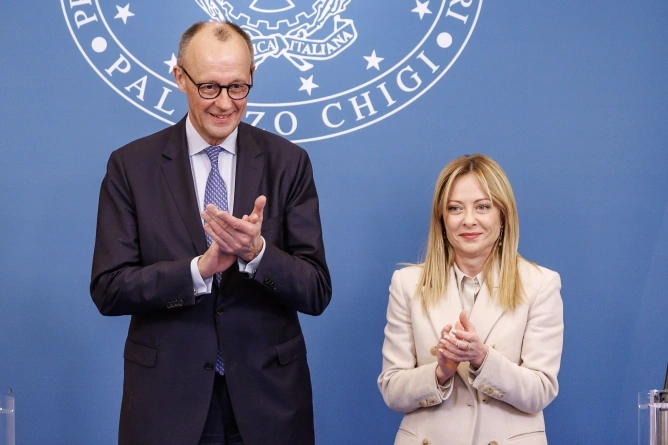
The relationship between Giorgia Meloni and Friedrich Merz, increasingly referred to as "Merzoni", marks a fundamental shift in the distribution of power within the European Union, gradually moving the center of gravity from the Franco-German couple towards an Italo-German tandem with its own agenda on competitiveness, deregulation, and rebalancing the relationship between states and the institutions in Brussels. This rapprochement has been built over a few months through the convergence of positions on industry, the mitigation of the Green Deal, immigration, and the rejection of debt mutualization projects supported by Emmanuel Macron, and their dynamics are beginning to redraw the power architecture of the Union and partially isolate Paris, forcing the other member states to reposition themselves between a federalist vision and a sovereignist-intergovernmental one.
A new tandem at the center of the EU
The Meloni-Merz relationship has formed based on a common diagnosis that European competitiveness is declining, industry is being suffocated by high energy costs and excessive regulation, and the internal market is far from being exploited to its true potential. Before the informal meeting at Alden Biesen, the two leaders, along with Belgian Prime Minister Bart De Wever, convened eighteen member states for a pre-summit focused on industry, energy, and simplifications, with the aim of preparing political conclusions for the European Council in March. The programmatic document Germany-Italy-Belgium, a "non-paper" on competitiveness, synthesizes this convergence by emphasizing the completion of the single market, reducing bureaucratic burdens, and an ambitious and pragmatic trade policy, while avoiding the sensitive front of a new common European loan or explicit protectionist measures like "Buy European".
The text introduces the idea of an "emergency brake" on EU legislation, a mechanism by which states could block or suspend, during the legislative process, norms considered excessive if they disproportionately affect businesses, especially small and medium-sized enterprises.
Moving away from Paris and contesting Macron
Giorgia Meloni has already suggested that 2026 could become "the year of Italy and Germany", presenting this "strategic friendship" as beneficial not only for the two states but also for the entire European Union. While Merz and Meloni calibrate a common vision on competitiveness, Emmanuel Macron increasingly appears as a contested or marginalized actor in European debates, including through the swift rejection in Berlin of his proposal for a new common European debt to finance industrial and defense projects, a discussion that Rome has preferred to keep at a distance to avoid reigniting fears related to debt mutualization.
Tensions between Paris and the new Italo-German tandem are also visible on other sensitive issues: Macron's refusal to support the EU-Mercosur trade agreement has generated direct friction with Merz, for whom trade policy is an essential tool in revitalizing European competitiveness, while the French initiative of "Buy European" has encountered reluctance in Germany and Italy, as well as firm opposition from the Nordic and Baltic countries, concerned about the additional complications in an already perceived suffocating regulatory framework.
In the European media and analytical space, the transition from the old "Merkron" – the Merkel-Macron tandem – to the new "Merzoni", in which the Rome-Berlin axis challenges the privileged position of the Franco-German couple, has become a recurring point of interpretation. International analyses cited in the European press note that, from trade agreements to the automotive dossier, Merz and Meloni increasingly appear as a united bloc, risking to blur Emmanuel Macron's role in defining the directions of European policy, while voices like former Italian ambassador Piero Benassi warn against dramatization and insist that this is neither about a new consolidated axis meant to replace the Franco-German couple nor a direct attack on France, but rather about a temporary convergence on a few specific issues.
Federalism vs intergovernmental sovereignism
Former Italian ambassador to Berlin, Piero Benassi, believes that the Meloni-Merz tandem currently functions more as an "agenda facilitator" around competitiveness, rather than as a new stable directorate of the European Union. At the same time, the content of criticisms coming from figures like Mario Monti, the former Italian Prime Minister, clarifies the nature of the fundamental rift between two approaches: on one hand, a federalist vision, associated with Emmanuel Macron, oriented towards deeper integration, common investments, and strengthening the capacity of European institutions; on the other hand, a sovereignist vision, centered on the idea of a "concert of states" in which the Rome-Berlin axis functions as a pivot and emphasizes national control over legislation. The "emergency brake" mechanism proposed by Italy and Germany, which would allow governments to temporarily stop or redirect legislative initiatives considered too burdensome, is emblematic of this sovereignist-intergovernmental approach, as it opens the way for an additional political filter on European norms.
Instead of promoting new common debt instruments, the Italo-German document insists on deregulation and rearranging the priorities of the internal market, from energy to cross-border infrastructures, without touching the sensitive front of fiscal solidarity at the Union level. On the other hand, Emmanuel Macron and supporters of a "positive" strategic autonomy advocate for more interventionist industrial policies, for "Buy European" type mechanisms, and for massive common investments, arguing that without these tools Europe cannot compete with Donald Trump's United States and China, which massively support their economies through state subsidies, and in this perspective, the Merz-Meloni axis risks being perceived as a brake on the deepening of integration rather than as a motor for it.
Critics, risks, and vulnerabilities
Criticism does not come only from the federalist side: diplomats from several states point out, in an analysis cited by Politico, that an agenda focused almost exclusively on simplification and reducing bureaucracy risks ignoring the crucial dimension of reducing external dependencies, from supply chains to defense capabilities, and a "lighter" Europe from a regulatory point of view, but lacking common resources and integrating projects, remains vulnerable to successive geopolitical shocks. The emergence of the "Merzoni" couple coincides with a moment of maximum external pressure on the European Union: the open antagonism of American President Donald Trump, China's aggressive tactics in the economic sphere, and hybrid threats from Russia force the Union to quickly rethink its global positioning, from trade to security.
In this context, Merz and Meloni position themselves as leaders of the wing that demands deregulation, legislative restraint, and accelerated decision-making, arguing that without internal competitiveness Europe cannot sustain either credible common defense projects or real strategic autonomy in relation to Washington and Beijing.
This perspective brings them the support of an important part of the business environment, especially in strongly industrialized states, for which simplifying rules and reducing energy costs are immediate priorities, but also forces member states to reposition themselves on multiple axes, including in relation to the United States, where some capitals hesitate to fully follow Macron's call for strategic autonomy for fear of losing access to the American market in a context of heightened protectionism.
The impact on Central and Eastern Europe
For Central and Eastern Europe, including Poland, the Merz-Meloni rapprochement offers a platform to push the Union towards a tougher line on deregulation and economic growth, as illustrated by Warsaw's support for the radical simplification of internal market rules. However, states in the region remain vigilant to the risk that the new Italo-German axis may revert to the reflex of a restricted "directorate", where major decisions are prepared in a reduced format and communicated later to other partners, which would fuel old frustrations related to unequal representation in the European decision-making process.
Another important effect of strengthening the Merzoni couple is the reconfiguration of ideological balances in the European Parliament, where there is already a practice of cooperation between the European People's Party, the ECR Conservatives, and the Patriots group on issues such as migration, climate policy, or foreign policy, to the detriment of a "Ursula majority" based on compromise between popular, socialist, and liberal parties.
The strengthening of the Meloni-Merz tandem may accelerate this realignment, further marginalizing the left and greens in defining the future legislative agendas of the Union, while Eastern European governments try to combine the benefits of a "lighter" normative Europe with the need for security guarantees and common financing. In this context, the balance between an Italo-German axis oriented towards deregulation and a federalist core led by Macron becomes a critical element for how countries in the region – including Romania – will calibrate their influence strategies in Brussels, between the fear of being excluded from the "inner circle" and the desire not to sacrifice financial solidarity instruments.
Scenarios for the global role of the EU
In the short term, several scenarios are emerging for the evolution of the Meloni-Merz relationship and its impact on the global role of the European Union. One scenario is that Merzoni functions as a controlled deregulation engine and imposes a package of measures regarding competitiveness, procedural simplification, and reduction of administrative burdens, without breaking the balance with France, in which case the Union would become more economically agile, maintaining a relatively similar political architecture and supporting its global role mainly through internal consolidation, not through the emergence of new federal instruments.
A second scenario is one of blockage between the Merzoni vision and Macron's, a situation in which the divisions between proponents of common debt and those of strict deregulation remain irreconcilable, and summits end with general statements, without new financing mechanisms, without a qualitative leap in common defense, and with a capital market that continues to be fragmented, in which case the Union risks the "slow agony" diagnosed by Mario Draghi and risks remaining a predominantly reactive global actor.
A third scenario is that of European polycentrism and controlled fragmentation, in which initiatives like the "Merzoni pact" are read as signs of diversifying centers of political impulse rather than as direct threats to cohesion, and multiple cores – from Rome-Berlin and Paris-The Hague to the Nordic, Baltic, and Eastern European groups – generate proposals that combine in variable configurations, outlining a Union less dependent on a single founding couple, but harder to coordinate.
Regardless of the scenario, one element remains constant in the diagnosis of European actors: in the absence of robust economic growth and an update of the outdated economic doctrine, Europe will remain very vulnerable to external shocks. In this context, Merz and Meloni politically emphasize when they directly link competitiveness to the defense of European democracy and social stability, arguing that only a prosperous continent can withstand internal populist pressures and external interferences, and the stakes for the future global role of the Union is whether this tandem will succeed in transforming "deregulation" from a business-friendly slogan into a coherent project that includes strategic investments, reducing dependencies, and a credible security architecture.
*****Synthesis made with the help of a data monitoring flow provided by the media monitoring platform NewsVibe Romania. The analysis, data, and images presented have been enhanced with the help of Machine Learning and Artificial Intelligence tools.
Latest News
19:20
19:16
19:04
18:57
18:51
See more news
NEWS ON THE SAME TOPICS